

Field Guide / Optics
Binoculars, scopes, red dots, rangefinders, telescopes, and the numbers printed on them, such as 8x42 or 4-12x40. Search or filter by type and how you use it, and use the diagrams to see what each spec means.
Specs are typical and vary by model, so check the maker's published numbers. Never look at the Sun through any optic without a certified solar filter. Rules on optics, such as scopes, lights, and electronics on certain hunts, differ by state. Check your state's current hunting regulations.
28 entries
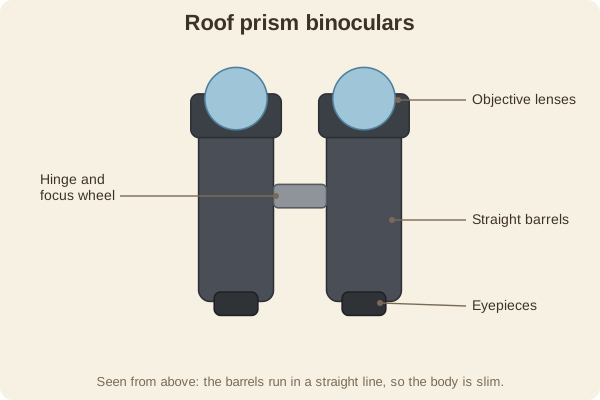 Binoculars
 with straight, slim barrels. They are the usual choice for hunters and birders because they are compact, tough, and easy to hold.
Straight barrels, usually 8x42 or 10x42
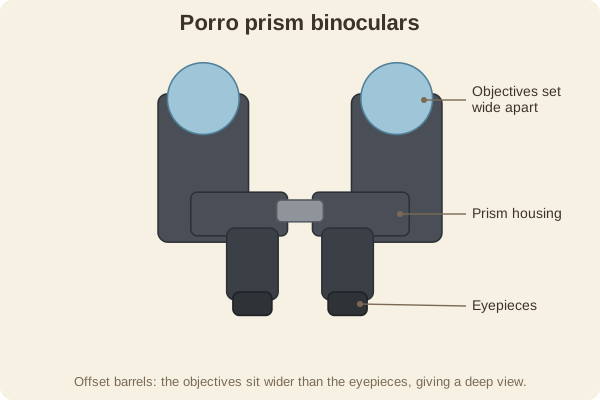 Binoculars
 with the classic offset barrels. They give a wide view and good depth for the price, though they are bulkier.
Offset barrels, wide view, good value
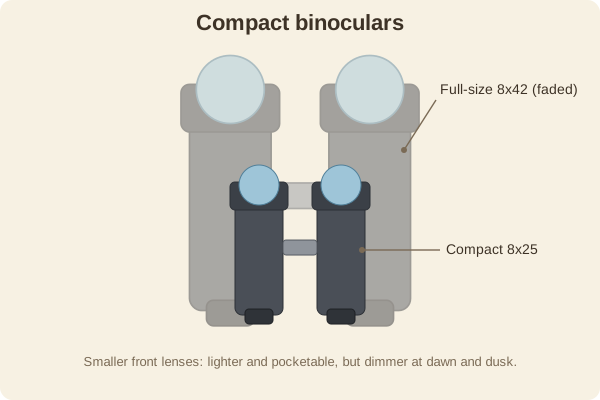 Binoculars
Small binoculars that fit in a pocket or a coat. They are easy to carry, but they gather less light than full-size ones.
Small and light, usually 8x25 or 10x25
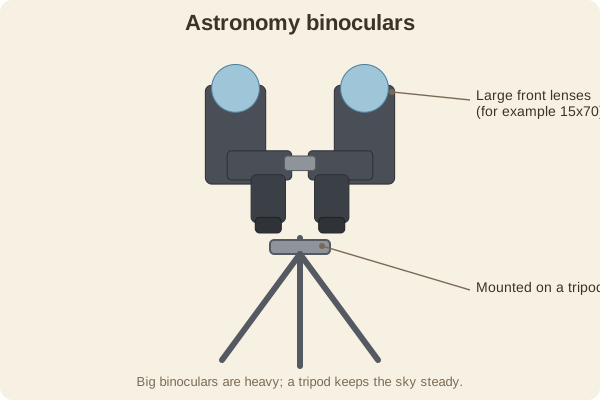 Binoculars
Large, high-power binoculars built for the night sky. They show star clusters, the Moon, and faint fuzzy objects, but they need a tripod.
Big front lenses, usually used on a tripod
 Scopes
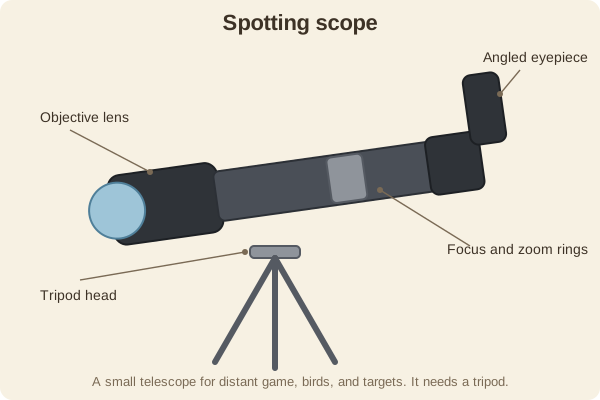
A small telescope for looking at distant game, birds, or targets. It has more power than binoculars and sits on a tripod.
Zoom power, usually 15-45x or 20-60x
 Scopes
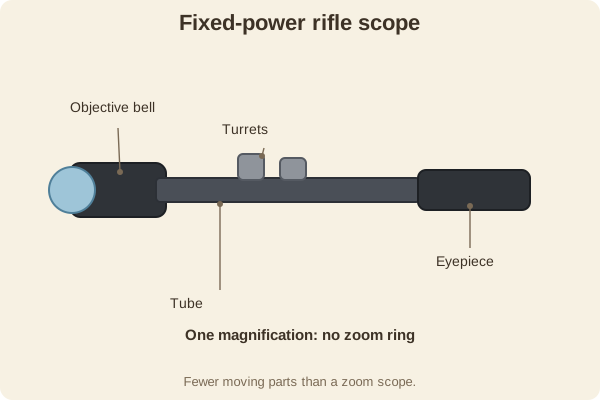
A rifle scope with one magnification. It is simple, tough, and has fewer parts to fail than a zoom scope.
One power, such as 4x or 6x
 Scopes
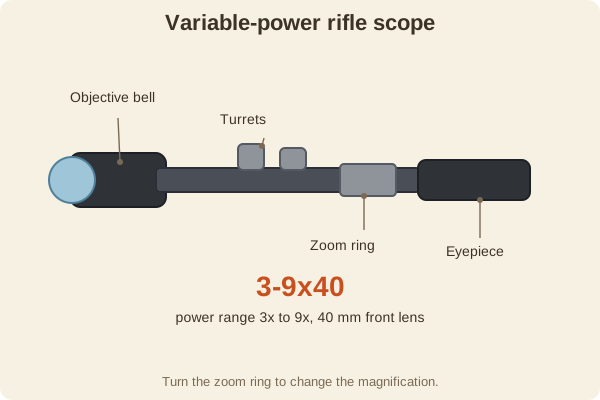
A rifle scope with a zoom ring. You can use low power in cover and turn it up for longer shots.
Zoom range, such as 3-9x40
 Red Dots & Sights
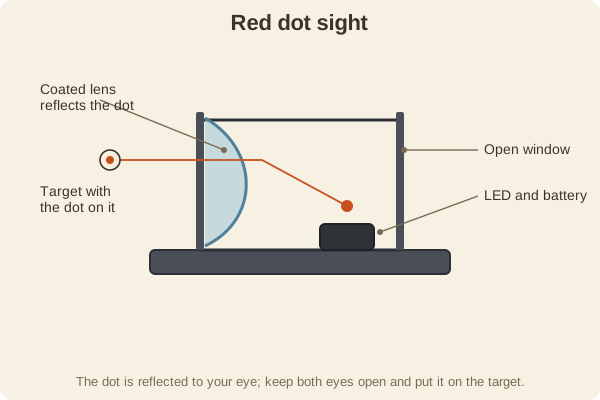
A no-magnification sight that projects a small glowing dot you place on the target. Fast to use with both eyes open.
1x, a dot that stays on target
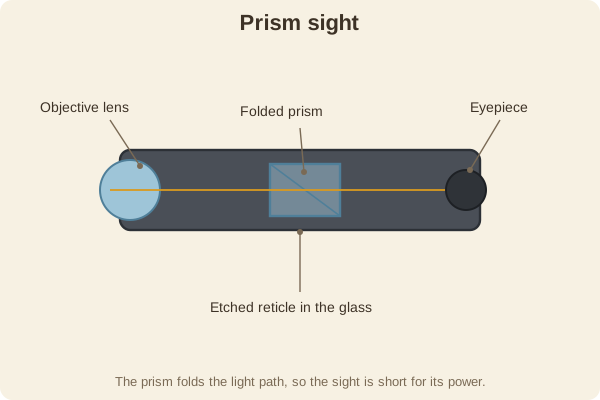 Red Dots & Sights
A short, tough sight with a small amount of fixed magnification and a reticle etched into glass.
Compact, fixed power, often 1x to 5x
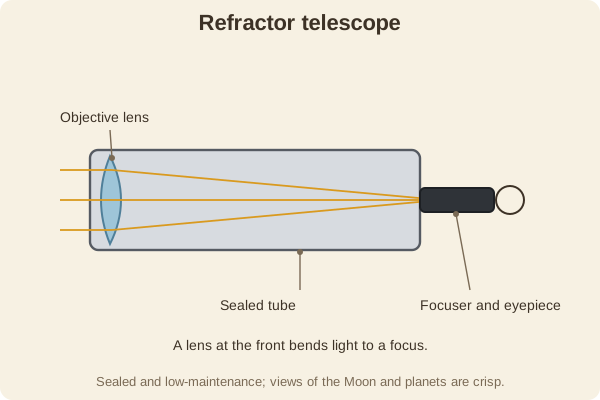 Telescopes
A telescope that uses a lens at the front to gather light. Sealed and low-maintenance, with sharp views of the Moon and planets.
Lens at the front, sealed tube
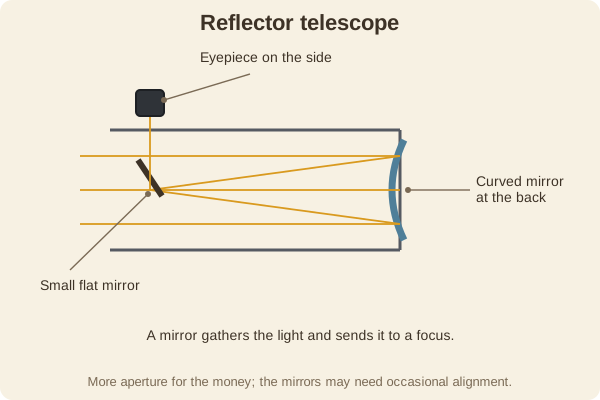 Telescopes
A telescope that uses a mirror at the back to gather light. It gives the most aperture for the price.
Mirror at the back, big light for the cost
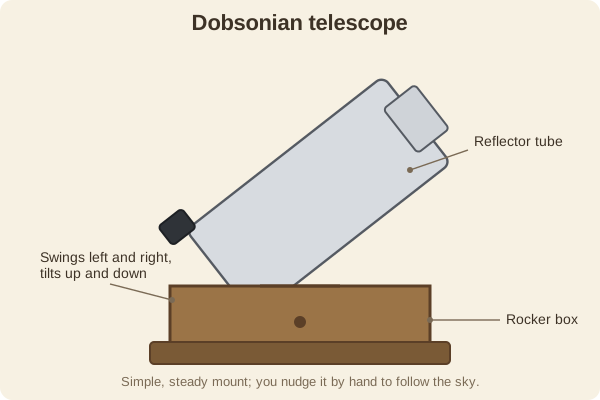 Telescopes
A reflector telescope on a simple rocker box mount. It is easy to aim and gives the most light for the money.
Large aperture on a simple rocker mount
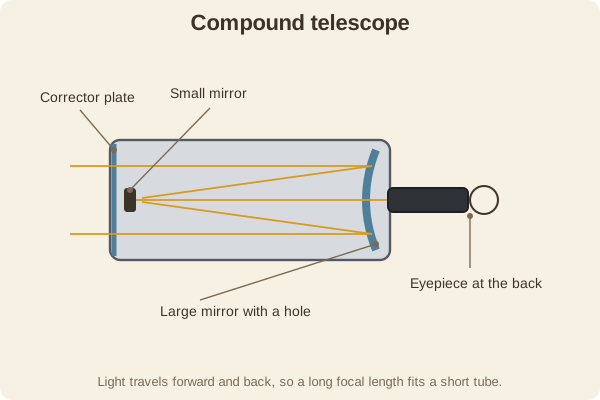 Telescopes
A compact telescope that folds the light path using both mirrors and a lens. Many models include a motorized mount.
Folded light path, short tube
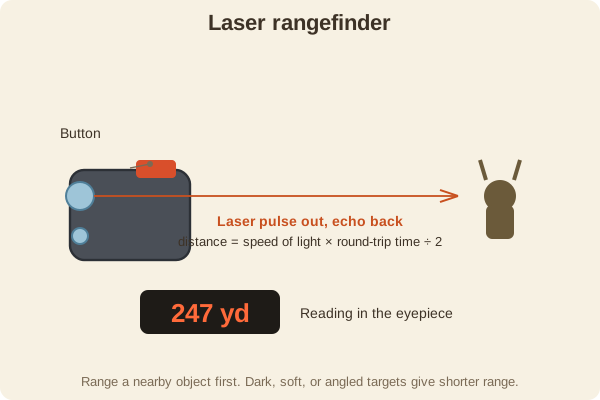 Tools & Accessories
A handheld device that measures the distance to a target with a laser. It helps you decide whether a shot is within your range.
Press a button to read the distance
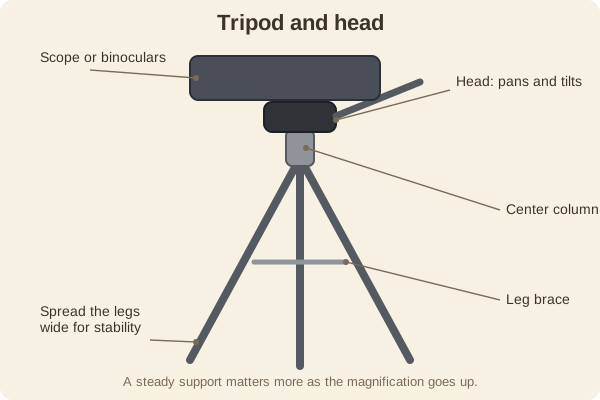 Tools & Accessories
The stand that holds a spotting scope, telescope, or large binoculars steady. A good tripod improves every view.
A steady support makes optics usable
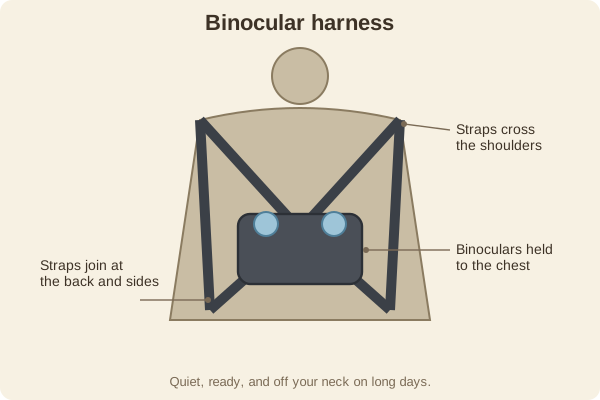 Tools & Accessories
A chest strap system that holds your binoculars against your body. It keeps them quiet, ready, and off your neck.
Carries binoculars on your chest
 Tools & Accessories
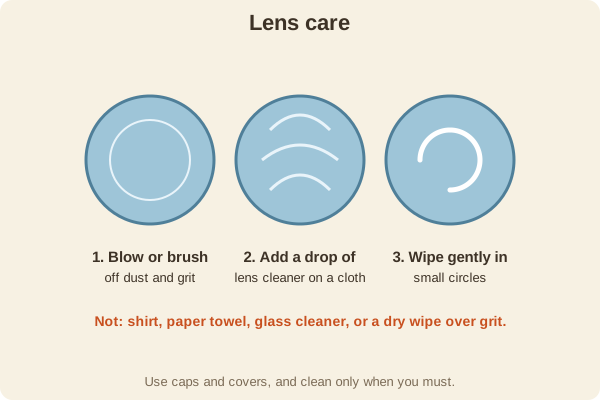
How to clean binocular, scope, and telescope lenses without scratching the coatings.
Blow, brush, then wipe gently
 Tools & Accessories
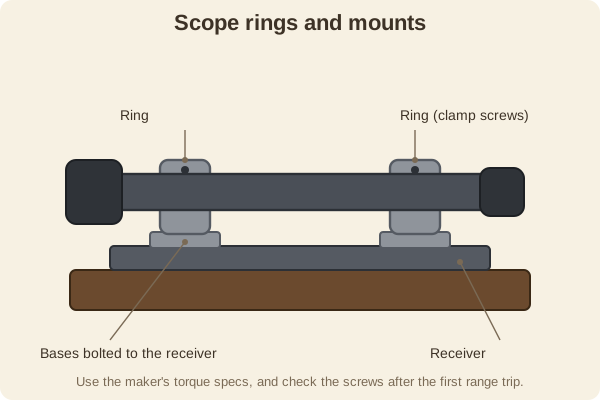
The hardware that holds a scope on a rifle. Good mounting keeps the scope aligned and the zero steady.
Solid, level, and torqued to spec
 Specs & Terms
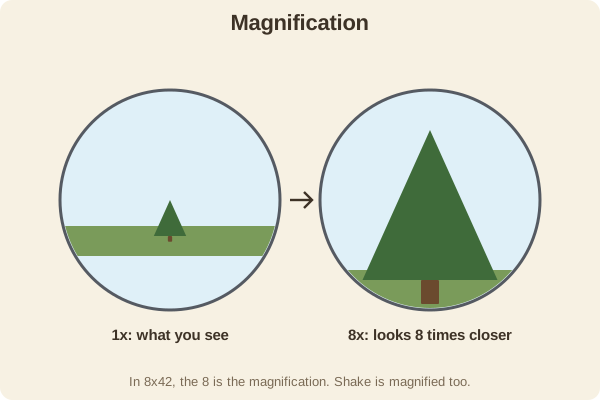
How many times closer an object looks. An 8x binocular makes something 800 yards away look like it is 100 yards away.
The first number in 8x42
 Specs & Terms
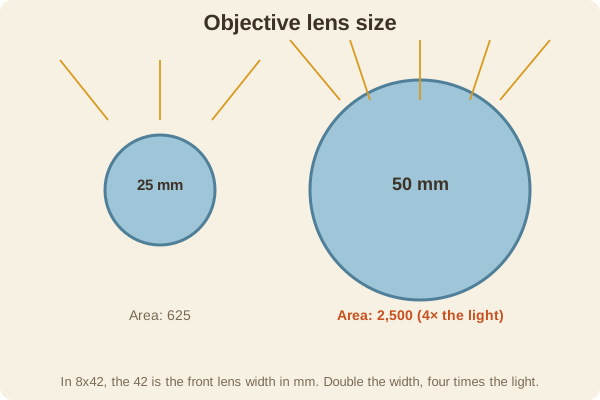
The diameter, in millimeters, of the big front lens. A larger lens gathers more light but makes the optic bigger and heavier.
The second number in 8x42
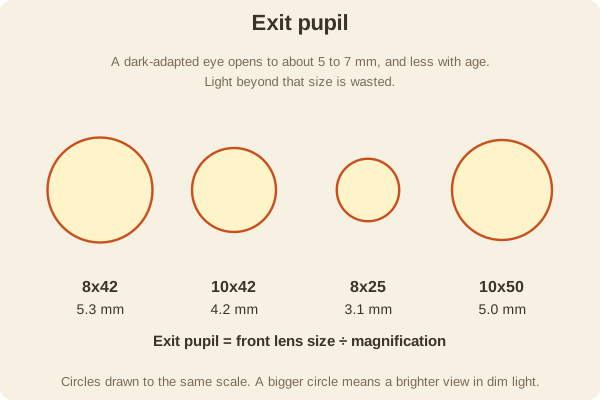 Specs & Terms
The small circle of light that leaves the eyepiece. Divide the front lens size by the power to find it.
Objective size divided by magnification
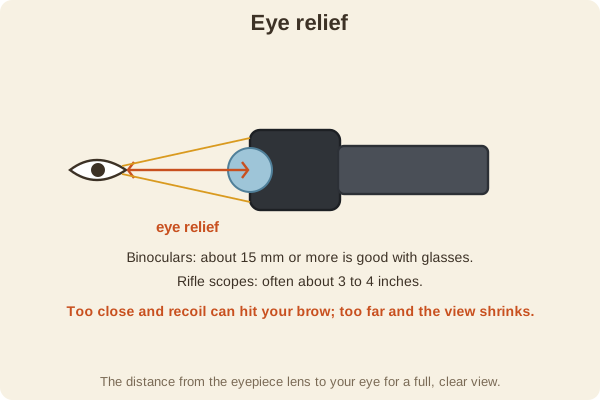 Specs & Terms
How far your eye can be behind the eyepiece and still see the full view. It matters if you wear glasses, and for safety on rifle scopes.
Distance from the eyepiece to your eye
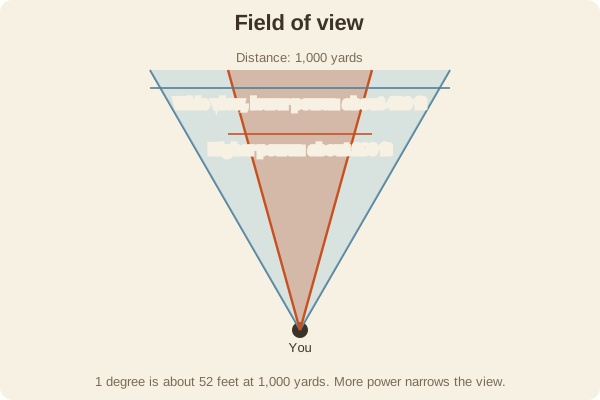 Specs & Terms
How wide a slice of the world you can see. It is usually listed in feet at 1,000 yards or in degrees.
Feet at 1,000 yards, or degrees
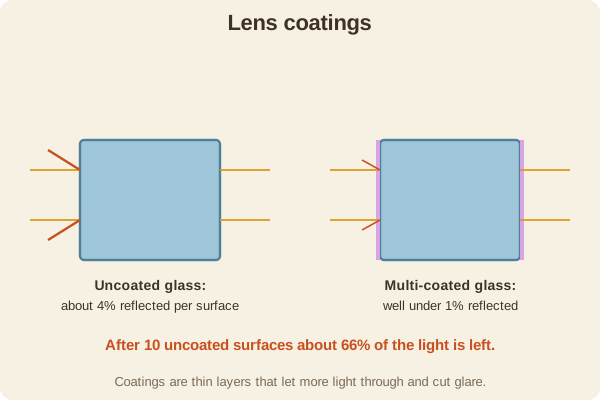 Specs & Terms
Very thin layers on lens and prism surfaces. They reduce glare and let more light through for a brighter, clearer view.
Look for fully multi-coated
 Specs & Terms
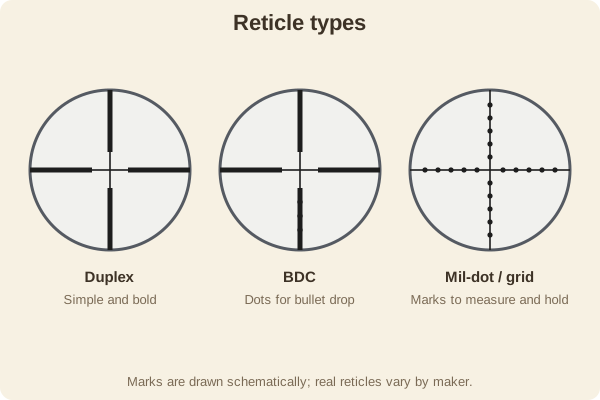
The aiming pattern inside a scope. Common types include the simple duplex, bullet-drop (BDC), and mil-dot or MOA grid reticles.
Duplex is simplest; BDC and mil help with holdover
 Specs & Terms
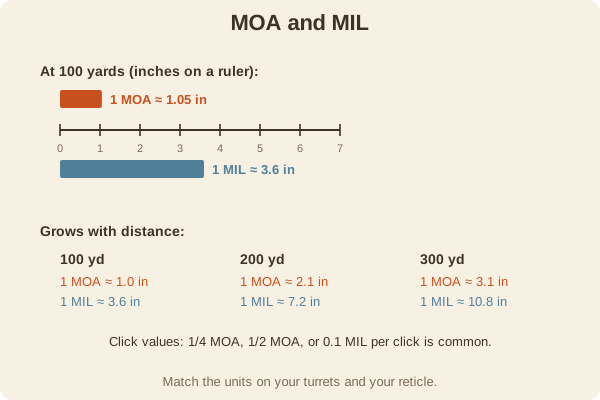
Two angular units used on scope turrets and reticles. One MOA is about 1 inch at 100 yards, and one MIL is about 3.6 inches at 100 yards.
1 MOA ≈ 1.05 in at 100 yd; 1 MIL ≈ 3.6 in at 100 yd
 Specs & Terms
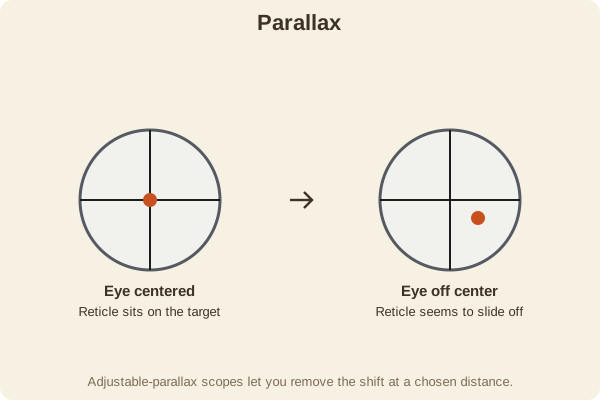
An apparent shift of the reticle against the target when your eye is off center. Most hunting scopes are set so it disappears at one distance.
Reticle seems to move when your head moves
 Specs & Terms
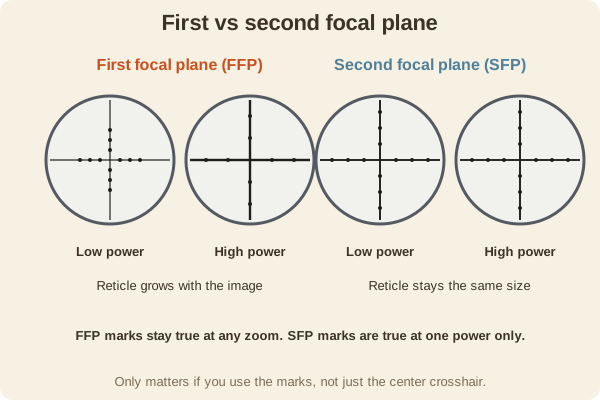
Whether the reticle sits in front of or behind the zoom lenses. It decides if the reticle grows as you zoom or stays the same size.
FFP scales with zoom; SFP stays the same size