

Roof Prism Binoculars
Also called: roof prism, straight-barrel binoculars
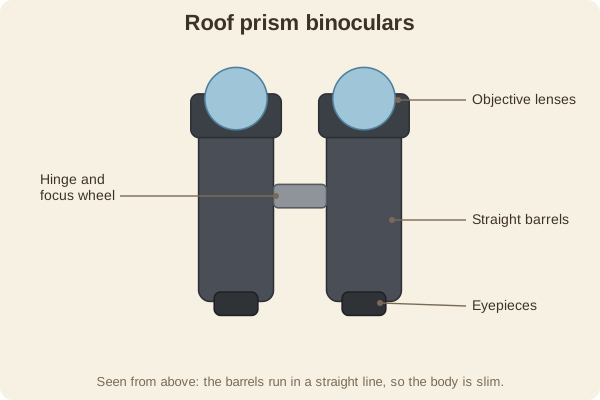
Binoculars with straight, slim barrels. They are the usual choice for hunters and birders because they are compact, tough, and easy to hold.
- Type
- Binoculars
- Typical sizes
- 8x42 and 10x42 are the most common
- Shape
- Straight tubes, with the eyepieces in line with the lenses
- Prisms
- Schmidt-Pechan or Abbe-Koenig roof prisms
- Weight
- Often about 1.5 to 2 pounds in the 42 mm size
- Used for
- Hunting, Birding & wildlife, Stargazing
What it is good for
- Carrying all day on a harness or neck strap.
- Hunting, birding, and general wildlife watching.
- Rough weather, since most are sealed and nitrogen- or argon-filled.
Where it falls short
- Good ones cost more than porro prisms of similar quality, because the roof prism is harder to make well.
- Cheap roof prisms can look dim or soft at the edges.
- Look for phase-correction coating, which sharpens contrast.
Tips
- Try several pairs and check that the focus wheel turns smoothly with gloves on.
- Look for a waterproof, fogproof rating if you hunt in wet weather.
Works well with
- Porro Prism Binoculars: the older, wider-bodied design, often cheaper for the same quality.
- Exit Pupil: 8x42 gives about a 5.3 mm exit pupil.
- Binocular Harness: keeps the weight off your neck.
Field notes
Most binoculars sold for hunting are roof prisms because the slim body fits in a pack pocket and survives bumps. The price difference comes mainly from how well the prisms are made, coated, and aligned.
Related guides
Specs here are typical, not guarantees; models differ, so check the maker's published numbers. Never look at the Sun through any optic without a certified solar filter, and zero or mount a scope with the firearm unloaded and pointed in a safe direction. Rules on optics, such as scopes on certain hunts or lasers and electronics, differ by state; our state resources directory links to each state's official regulations. Want a buying guide? Read Choosing Hunting Optics.