

Field of View
Also called: FOV, width of view
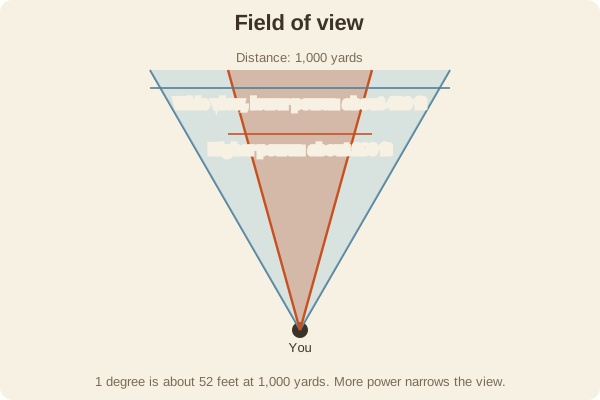
How wide a slice of the world you can see. It is usually listed in feet at 1,000 yards or in degrees.
- Type
- Specs & Terms
- Units
- Feet at 1,000 yards, meters at 1,000 meters, or angular degrees
- Conversion
- 1 degree is about 52 feet at 1,000 yards
- Typical 8x42
- Often about 380 to 430 feet at 1,000 yards
- Used for
- Hunting, Stargazing, Birding & wildlife, Target shooting
What it is good for
- Finding moving game or birds quickly.
- Scanning wide spaces.
- Comparing models.
Where it falls short
- It narrows as power goes up.
- Wide-angle designs can soften at the edges.
- The listed number is the maker's claim.
Tips
- For tracking birds and moving game, wider is easier.
Works well with
- Magnification: the main trade-off.
Field notes
Imagine a window. High power makes you stand farther back from the window, so you see a smaller part of the scene.
Related guides
Specs here are typical, not guarantees; models differ, so check the maker's published numbers. Never look at the Sun through any optic without a certified solar filter, and zero or mount a scope with the firearm unloaded and pointed in a safe direction. Rules on optics, such as scopes on certain hunts or lasers and electronics, differ by state; our state resources directory links to each state's official regulations. Want a buying guide? Read Choosing Hunting Optics.