

Compound Telescope
Also called: Schmidt-Cassegrain, Maksutov, catadioptric
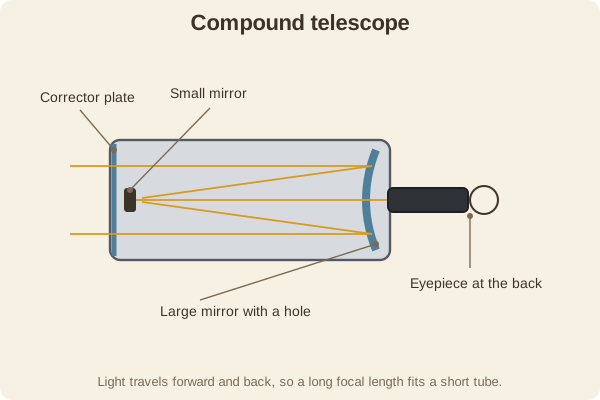
A compact telescope that folds the light path using both mirrors and a lens. Many models include a motorized mount.
- Type
- Telescopes
- Typical apertures
- 90 to 280 mm
- Tube length
- Short for its focal length
- Mounts
- Often computerized GoTo mounts
- Used for
- Stargazing
Safety: Never point a telescope, finder, or any other optic at the Sun without a certified solar filter made for it. Even a glance can cause permanent eye damage.
What it is good for
- Travel and storage, thanks to the short tube.
- Planets and the Moon at high power.
- People who like computerized pointing.
Where it falls short
- Costs more per inch of aperture than a Dobsonian.
- A sealed front corrector plate can fog or dew over without a shield.
- Computerized mounts need power and setup.
Tips
- Use a dew shield on humid nights.
Works well with
- Dobsonian Telescope: more aperture per dollar, but larger.
- Tripod and Head: a solid base is needed.
Field notes
Folding the light path makes a long focal length fit into a short tube, which helps with magnification and portability.
Related guides
Specs here are typical, not guarantees; models differ, so check the maker's published numbers. Never look at the Sun through any optic without a certified solar filter, and zero or mount a scope with the firearm unloaded and pointed in a safe direction. Rules on optics, such as scopes on certain hunts or lasers and electronics, differ by state; our state resources directory links to each state's official regulations. Want a buying guide? Read Choosing Hunting Optics.