
Gemini
The Twins
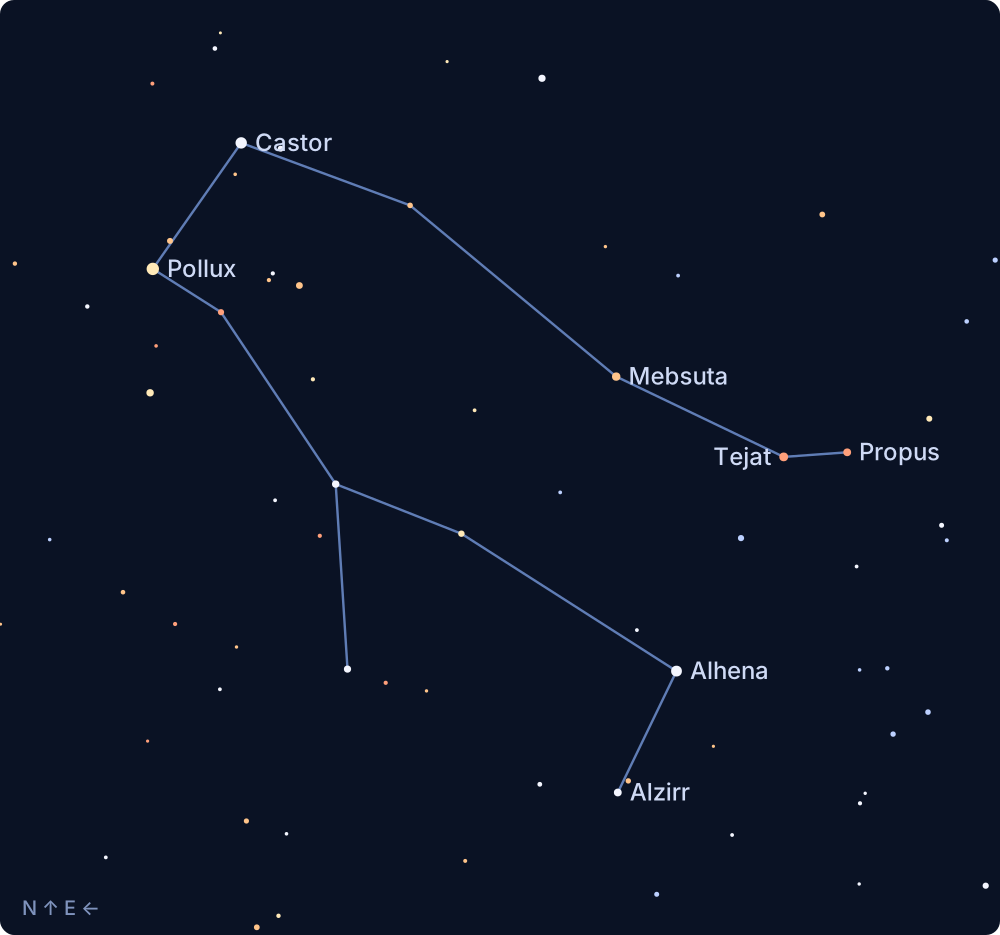
A winter zodiac constellation marked by two bright stars, Castor and Pollux, standing side by side like the heads of the twins.
- Best season
- Winter
- Best months
- December through March, high in the sky on winter evenings
- Visibility
- Visible from everywhere in the United States
- Abbreviation
- Gem
How to find it
- Look northeast of Orion for two bright stars close together. The brighter, slightly orange one is Pollux, and the white one beside it is Castor.
- From each of these stars, a long line of fainter stars runs back toward Orion, forming the twins' bodies.
Brightest stars
- Pollux (orange giant, the brighter twin)
- Castor (a multiple-star system that looks like one star)
- Alhena
What to look for
- The color difference between golden Pollux and white Castor.
- The two long lines of stars that make the twins' bodies, running toward Orion.
Binocular and telescope targets
- M35: a large open cluster at the twins' feet, visible in binoculars
- Castor: splits into two stars in a small telescope, and each of those is itself a closer pair
Using it to find other things
- Procyon in Canis Minor lies south of Pollux, roughly in line with it.
- The Geminid meteor shower, in mid-December, appears to come from near Castor.
About this constellation
Gemini is easy to find because Castor and Pollux, the two heads of the twins, stand out as a close pair of bright stars in an otherwise sparse region of sky.
The Geminid meteor shower, one of the strongest of the year, peaks in mid-December and appears to radiate from near Castor. It is a good excuse for a cold night outside.
Related guides
Visibility depends on your latitude, the date, and the time of night. The months above assume a typical evening from the contiguous United States, so use a planetarium app to confirm what is up tonight. Never look at the Sun through binoculars or a telescope without a proper solar filter.
Star positions: Hipparcos and Bright Star catalogues via d3-celestial (BSD-3-Clause, © 2015 Olaf Frohn).