
Deep-Sky Objects for Beginners: Galaxies, Nebulae, and Clusters
What deep-sky objects are, which ones are easy to find, what they'll actually look like through binoculars or a telescope, and how to see them.
Published October 14, 2026
Beyond the Moon and Planets
Once you've seen Saturn's rings and the Moon's craters, the natural next step is the deep sky: star clusters, glowing clouds of gas, and galaxies made of billions of stars. These objects are much fainter than the planets, so they ask more of you — darker skies, patience, and realistic expectations. But the reward is seeing light that has traveled for thousands or millions of years, with your own eyes. Our guide to observing the Moon and planets covers the easier targets; this one picks up where it leaves off.
1. What "Deep Sky" Means
- Deep-sky objects are anything beyond our solar system that isn't a single star — clusters of stars, nebulae (clouds of gas and dust), and galaxies.
- Star clusters come in two types: open clusters, loose groups of young stars, and globular clusters, dense balls of hundreds of thousands of ancient stars.
- Nebulae include emission nebulae that glow from nearby hot stars, planetary nebulae (shells of gas thrown off by dying stars), and others.
- Galaxies are vast collections of stars, and the ones you can see are mostly distant, faint smudges of light.
2. Why Darkness Matters Most
- Deep-sky objects are faint and spread out, so sky brightness is the biggest factor in what you can see. Light pollution washes them out, which is why the same galaxy might be invisible from town and obvious from a dark site. Our guide to understanding light pollution and dark-sky locations explains how to find a dark site.
- Moonlight matters too. Plan your deep-sky sessions around the new Moon, or the days around it, when the sky is darkest.
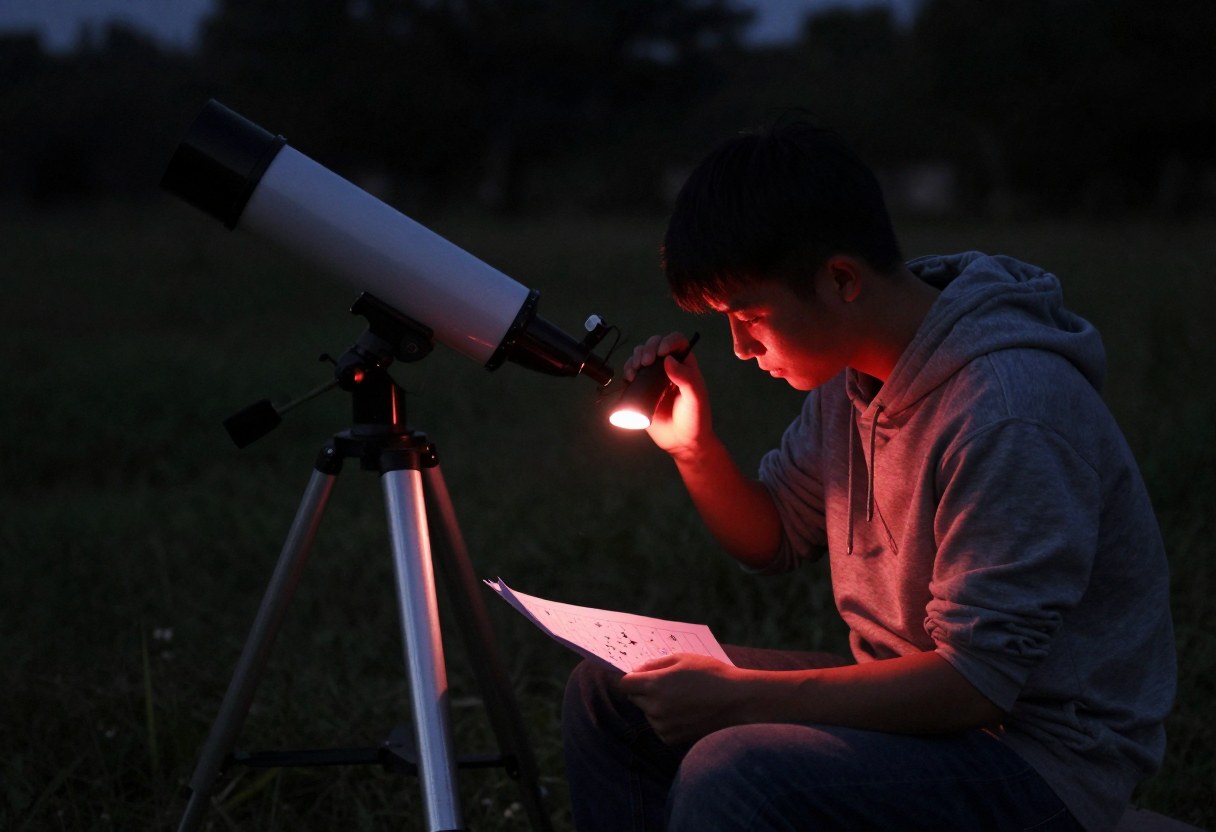
- Let your eyes dark-adapt for 20 to 30 minutes, and avoid white light. A red flashlight protects your night vision.
- Transparency and seeing both help. A clear, steady night with little haze makes a big difference.
3. Easy First Targets (Mostly Naked Eye and Binoculars)
These are the classics, and several are visible without any equipment from a reasonably dark site. Which ones are up depends on the season and your latitude, so check a planetarium app or our guide to stargazing apps and star charts.
- The Pleiades (M45) is an open cluster in Taurus, visible in fall through spring. To the naked eye it looks like a small, dipper-shaped cluster of six or seven stars, and binoculars reveal dozens more.
- The Orion Nebula (M42) is an emission nebula in Orion's sword, visible in winter. It's visible to the naked eye as a fuzzy "star," and binoculars or a small telescope show a glowing cloud around a tight group of stars.
- The Andromeda Galaxy (M31) is the nearest large galaxy, visible in the autumn sky. From a dark site, it appears to the naked eye as a faint, elongated smudge, and binoculars show it more clearly. It's more than two million light-years away.
- The Double Cluster in Perseus is a pair of open star clusters, visible in binoculars as two rich patches of stars, best in the fall and winter.
- The Beehive Cluster (M44) in Cancer is a large open cluster that looks great in binoculars during spring.
- The Great Globular Cluster in Hercules (M13) is a ball of stars visible as a fuzzy patch in binoculars in summer, and a small telescope starts to resolve its outer stars.
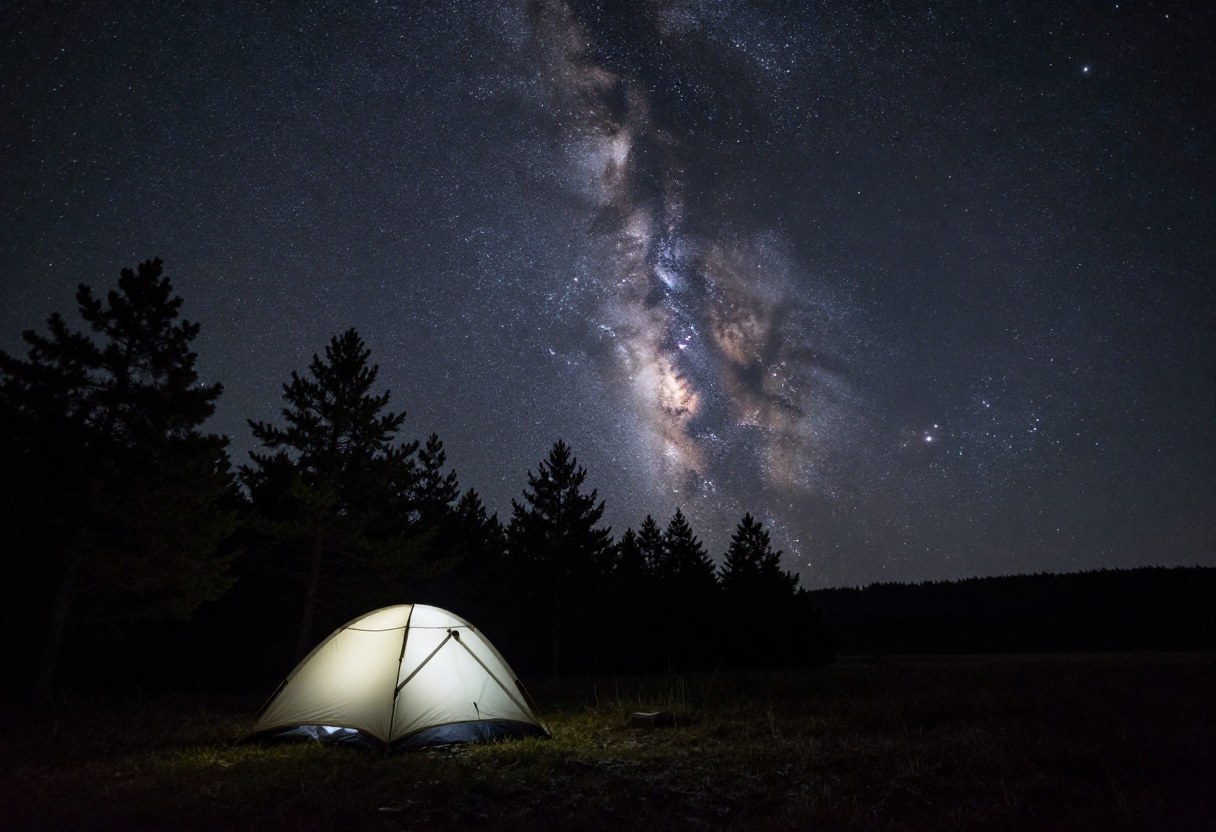
- The Milky Way itself is visible from a dark site, particularly in summer, when the bright central region in Sagittarius and Scorpius is high in the sky, with the dark "Great Rift" splitting it.
4. What You'll Really See
- Forget the colorful photographs. Long-exposure images collect far more light than your eye can, so nebulae and galaxies look much fainter and mostly gray through an eyepiece. Seeing them directly is a different, quieter experience.
- Galaxies appear as faint, fuzzy glows, often brighter in the center. Don't expect spiral arms in a small telescope.
- Most nebulae look like subtle gray clouds, though the Orion Nebula can show a hint of green in good conditions.
- Clusters are the most satisfying for beginners, since they resolve into stars even in small instruments.
- Averted vision is a real technique: looking slightly to the side of a faint object puts its light on the more sensitive part of your retina, and makes it appear brighter.
5. Equipment
- Your eyes alone show the Milky Way, the Pleiades, the Orion Nebula, and Andromeda from a dark site.
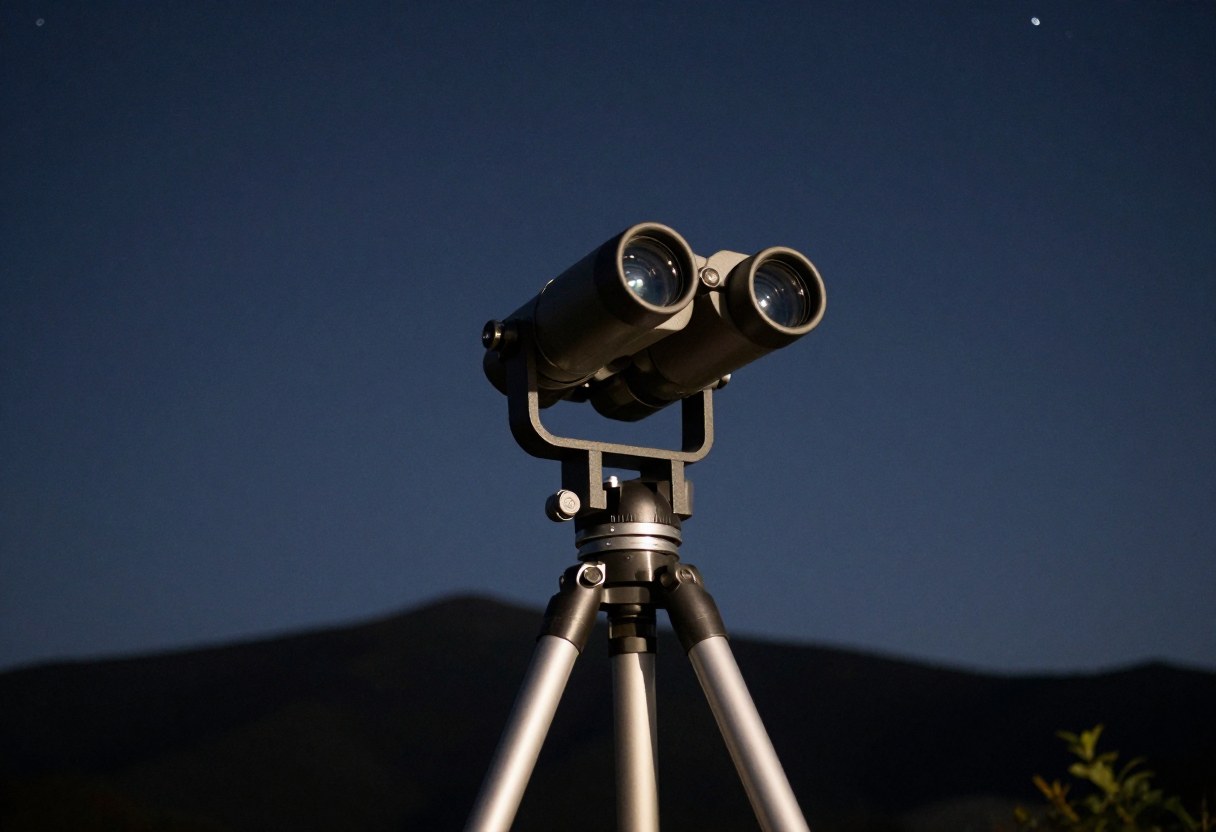
- Binoculars (7×50 or 10×50) are the best beginner deep-sky instrument, with a wide field of view and bright images. Our binoculars for astronomy guide covers how to choose. A tripod or a way to brace them makes a big difference.
- A small to medium telescope shows more detail and reaches fainter objects. For deep sky, aperture matters most, and a Dobsonian-style reflector gives the most light for the money. See our guide to choosing a telescope.
- A low-power, wide-field eyepiece helps find and frame deep-sky objects.
- A star chart or planetarium app is essential for finding things. Many beginners start by "star-hopping" from bright stars to their target.
6. The Messier Catalog: A Ready-Made To-Do List
- In the 1700s, the astronomer Charles Messier compiled a list of 110 fuzzy objects to avoid confusing them with comets. It turns out to be a great list of the brightest deep-sky objects, which is why they carry M-numbers such as M31, M42, and M45.
- Working through the Messier objects is a classic way to learn the sky, and many are within reach of binoculars and small telescopes.
- Some astronomy clubs run "Messier marathons", in which observers try to find as many as possible in one night, usually in spring.
7. Tips for Success
- Start with the easy ones. Success with the Pleiades and Orion Nebula builds confidence and eye skill.
- Be patient, and give each object a few minutes. Details emerge as your eyes adapt.
- Go to the dark site, even if it's an hour's drive. A dark sky matters more than a more expensive telescope.
- Join a local astronomy club. Members often hold star parties, share equipment, and help new observers find objects.
- Keep a log of what you see, with sketches or notes — it makes you a better observer.
Safety First: Dark sites are often remote and the night cold. Tell someone where you're going, dress for temperatures well below the daytime forecast, and keep a light and a way to call for help. And as always, never point binoculars or a telescope at the Sun without a proper solar filter.
Common Mistakes
- Observing from a light-polluted site and concluding that deep-sky objects are boring.
- Expecting photographs. Real views are fainter and grayer.
- Observing under a bright Moon, which washes out faint objects.
- Not dark-adapting, or ruining dark adaptation with white light.
- Starting with the hardest targets, rather than the bright showpieces.
Quick Decision Checklist
- I've picked a dark site and a night near the new Moon
- I've allowed 20–30 minutes for dark adaptation and I'm using a red light
- I've started with easy targets: the Pleiades, Orion Nebula, Andromeda, or the Milky Way
- I have binoculars or a telescope, plus a chart or planetarium app
- I'm using averted vision on faint objects and giving each a few minutes
Glossary
- Open Cluster: A loose group of young stars born together, such as the Pleiades.
- Globular Cluster: A dense, spherical group of hundreds of thousands of old stars, such as M13.
- Nebula: A cloud of gas and dust in space, sometimes glowing or reflecting starlight.
- Averted Vision: Looking slightly off to the side of a faint object to see it better with the more sensitive part of the retina.
Final Takeaway
Deep-sky observing rewards darkness, patience, and the right expectations. Start with the Pleiades, the Orion Nebula, Andromeda, and the Milky Way, use binoculars, learn to dark-adapt and use averted vision, and head for a dark site on a moonless night. You'll be looking at light that's been traveling for thousands, or millions, of years — and you won't need a big telescope to see it.
Which objects are visible depends on the season, your latitude, and sky conditions — use a current planetarium app or sky guide, and check the Moon's phase before planning a night.