
Learning the Constellations: A Season-by-Season Sky Guide
How to find your way around the night sky using a few anchor stars and patterns, and what to look for in each season.
Published October 15, 2026
You Only Need a Few Anchors
The night sky looks overwhelming at first — thousands of stars, no labels. But the sky is much less intimidating than it looks, because you don't have to learn it all at once. Learn a few bright, easy patterns, and use them as stepping stones to the rest. Better yet, the sky changes with the seasons, so you can learn one season's stars at a time. This guide covers the key patterns visible from the northern hemisphere's mid-latitudes, such as most of the United States. If you're brand new, start with our stargazing for beginners guide and come back here.

1. A Few Basics
- A constellation is a region of sky with a traditional pattern of stars. There are 88 official constellations, and they cover the entire sky.
- An asterism is an informal pattern within or across constellations, such as the Big Dipper, which is part of Ursa Major, or the Summer Triangle.
- The stars in a pattern are usually not near each other. They just line up from our point of view.
- The sky turns through the night at about 15 degrees an hour, as Earth rotates, so stars rise and set like the Sun.
- The sky also shifts through the year. A given star rises about two hours earlier each month, which is why different constellations are visible in different seasons.
- Use your hand to measure. At arm's length, your fist covers about 10 degrees of sky, and your outstretched hand span about 20.
2. The Year-Round Anchors Near the North Star
These are the best patterns to learn first, because for much of the US they never set.
- The Big Dipper is a seven-star asterism that's easy to spot. Its two "pointer stars" at the end of the bowl point to Polaris.
- Polaris, the North Star, sits almost directly above the Earth's north pole, so it barely moves while the sky wheels around it. It's not especially bright, but it's useful: its height above your horizon equals your latitude, and it always marks north.
- Cassiopeia is a "W" or "M" shape on the opposite side of Polaris from the Big Dipper. When one is high, the other is low.
- Learning these gives you a compass and a clock. The Dipper and Cassiopeia circle around Polaris, and you can use their position to orient yourself and get a rough sense of the time.
3. Spring (March to May)
- Leo, the Lion, is one of the easiest constellations, with a backward-question-mark "sickle" forming the head and mane, and a triangle for the hindquarters. Its bright star is Regulus.
- Follow the Big Dipper's handle in an arc to Arcturus, a bright orange star in Boötes, then "speed on to Spica", the bright blue-white star in Virgo. It's a classic star-hopping guide.
- The Big Dipper is high overhead in spring evenings.
- Spring is also the season of galaxies, as our view faces away from the Milky Way's disk. See our guide to deep-sky objects.
4. Summer (June to August)
- The Summer Triangle is a big, easy pattern of three bright stars: Vega in Lyra, Deneb in Cygnus, and Altair in Aquila. It rises high in the east on summer evenings.
- Cygnus, the Swan, forms the "Northern Cross," with Deneb at the top, running along the Milky Way.
- Scorpius hangs low in the south, with a curved tail and the red giant Antares as its heart. Next to it, Sagittarius looks like a teapot, and the brightest part of the Milky Way rises above it.
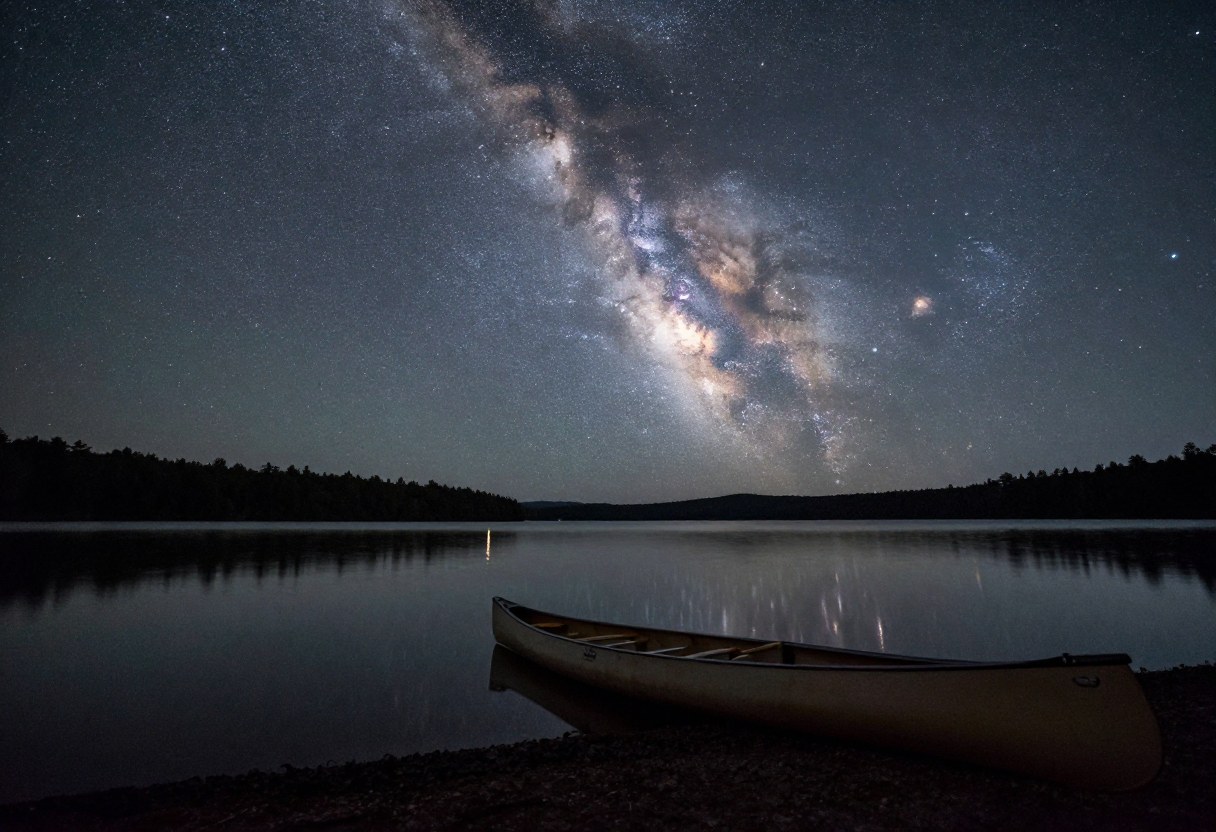
- Summer is the best season for the Milky Way, which stretches from the northeast to the southern horizon from a dark site. Our guide to understanding light pollution helps you find one.
5. Fall (September to November)
- The Great Square of Pegasus is a large, faint square of four stars that dominates the autumn sky.
- Andromeda extends from one corner of the Square as a chain of stars, and it leads you to the Andromeda Galaxy, which is a good target for binoculars.
- Perseus and Cassiopeia rise high in the northeast. The Double Cluster lies between them.
- Fomalhaut is a lone, fairly bright star low in the south, with no bright neighbors.
- The Summer Triangle is still visible early in the evening, sinking to the west.
- Fall is a great time for stargazing, with long nights and comfortable temperatures — and the Orionid and Leonid meteor showers.
6. Winter (December to February)
- Orion, the Hunter, is the showpiece of the winter sky. It has two bright stars, the red Betelgeuse and blue-white Rigel, and a belt of three stars in a row. The Orion Nebula is the fuzzy "star" in his sword.
- Follow the belt to the left (down) to Sirius, the brightest star in the night sky, in Canis Major. It twinkles strongly and flickers with color near the horizon.
- Follow the belt up and to the right to Aldebaran, the orange eye of Taurus, the Bull, and the nearby Pleiades cluster.
- Gemini's twin stars Castor and Pollux sit high above Orion, and Capella shines high overhead.
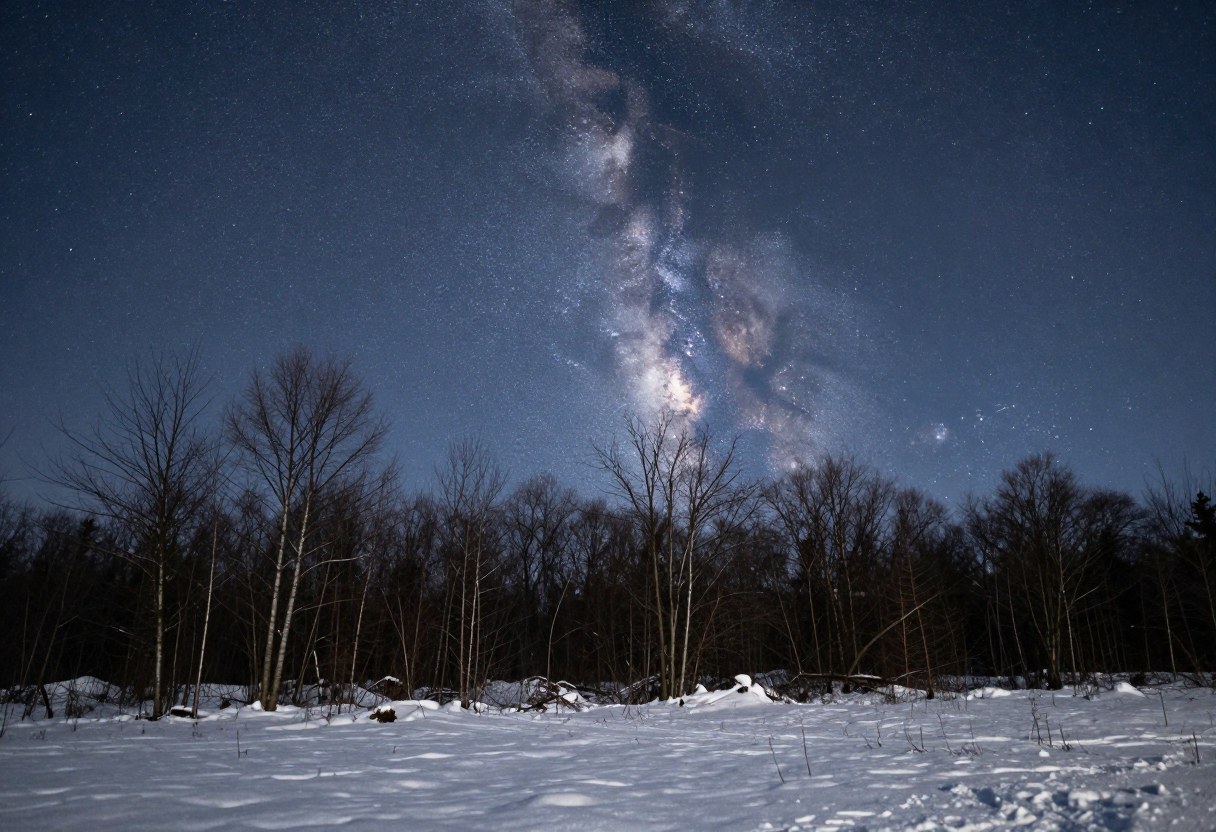
- Winter has more bright stars than any other season, making it the easiest to learn. Just dress warmly, as covered in our layering guide.
7. Tools That Help
- A planetarium app or a star chart shows what's up tonight, and many apps use your phone's sensors to label what you're pointing at. See our guide to stargazing apps and star charts.
- A planisphere is a simple rotating star wheel you can set for any date and time, with no battery.
- Binoculars reveal the stars within the patterns and show clusters and nebulae. See our binoculars for astronomy guide.
- A red flashlight and warm clothes let you stay out longer and keep your night vision.
8. How to Practice
- Go out regularly, even for ten minutes. The sky is more familiar the more often you look.
- Learn one new pattern each time. Start with the anchors, then add neighbors.
- Use star-hopping: find a bright star, then follow lines and shapes to the next one.
- Choose a dark site when you can. Light pollution erases the faint stars that complete many patterns, but bright anchors work even from town.
- Join an astronomy club or a local star party. Experienced observers are usually happy to show you the sky.
Safety First: Dark sites are often remote and the night cold. Tell someone where you're going, dress for temperatures well below the daytime forecast, and watch your footing in the dark with a red light.
Common Mistakes
- Trying to learn everything at once instead of a few anchors per season.
- Expecting the patterns to look like their pictures. The stick figures are tools, not drawings.
- Observing from bright locations and being unable to see the fainter stars.
- Not letting your eyes adjust to the dark.
- Forgetting that the sky changes with the time of night and season.
Quick Decision Checklist
- I can find the Big Dipper, Polaris, and Cassiopeia
- I know the key patterns for the current season
- I'm using a chart or app, and a red light
- I've let my eyes adjust for 20–30 minutes
- I'm adding one new pattern each time I go out
Glossary
- Asterism: An informal pattern of stars, such as the Big Dipper or Summer Triangle.
- Circumpolar: Stars that circle the celestial pole and never set from a given location.
- Star-Hopping: Finding faint objects by following lines and shapes from bright, known stars.
- Planisphere: A rotating star wheel that shows the sky for any date and time.
Final Takeaway
You don't have to memorize the sky. Learn the Big Dipper, Polaris, and Cassiopeia as year-round anchors, then add each season's showpiece: Leo and Arcturus in spring, the Summer Triangle and Scorpius in summer, the Great Square in fall, and Orion in winter. A few clear nights outside, and the sky stops being a jumble and becomes a map.
Which constellations are visible depends on your latitude, the date, and the time of night — use a current star chart or app to confirm what's up on a given evening.