
Observing the Moon and Planets for Beginners
What you can actually see of the Moon, Venus, Mars, Jupiter, and Saturn with your eyes, binoculars, and a small telescope — and when to look.
Published October 12, 2026
The Easiest, Most Rewarding Targets in the Sky
Deep-sky objects like galaxies and nebulae demand dark skies, patience, and often a decent telescope. The Moon and planets are the opposite: bright, easy to find, and visible even from a city backyard. A pair of binoculars shows you the Moon's craters and Jupiter's four largest moons; a small telescope shows you Saturn's rings, and the first time you see them with your own eyes tends to stick with people for life. If you're new to stargazing, this is where to start.
1. The Moon: Look at the Edge, Not the Middle
- The best time to look at the Moon is when it's partially lit, not full. Along the line between light and dark — the terminator — the Sun's low angle casts long shadows that make craters, mountains, and ridges stand out in sharp relief. A full Moon is bright and flat, with those details washed out.
- With the naked eye, you can see the dark "seas" (maria) — vast plains of ancient lava — and the bright highlands.
- With binoculars, you'll see dozens of craters, mountain ranges, and the contrast of the maria, including prominent craters such as Tycho and Copernicus, whose bright ray systems are visible near full Moon.
- With a small telescope, you can spend whole evenings exploring crater walls, central peaks, and rilles. Over the course of a lunar month, the terminator sweeps across the surface, revealing a different landscape each night.
- The Moon is bright enough to be uncomfortable through a telescope. A neutral-density "moon filter" or simply a lower magnification makes viewing more comfortable.
- Look for earthshine on a thin crescent: the faint glow on the dark part of the Moon, sunlight reflected from Earth.
2. Planets vs. Stars
- Planets look like bright, steady "stars" that don't twinkle as much, because they're disks rather than points of light. They also wander against the background stars over weeks and months.
- Planets follow the ecliptic, the path the Sun and Moon trace across the sky, so you'll find them in a line, rather than scattered across the sky.
- A planetarium app is the easiest way to know what's visible tonight. Our guide to stargazing apps and star charts covers what to use.
3. What Each Planet Looks Like
- Venus is the brightest planet and the brightest "star" in the evening or morning sky. Through binoculars or a small telescope, it shows phases like the Moon — crescent, half, gibbous — though no surface detail, since it's wrapped in thick cloud.
- Mars is a small, reddish disc that's mostly a disappointment most of the time. It's best around its opposition, which happens about every two years, when it's closest to Earth. Then a telescope can show dark surface markings and sometimes a polar ice cap.
- Jupiter is a rewarding target. Even steady binoculars can show its four largest moons — Io, Europa, Ganymede, and Callisto — as tiny points in a line, which change positions from night to night. A small telescope reveals Jupiter's cloud bands and sometimes the Great Red Spot.
- Saturn is the showstopper. A small telescope at around 30 to 50 times magnification shows its rings clearly, along with its largest moon, Titan. The tilt of the rings changes over the years, so they appear more or less open depending on when you look.
- Mercury is hard to catch, since it stays close to the Sun and is only visible low on the horizon shortly after sunset or before sunrise on certain dates. It's a fun challenge.
- Uranus and Neptune are visible in binoculars or a small telescope as faint dots with a star chart, but they won't impress at first look.
4. Equipment: Start With What You Have
- Your eyes show the Moon's phases and maria, the brightness of planets, and their movement from week to week.
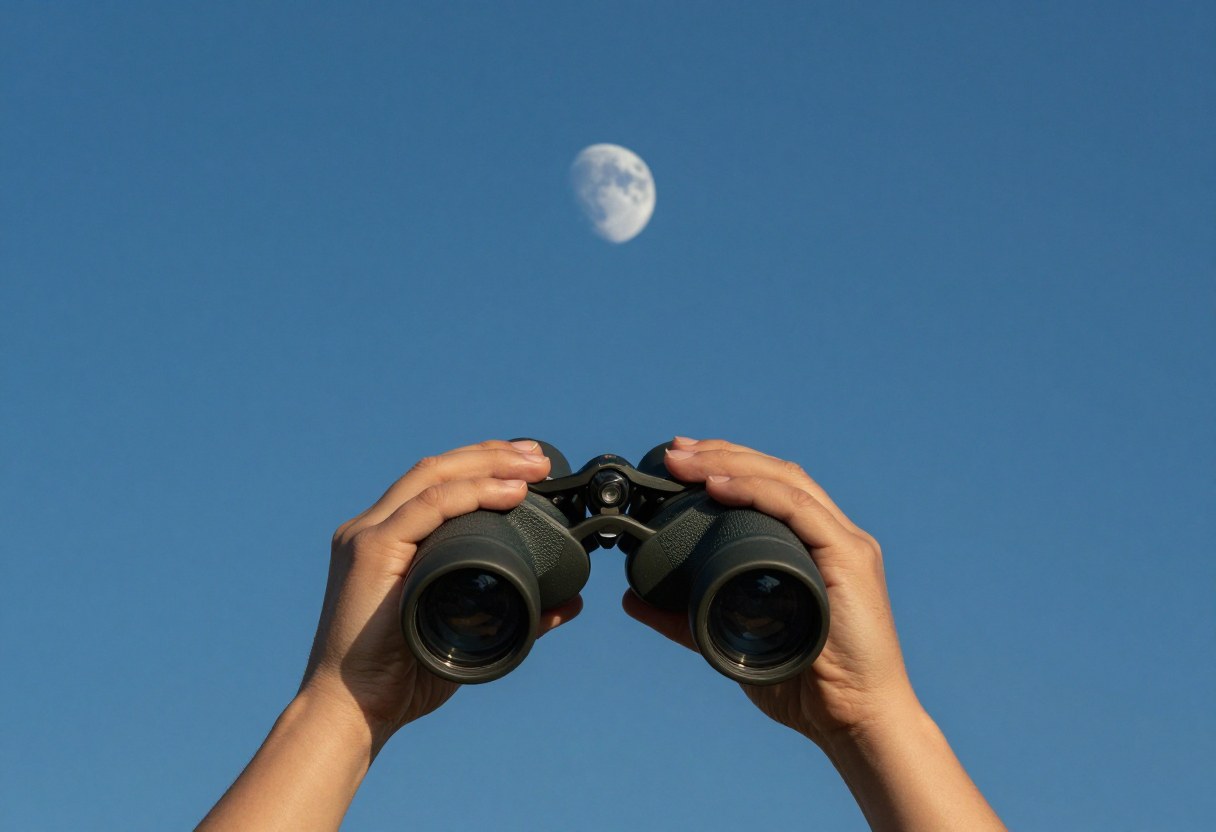
- Binoculars are the best first instrument. A 7×50 or 10×50 pair is affordable, portable, and shows lunar craters and Jupiter's moons. Our binoculars for astronomy guide covers how to choose a pair.
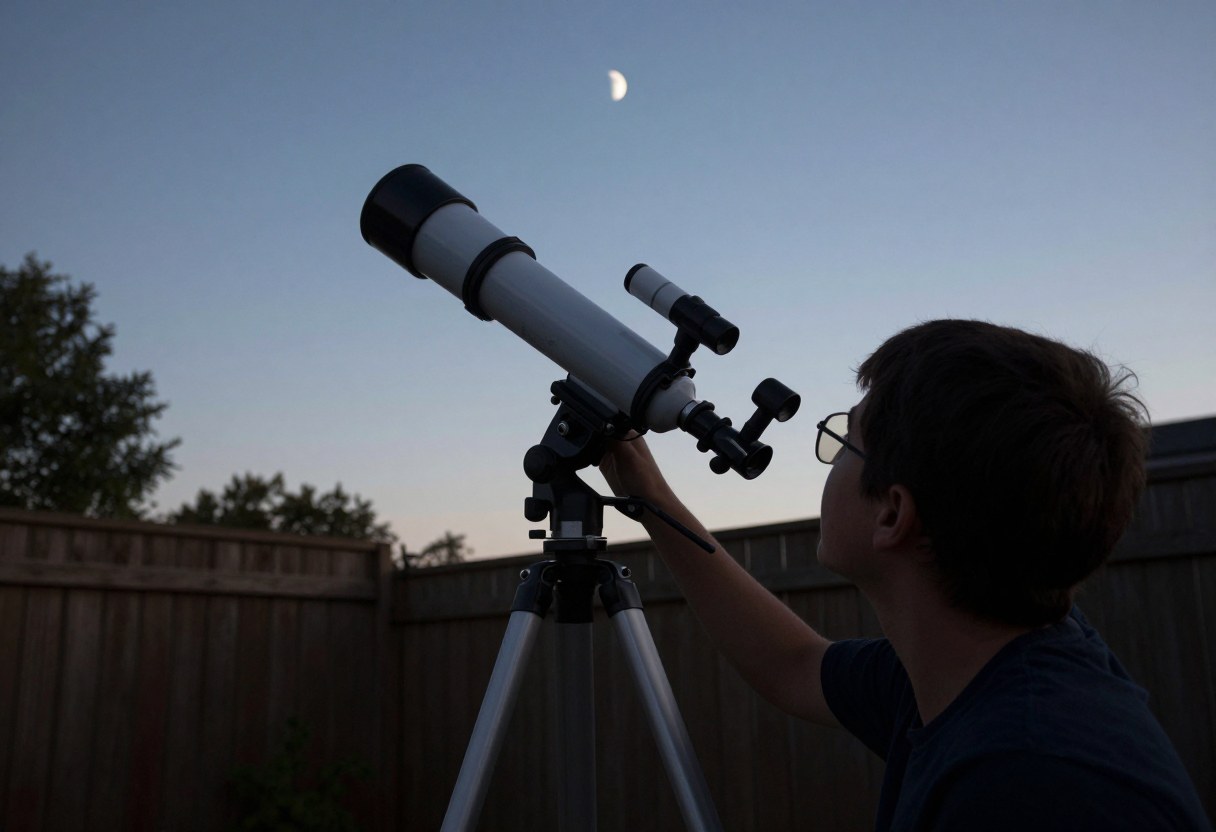
- A small telescope brings Saturn's rings and Jupiter's bands into view. See our guide to choosing a telescope — a stable mount matters as much as the optics, and a wobbly tripod ruins the experience.
- A good eyepiece set and a Barlow lens help with magnification, but the practical limit for most small telescopes is about 50 times per inch of aperture, and atmospheric turbulence often limits you below that.
- Accessories — a red flashlight, a comfortable chair, and warm clothing — make a surprising difference, as covered in our guide to essential stargazing gear and accessories.
Safety First: Never look at the Sun through binoculars or a telescope without a proper, certified solar filter designed for that instrument. Even a brief glance can cause permanent blindness. Be especially careful at twilight, when you may be sweeping the sky for Mercury or Venus close to the Sun.
5. Tips for Better Views
- Let your telescope cool down. Bringing a telescope from a warm house into the cold air creates heat currents in the tube that blur the image. Give it 20 to 30 minutes to reach outdoor temperature.
- Observe when the object is high in the sky. Low objects are viewed through much more atmosphere, which blurs and distorts them. Planets near the horizon almost always look worse.
- Start at low magnification, then step up. It's easier to find the object and keep it in view, and often the best views are at moderate power.
- Pay attention to "seeing." On some nights, the atmosphere is steady and planets look crisp; on others, they shimmer and boil. Steady nights are worth waiting for.
- Be patient. Details emerge as your eye adjusts. Spending ten minutes at the eyepiece reveals far more than a quick glance.
- Light pollution matters less for the Moon and planets, so a city balcony works fine — one reason they're ideal for beginners. See our guide to understanding light pollution when you're ready to chase fainter targets.
6. Planning Your Observing
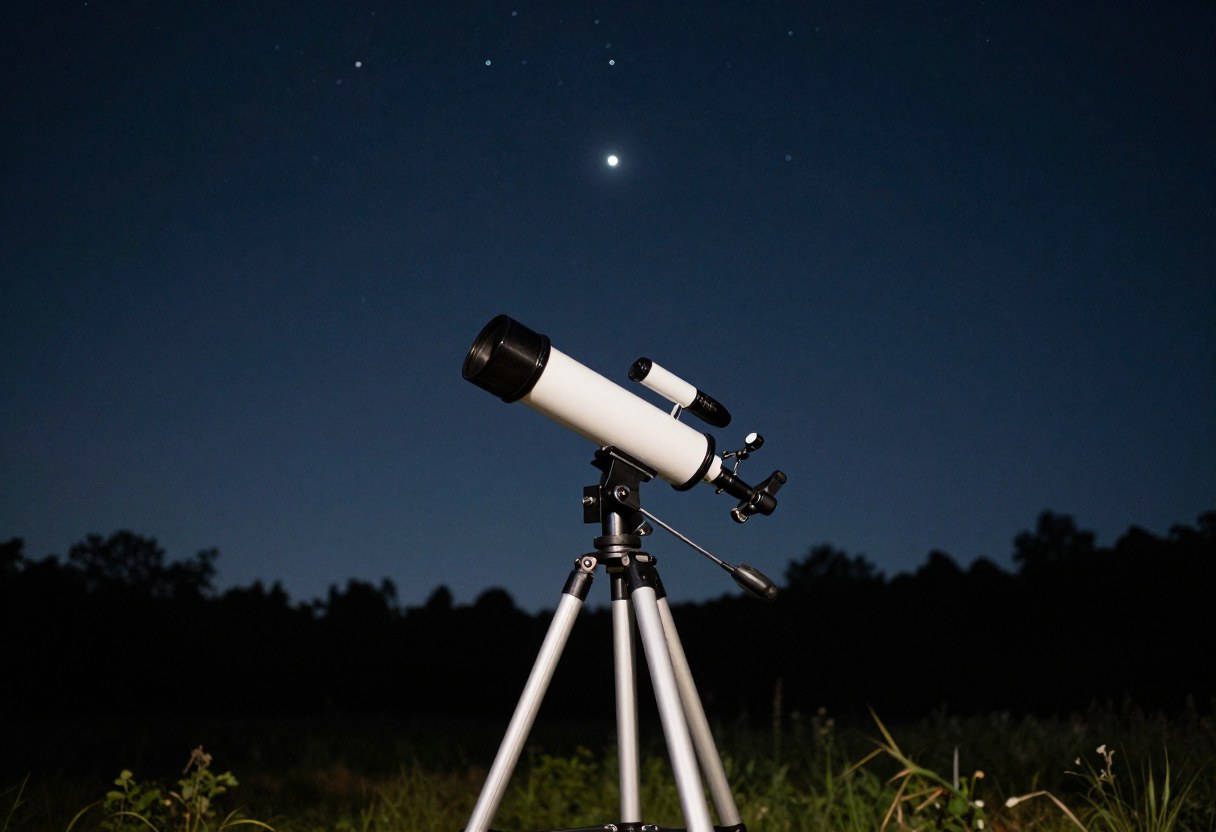
- Check a planetarium app or a monthly sky guide for which planets are visible, when they rise and set, and where to find them.
- Note special events, such as close pairings of planets, planets near the Moon, and Mars's oppositions, which add excitement to a night.
- Keep an observing log. Sketching what you see — even roughly — trains your eye and gives you a record of what you've seen.
- Check the Moon phase when planning a deep-sky night, since a bright Moon washes out faint objects, but it's the ideal time to observe the Moon itself.
Common Mistakes
- Expecting Hubble-style images. What you see in an eyepiece is smaller, dimmer, and less colorful than photographs, but it's real light, directly from the object.
- Looking at the full Moon and finding it dull and glaring, instead of at a partial phase.
- Using too much magnification, which gives a dim, blurry, shaky image.
- Observing planets when they're low in the sky, then blaming the telescope.
- Skipping the cooldown time.
Quick Decision Checklist
- I've checked a planetarium app for what's visible tonight and when it's highest
- I'm looking at the Moon near the terminator (partial phase) for the best detail
- I've started with binoculars or low magnification
- My telescope has had time to cool, and it's on a steady mount
- I have a certified solar filter if I ever plan to look near the Sun — and I never look without one
Glossary
- Terminator: The line between the lit and dark parts of the Moon, where shadows are longest and surface detail is most dramatic.
- Maria: The large, dark, flat plains on the Moon formed by ancient lava flows.
- Opposition: When a planet is directly opposite the Sun in our sky, making it closest to Earth and at its biggest, brightest appearance.
- Seeing: The steadiness of the atmosphere, which determines how sharp planetary views are on a given night.
Final Takeaway
The Moon and planets are the most accessible sights in the night sky: bright, easy to find, and visible from almost anywhere. Start with your eyes and binoculars, look at the Moon along its terminator, catch Jupiter's moons and Saturn's rings, and let your telescope cool before you observe. A few nights of patient looking can turn a casual interest into a hobby.
Planet positions, visibility, and the Moon's phase change constantly — use a current planetarium app or sky guide to see what's up on any given night, and never observe the Sun without a proper solar filter.