
Aquarius
The Water Bearer
A large, faint autumn zodiac constellation south of the Great Square of Pegasus, with a small Y-shaped Water Jar and several interesting nebulae.
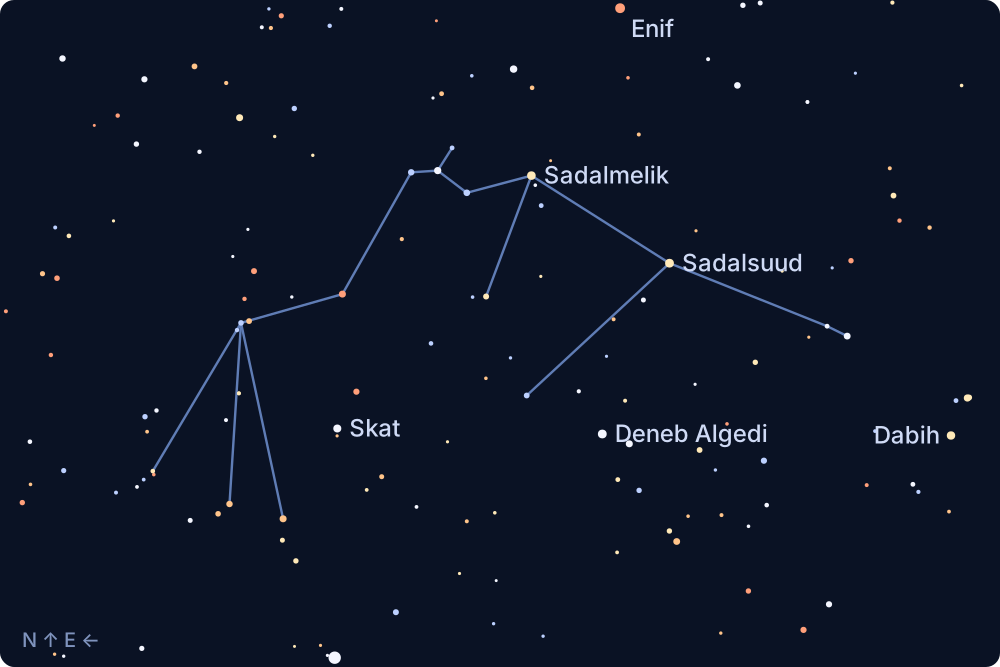
- Best season
- Autumn
- Best months
- September through November, in the south on autumn evenings
- Visibility
- Visible from everywhere in the United States
- Abbreviation
- Aqr
How to find it
- Start at the Great Square of Pegasus and look south. Aquarius is the faint, sprawling region south of the Square.
- In a dark sky, look for the Water Jar, a small Y-shaped group of four stars near the top of the constellation.
Brightest stars
- Sadalsuud (the brightest star in Aquarius)
- Sadalmelik
- Skat
What to look for
- The Water Jar, a small Y-shaped group of four stars that is easiest to see on a dark night.
Binocular and telescope targets
- Helix Nebula: a large, faint planetary nebula, visible in binoculars from a dark site
- Saturn Nebula (NGC 7009): a small planetary nebula that a telescope shows as a blue-green disc
- M2: a bright globular cluster, visible in binoculars
Using it to find other things
- Aquarius lies south of the Great Square of Pegasus.
About this constellation
Aquarius has no standout star, so it is easiest to learn from the Great Square of Pegasus. From the Square, look south for the faint region that holds the Water Jar.
It is also the radiant of two meteor showers, the Eta Aquariids in May and the Delta Aquariids in late July, though both favor observers in the southern United States.
Related guides
Visibility depends on your latitude, the date, and the time of night. The months above assume a typical evening from the contiguous United States, so use a planetarium app to confirm what is up tonight. Never look at the Sun through binoculars or a telescope without a proper solar filter.
Star positions: Hipparcos and Bright Star catalogues via d3-celestial (BSD-3-Clause, © 2015 Olaf Frohn).