
Finding North by the Stars
Also called: Polaris, North Star, Big Dipper pointers, Cassiopeia, celestial navigation
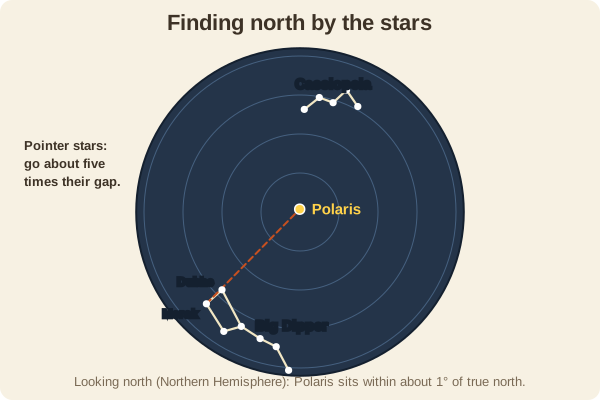
In the Northern Hemisphere, Polaris sits almost exactly above true north. You can find it from the Big Dipper's pointer stars or from Cassiopeia.
- Type
- Techniques
- Visible from
- The Northern Hemisphere only; it sits lower in the sky as you go south
- Altitude
- About equal to your latitude in degrees above the horizon
- Pointer stars
- Follow the two end stars of the Big Dipper's bowl (Dubhe and Merak) up about five times their gap
- Cassiopeia
- The W-shaped constellation on the opposite side of Polaris from the Dipper
- Brightness
- Moderately bright, not the brightest star
- Used for
- Sun & stars, Hiking & camping, Hunting, Fishing & boating
What it is good for
- A quick, free check of which way is north at night.
- Setting a rough direction when you have no compass.
- Stargazers learning to find their way around the sky.
Where it falls short
- Needs a clear night and a view of the northern sky.
- It does not work in the Southern Hemisphere.
- Polaris is not the brightest star, so it can be hard to pick out in bright moonlight.
Tips
- Face Polaris, and north is straight ahead, with south behind, east to your right, and west to your left.
- Use a bright star, a tree, or a ridge as a marker, so you can keep the direction when the stars move.
Works well with
- Shadow Stick Method: the daytime version using the Sun.
- Natural Navigation Myths: what not to rely on.
Field notes
The sky seems to turn around Polaris because it sits almost on the line of Earth's axis. The Big Dipper and Cassiopeia circle it through the night and the seasons, but Polaris stays put, so it marks north.
Related guides
Numbers here are typical, and values such as magnetic declination change over time and place, so check a current source such as NOAA or your map's legend. Practice near home before you rely on a skill far from help, carry a paper map and compass as a backup, and tell someone your plan. Rules on electronics, land access, and trespass differ by state; our state resources directory links to each state's official regulations. Want a step-by-step guide? Read Trail Navigation Basics.