
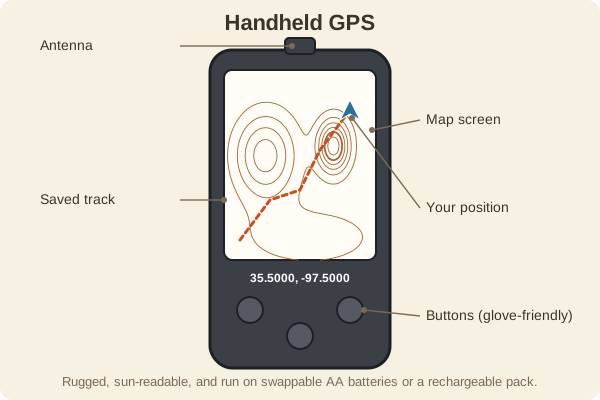
Handheld GPS
Also called: GPS unit, GPSr, hiking GPS, outdoor GPS
A rugged, battery-powered receiver that shows your position on a map. It is built for weather, long battery life, and use with gloves.
- Type
- GPS & Devices
- How it works
- Receives signals from navigation satellites and works out your position
- Power
- Replaceable AA batteries or a rechargeable pack; often 15 to 30 hours or more
- Screen
- Readable in sun, many with buttons that work with gloves
- Maps
- Loaded topo maps; many can add trail and land layers
- Used for
- Hiking & camping, Hunting, Fishing & boating
What it is good for
- Long trips, cold weather, and rain where a phone struggles.
- Marking waypoints such as a truck, camp, or stand.
- People who want a dedicated tool with swappable batteries.
Where it falls short
- More expensive than a phone app, and the screen is small.
- A GPS can fail, so it never replaces a map and compass.
- Menus can be confusing until you practice.
Tips
- Carry spare batteries and keep them warm in a pocket in the cold.
- Set the position format and the datum to match your map.
- Learn to mark a waypoint and use 'go to' at home before you need it.
Works well with
- Waypoints, Tracks, and Routes: what you store and follow.
- GPS Accuracy and Battery: what to expect and how to save power.
- Satellite Communicator: adds two-way messaging and SOS.
Field notes
A dedicated GPS gives you the main advantages of a phone, plus a tougher case and batteries you can swap. It still tells you where you are only on the screen, so you must combine it with map reading to decide where to go.
Related guides
Numbers here are typical, and values such as magnetic declination change over time and place, so check a current source such as NOAA or your map's legend. Practice near home before you rely on a skill far from help, carry a paper map and compass as a backup, and tell someone your plan. Rules on electronics, land access, and trespass differ by state; our state resources directory links to each state's official regulations. Want a step-by-step guide? Read Trail Navigation Basics.