

GPS Accuracy and Battery
Also called: GPS accuracy, GPS datum, WGS 84, NAD 27, battery life, GPS error
A consumer GPS is usually good to within a few meters in the open, but trees, canyons, and the wrong datum can make it worse. Battery habits decide how long it lasts.
- Type
- GPS & Devices
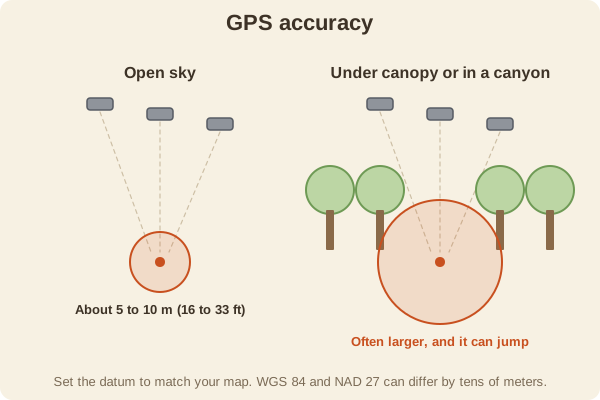
- Open sky
- Often within about 5 to 10 meters (16 to 33 feet)
- Under dense canopy or in a canyon
- Error can double or more, and the position can jump
- Datum
- Set it to match your map (WGS 84 is common); older maps may use NAD 27, which can differ by tens of meters up to about 100
- Battery tips
- Dim the screen, turn off unused radios, and use a longer track interval
- Used for
- Hiking & camping, Hunting, Fishing & boating
What it is good for
- Knowing how far to trust the dot on the screen.
- Setting up a GPS correctly before a trip.
Where it falls short
- No consumer GPS is exact, and the reported accuracy is an estimate.
- Cold weather cuts battery life and some screens slow down.
- A stale position can mislead if the device has not locked on.
Tips
- Wait for a solid lock in the open before you set off.
- Average several readings for an important waypoint.
- Carry spare batteries or a power bank, and keep them warm.
Works well with
- Handheld GPS: where the settings live.
- Latitude and Longitude: datum affects these numbers.
Field notes
Think of the position as a circle of possible places, not a single point. In the open the circle is small; under thick trees or beside a cliff it grows, so use the map and your eyes too.
Related guides
Numbers here are typical, and values such as magnetic declination change over time and place, so check a current source such as NOAA or your map's legend. Practice near home before you rely on a skill far from help, carry a paper map and compass as a backup, and tell someone your plan. Rules on electronics, land access, and trespass differ by state; our state resources directory links to each state's official regulations. Want a step-by-step guide? Read Trail Navigation Basics.