

Taking a Bearing
Also called: compass bearing, azimuth, heading, follow a bearing
A bearing is a direction measured in degrees clockwise from north. Taking one from the map and following it is the core compass skill.
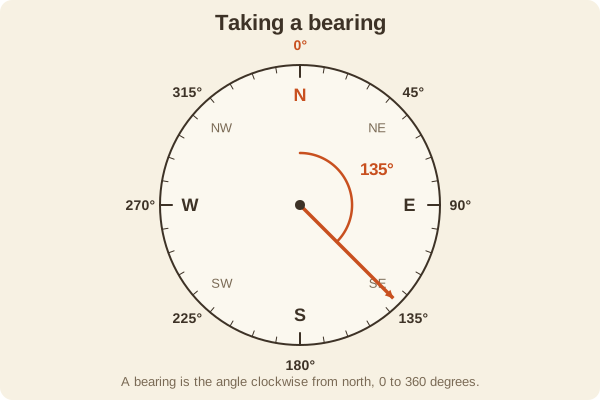
- Type
- Compass
- North, east, south, west
- 0, 90, 180, and 270 degrees
- Northeast
- 45 degrees (and southeast 135, southwest 225, northwest 315)
- Error at one mile
- Each degree off puts you about 92 feet to the side after one mile
- Also called
- Azimuth or heading
- Used for
- Hiking & camping, Hunting, Fishing & boating
What it is good for
- Heading across country when there is no trail.
- Walking a straight line in fog, snow, or thick woods.
- Returning to a camp, truck, or stand you marked.
Where it falls short
- A small error grows with distance, so check your position often.
- Walking a bearing past obstacles needs a plan to get back on line.
- A bearing from a map is a true or grid bearing until you account for declination.
Tips
- From the map: lay the compass edge along your route with the direction-of-travel arrow toward the goal, turn the dial until its lines match the map's north-south lines, then correct for declination.
- On the ground: hold the compass level, turn your body until the red needle end sits inside the orienting arrow, and walk the way the travel arrow points.
- Pick a landmark on the bearing and walk to it, then repeat, instead of staring at the needle.
Works well with
- Back Bearing: the reverse direction, for getting back.
- Magnetic Declination: the correction between map north and compass north.
- Aiming Off: a way to deal with small errors.
Field notes
Think of the compass dial as a circle of 360 degrees. North is zero, east is 90, south is 180, and west is 270. A bearing of 135 degrees therefore means southeast. The number is only useful if you know whether it was measured from true north or magnetic north, which is why declination matters.
Related guides
Numbers here are typical, and values such as magnetic declination change over time and place, so check a current source such as NOAA or your map's legend. Practice near home before you rely on a skill far from help, carry a paper map and compass as a backup, and tell someone your plan. Rules on electronics, land access, and trespass differ by state; our state resources directory links to each state's official regulations. Want a step-by-step guide? Read Trail Navigation Basics.