

Aiming Off
Also called: deliberate offset, aim off, intentional error, offset bearing
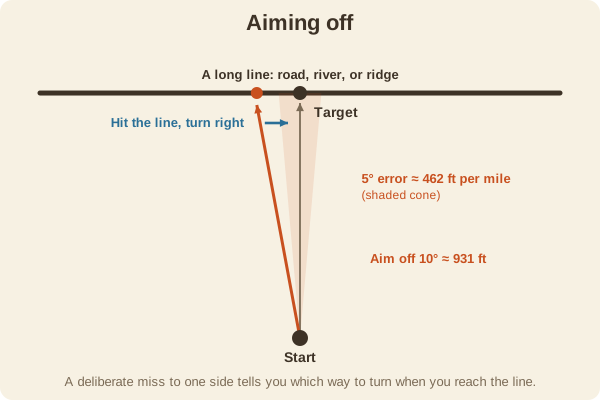
When your target sits on a long line such as a road or river, aim a little to one side on purpose. Then you know which way to turn when you hit the line.
- Type
- Techniques
- Typical offset
- 5 to 10 degrees, or a distance that clearly exceeds your expected error
- Why
- If you aim straight at a point on a line, you cannot tell whether it is left or right of you
- Example
- A 5-degree error over one mile is about 460 feet to the side
- Used for
- Hiking & camping, Hunting, Fishing & boating
What it is good for
- Finding a trail junction, bridge, or cabin along a road or creek.
- Coming back to a truck parked along a road.
Where it falls short
- It only works when you hit a long line you can follow.
- It adds a little distance on the final leg.
Tips
- Choose the side that has an easy follow-along, such as a trail on the left.
- Combine with a handrail: once you hit the line, turn the known direction.
Works well with
- Handrails and Catching Features: the line you aim at.
- Taking a Bearing: how to hold the offset.
Field notes
No one walks a perfect bearing, so aiming off turns an unknown error into a known one. You will miss your target, but you will know which way to turn.
Related guides
Numbers here are typical, and values such as magnetic declination change over time and place, so check a current source such as NOAA or your map's legend. Practice near home before you rely on a skill far from help, carry a paper map and compass as a backup, and tell someone your plan. Rules on electronics, land access, and trespass differ by state; our state resources directory links to each state's official regulations. Want a step-by-step guide? Read Trail Navigation Basics.