

Back Bearing
Also called: reverse bearing, reciprocal bearing, return heading
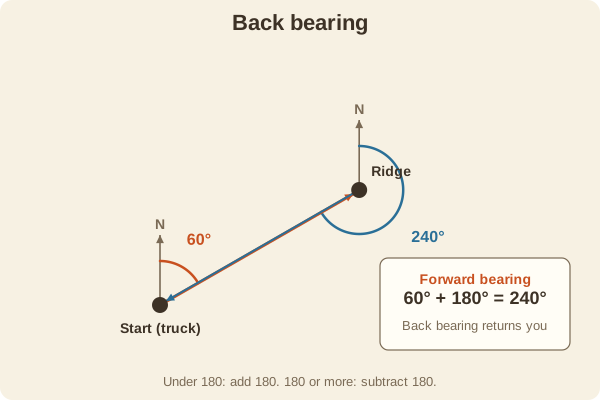
The back bearing is the opposite direction of a bearing. It points back along the way you came, and it is the bearing used in triangulation.
- Type
- Compass
- If the bearing is under 180
- Add 180 degrees (60 becomes 240)
- If the bearing is 180 or more
- Subtract 180 degrees (240 becomes 60)
- Quick check
- The two bearings always differ by exactly 180 degrees
- Used for
- Hiking & camping, Hunting, Fishing & boating
What it is good for
- Returning to a truck, camp, or stand in a straight line.
- Checking you are on the right line by sighting back to your start.
- Plotting a line on a map during triangulation.
Where it falls short
- A mistake in the add-or-subtract step sends you the wrong way, so double-check.
- A back bearing only returns you to the start if you walked the line straight.
Tips
- Write the forward and back bearing in your notebook before you leave.
- Many compasses have a back-bearing mark on the dial or a sighting mirror that makes this quicker.
Works well with
- Taking a Bearing: the forward direction this reverses.
- Triangulation (Resection): uses back bearings to fix your position.
Field notes
Facing the other way along a straight line changes the heading by half a turn, which is 180 degrees on a 360-degree dial. If you walked 60 degrees to reach a ridge, the way back is 240 degrees.
Related guides
Numbers here are typical, and values such as magnetic declination change over time and place, so check a current source such as NOAA or your map's legend. Practice near home before you rely on a skill far from help, carry a paper map and compass as a backup, and tell someone your plan. Rules on electronics, land access, and trespass differ by state; our state resources directory links to each state's official regulations. Want a step-by-step guide? Read Trail Navigation Basics.