
Blue Catfish
Ictalurus furcatus
The largest North American catfish: a slate-blue giant of big rivers and reservoirs that can reach well over a hundred pounds.
- Type
- Catfish
- Water
- Warm water
- Habitat
- Rivers, Reservoirs, Lakes
- Typical size
- 5 to 30 lb; fish over 50 lb are possible in big waters
- Range
- Native to the Mississippi, Ohio, and Missouri River basins and Gulf Coast rivers, and introduced in other rivers and reservoirs, including along the Atlantic coast.
- Best seasons
- Year-round; many anglers fish winter for large fish
How to identify it
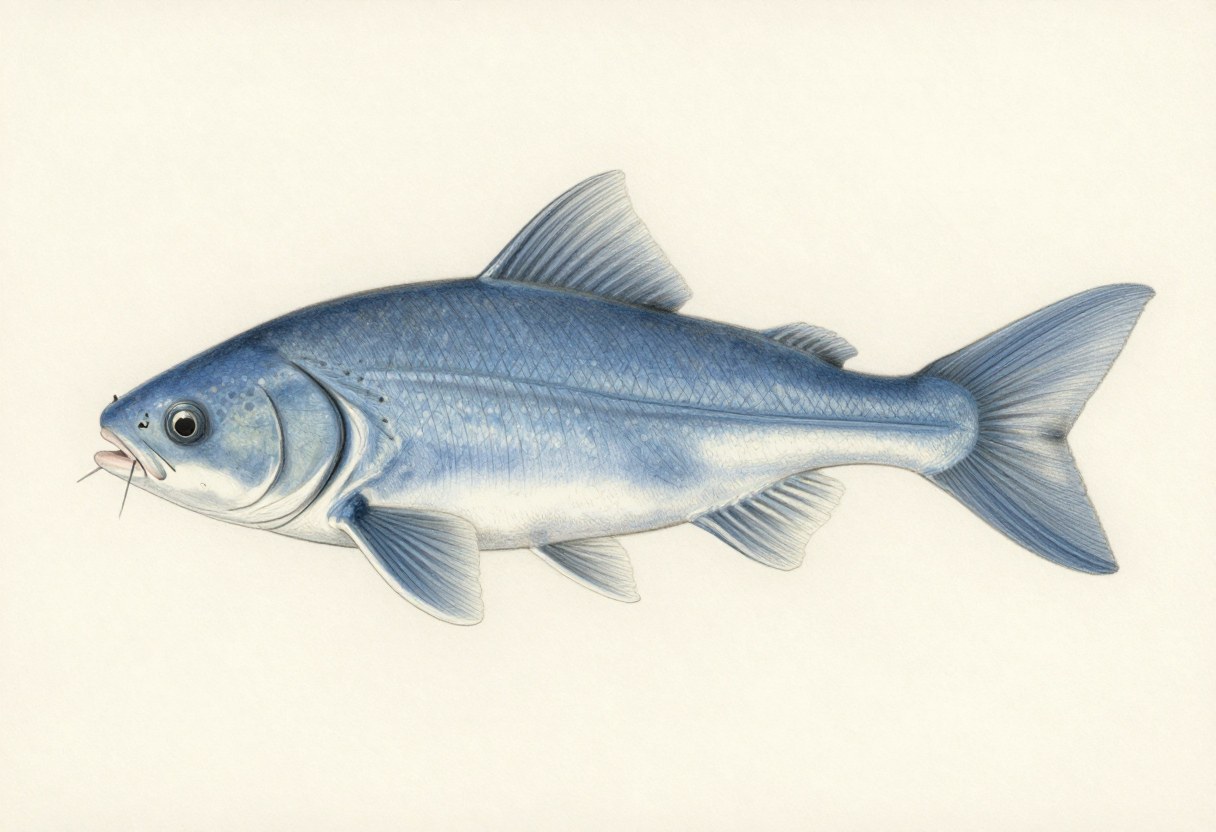
- The body is slate-blue to silver-gray with no spots on adult fish.
- The anal fin is long with a straight edge and about 30 to 35 rays.
- The back is humped in front of the dorsal fin, and the tail is deeply forked.
- The belly is white, and four pairs of barbels surround the mouth.
Often confused with
- Channel Catfish: smaller, often spotted when young, with a rounded anal fin of about 24 to 29 rays.
- Flathead Catfish: a flat, broad head, a mottled yellow-brown body, and a squared tail.
Best baits and lures
- Fresh cut shad
- Skipjack herring
- Cut bluegill
- Live shad
Techniques
- Drift or anchor over channel edges and deep holes with cut bait on the bottom
- Use heavy rods, strong line, and large circle hooks
- Fish below dams and at river confluences
- Move until you find fish; they hold in big water
Fishing notes
Blue catfish are the heavyweights of freshwater fishing. They feed heavily on baitfish like shad and herring, so fresh cut bait from the same water is usually the best option.
They roam channels and flats in big rivers and reservoirs and often hold in current and deep water. Heavy tackle matters, since a big blue can pull hard and long.
Many anglers release the largest fish, which are old and slow-growing. Check size and bag limits, as some states regulate blue catfish separately.
Related guides
Size limits, bag limits, legal baits, and seasons vary by state and waterbody and change over time. Check your state's current regulations — our state resources directory links straight to each state's official fishing rules and license portal.