
Taurus
The Bull
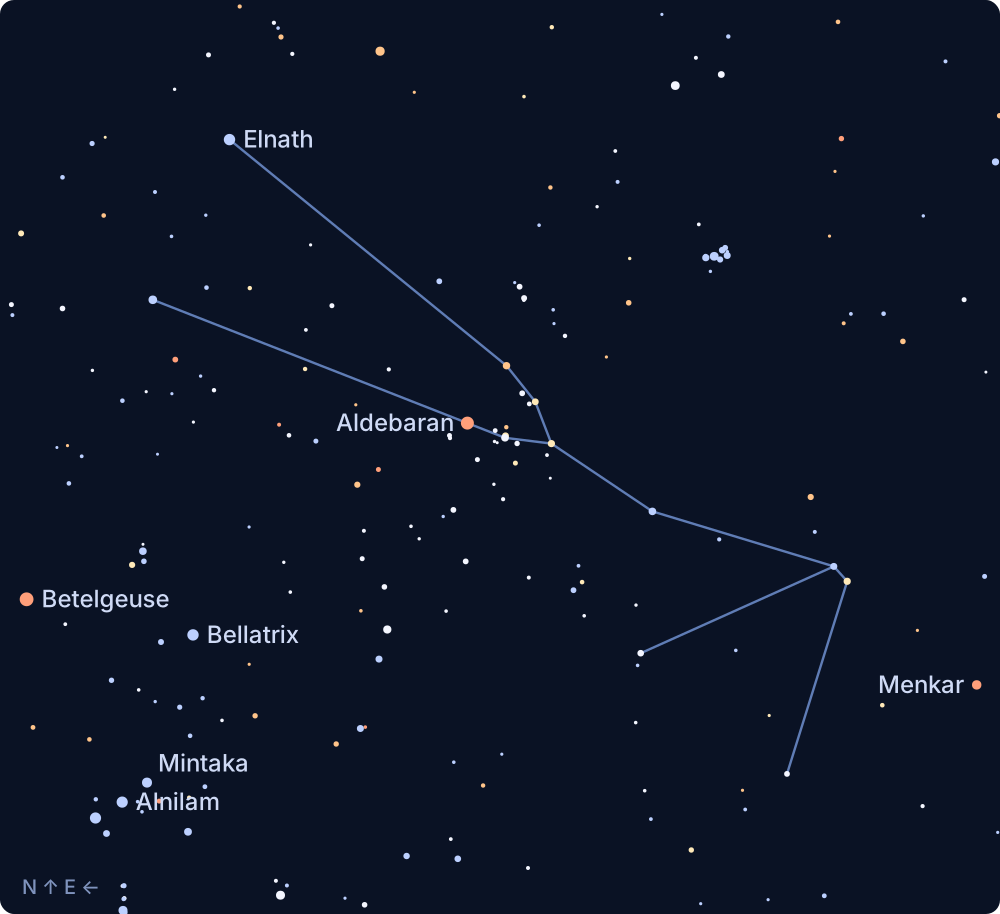
A winter zodiac constellation anchored by orange Aldebaran, the V-shaped Hyades face, and the Pleiades star cluster, all easy to find from Orion.
- Best season
- Winter
- Best months
- November through February, high in the south on winter evenings
- Visibility
- Visible from everywhere in the United States
- Abbreviation
- Tau
How to find it
- Start at Orion's belt and follow the line of three stars up and to the right. The first bright orange star you reach is Aldebaran.
- Around Aldebaran, a V of fainter stars forms the bull's face. That is the Hyades cluster.
- Keep going the same way past Aldebaran and you reach the Pleiades, a tight little knot of stars that looks like a miniature dipper.
Brightest stars
- Aldebaran (orange giant, the bull's eye)
- Elnath (the tip of the northern horn)
- Pleiades cluster (the Seven Sisters, a naked-eye star cluster)
What to look for
- How many Pleiades stars you can count by eye. Six is typical, and many more show up in binoculars.
- The color of Aldebaran. It is orange, easy to see even from town.
Binocular and telescope targets
- Pleiades (M45): a bright open star cluster, spectacular in binoculars
- Hyades: the closest open cluster to us, spread across the bull's face and best seen in binoculars
- Crab Nebula (M1): the remains of an exploding star, visible only with a telescope
Using it to find other things
- From Orion's belt, Taurus is up and to the right; Sirius is down and to the left.
- Elnath, the tip of the bull's northern horn, is shared with the neighboring constellation Auriga.
About this constellation
Taurus is a winter showpiece because it hosts two of the best star clusters in the sky. The Hyades form the bull's V-shaped face, and the Pleiades ride on its shoulder.
Aldebaran appears to sit in the Hyades, but it is actually much closer to us than the cluster, a chance alignment. Its orange color marks a cooler, older star than blue-white Rigel in nearby Orion.
The Moon and bright planets pass close by, so a bright 'star' near Aldebaran or the Pleiades can be a planet.
Related guides
Visibility depends on your latitude, the date, and the time of night. The months above assume a typical evening from the contiguous United States, so use a planetarium app to confirm what is up tonight. Never look at the Sun through binoculars or a telescope without a proper solar filter.
Star positions: Hipparcos and Bright Star catalogues via d3-celestial (BSD-3-Clause, © 2015 Olaf Frohn).