
Sagittarius
The Archer
A summer zodiac constellation shaped like a teapot, sitting in the direction of the center of the Milky Way and surrounded by star clouds, nebulae, and clusters.
- Best season
- Summer
- Best months
- June through September, low in the southern sky on summer evenings
- Visibility
- Visible from the United States, low in the south; best from southern states
- Abbreviation
- Sgr
How to find it
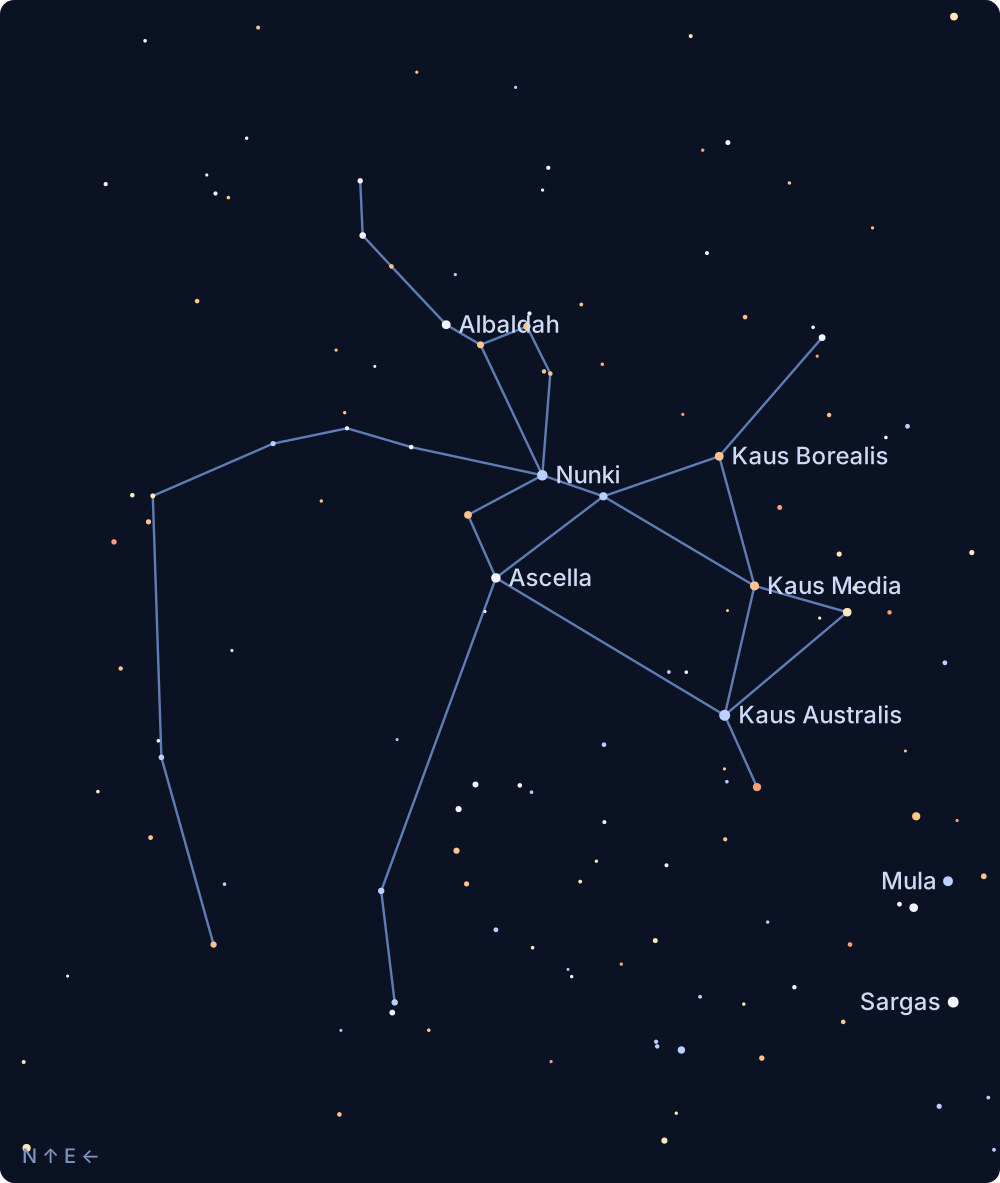
- Look south in summer, just east of Scorpius. A group of eight stars outlines a teapot.
- On a dark night, the Milky Way rises from the spout like steam.
Brightest stars
- Kaus Australis (the brightest star in the Teapot)
- Nunki
- Ascella
- Kaus Media and Kaus Borealis
What to look for
- The thick part of the Milky Way rising above the Teapot's spout on a dark night.
- How low the Teapot sits. You need a clear southern horizon to see all of it.
Binocular and telescope targets
- Lagoon Nebula (M8): a glowing gas cloud visible to the naked eye in dark skies
- Trifid Nebula (M20): a nebula with dark dust lanes, best in a telescope
- M22: one of the brightest globular clusters, a fine target in binoculars
- M24 (Sagittarius Star Cloud): a bright patch of Milky Way that binoculars fill with stars
Using it to find other things
- Sagittarius lies east of Scorpius. Together they form the richest part of the summer sky.
- The center of our galaxy lies in the direction of the Teapot.
About this constellation
Sagittarius is the best place to start exploring the summer Milky Way. When you look at the Teapot you are looking toward the center of our galaxy, though dust hides the center itself.
From the United States it stays low, so it helps to have a clear southern horizon. A dark site makes the difference between faint smudges and a spectacular star field.
Related guides
Visibility depends on your latitude, the date, and the time of night. The months above assume a typical evening from the contiguous United States, so use a planetarium app to confirm what is up tonight. Never look at the Sun through binoculars or a telescope without a proper solar filter.
Star positions: Hipparcos and Bright Star catalogues via d3-celestial (BSD-3-Clause, © 2015 Olaf Frohn).