
Leo
The Lion
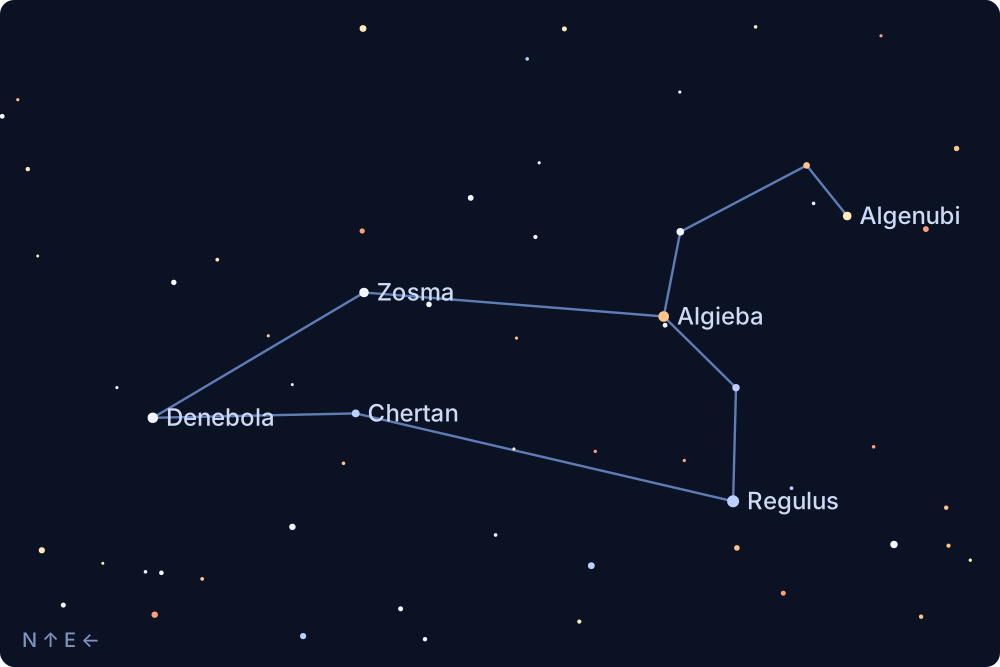
A spring zodiac constellation with a backward question mark for a mane and a triangle for the hindquarters, led by bright blue-white Regulus.
- Best season
- Spring
- Best months
- March through June, high in the south on spring evenings
- Visibility
- Visible from everywhere in the United States
- Abbreviation
- Leo
How to find it
- Look south in spring for a backward question mark of stars, called the Sickle. The dot at the bottom of the question mark is Regulus.
- A triangle of stars to the left forms the lion's rear, ending at Denebola, the tail.
- Imagine the Sickle as the head and mane, and the triangle as the body.
Brightest stars
- Regulus (blue-white, the lion's heart)
- Denebola (the tail)
- Algieba (a close double star)
What to look for
- How easily the Sickle shape stands out compared with the fainter stars around it.
- Regulus sits almost exactly on the path of the Sun, Moon, and planets, so they pass very close to it.
Binocular and telescope targets
- Algieba: a golden pair of stars that splits in a small telescope
- Leo Triplet (M65, M66, NGC 3628): three galaxies that fit in one telescope view
- M95 and M96: two more bright galaxies near the lion's belly
Using it to find other things
- Leo's hindquarters sit near Virgo and the Virgo Cluster of galaxies.
- The Leonid meteor shower in mid-November appears to radiate from the Sickle.
About this constellation
Leo is one of the few constellations that looks something like what it is named for. The Sickle makes a convincing head and mane, and the triangle of stars behind it makes a convincing body.
Regulus is a hot blue-white star that spins so quickly it is slightly flattened. Because the planets pass near it, it makes a handy marker when one of them is in the neighborhood.
Related guides
Visibility depends on your latitude, the date, and the time of night. The months above assume a typical evening from the contiguous United States, so use a planetarium app to confirm what is up tonight. Never look at the Sun through binoculars or a telescope without a proper solar filter.
Star positions: Hipparcos and Bright Star catalogues via d3-celestial (BSD-3-Clause, © 2015 Olaf Frohn).