
Bullsnake
Pituophis catenifer sayi
Also called: gopher snake, Great Plains bullsnake
A big, harmless snake of the Great Plains that hisses loudly and shakes its tail to pass for a rattlesnake, and so is often killed for no reason.
- Kind
- Harmless Lookalikes
- Typical length
- 4 to 6 feet
- Range
- The Great Plains and neighboring areas, from the Dakotas and Texas west into the Rockies and Southwest
- Regions
- Midwest & Plains, Southwest, Rockies & West
- Habitat
- Grass & prairie, Desert & rocky ground
- When active
- Spring through fall, active by day and at dusk
Note: Do not get close enough to check head shape or pupils. A rattlesnake and a bullsnake can live in the same patch of ground, so a rattling sound is always reason to back away.
How to identify it
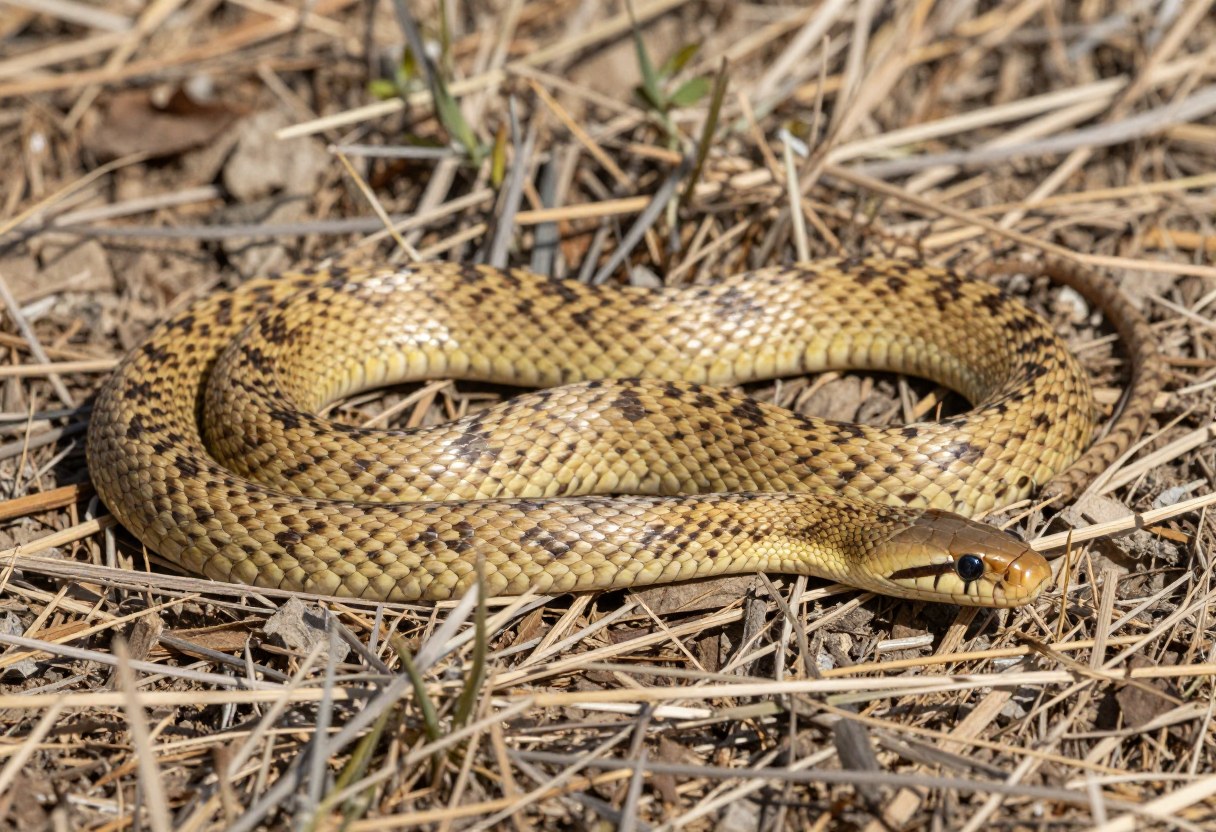
- Large dark brown blotches run down a yellow or tan body.
- It has no rattle, and its head is narrow and only slightly wider than the neck.
- When alarmed it hisses loudly, flattens its head, and vibrates its tail, which makes noise in dry grass or leaves.
- It is long and slim compared with a rattlesnake of the same length.
Often confused with
- Prairie Rattlesnake: shorter and thicker, with a rattle and a wide, triangular head.
- Western Diamondback Rattlesnake: diamond blotches and bold black and white tail bands, plus a rattle.
If you meet one
- Leave it alone. Harmless snakes eat rodents and are useful neighbors, and many are protected by state law.
- Give it room and let it move on. Handling or cornering a snake is how most bites happen, even from harmless ones.
- If you cannot tell for sure what it is, treat it as venomous and walk around it.
Field notes
Bullsnakes eat rodents, rabbits, and birds, and are a major help to farmers and ranchers. Their rattlesnake act is a bluff that protects them from predators and often gets them killed by people.
Related guides
This page is a general reference, not medical advice and not a substitute for identifying a real snake with an expert. Many snakes are protected by state law, and rules about killing or handling them vary, so check your state wildlife agency; our state resources directory links to each one. For any bite, get emergency care.