
American Sycamore
Platanus occidentalis
A huge streamside tree with patchy, peeling white and tan bark, which makes it easy to spot along rivers.
- Type
- Hardwoods
- Leaves
- Lobed leaves
- Region
- Northeast, Southeast, Midwest & Plains
- Typical size
- 75–100 ft tall, with a trunk 3–6 ft across
- Range
- The eastern and central United States, along streams and in bottomlands
- Look for it
- Winter, when the pale upper trunk and branches show against the sky
How to identify it
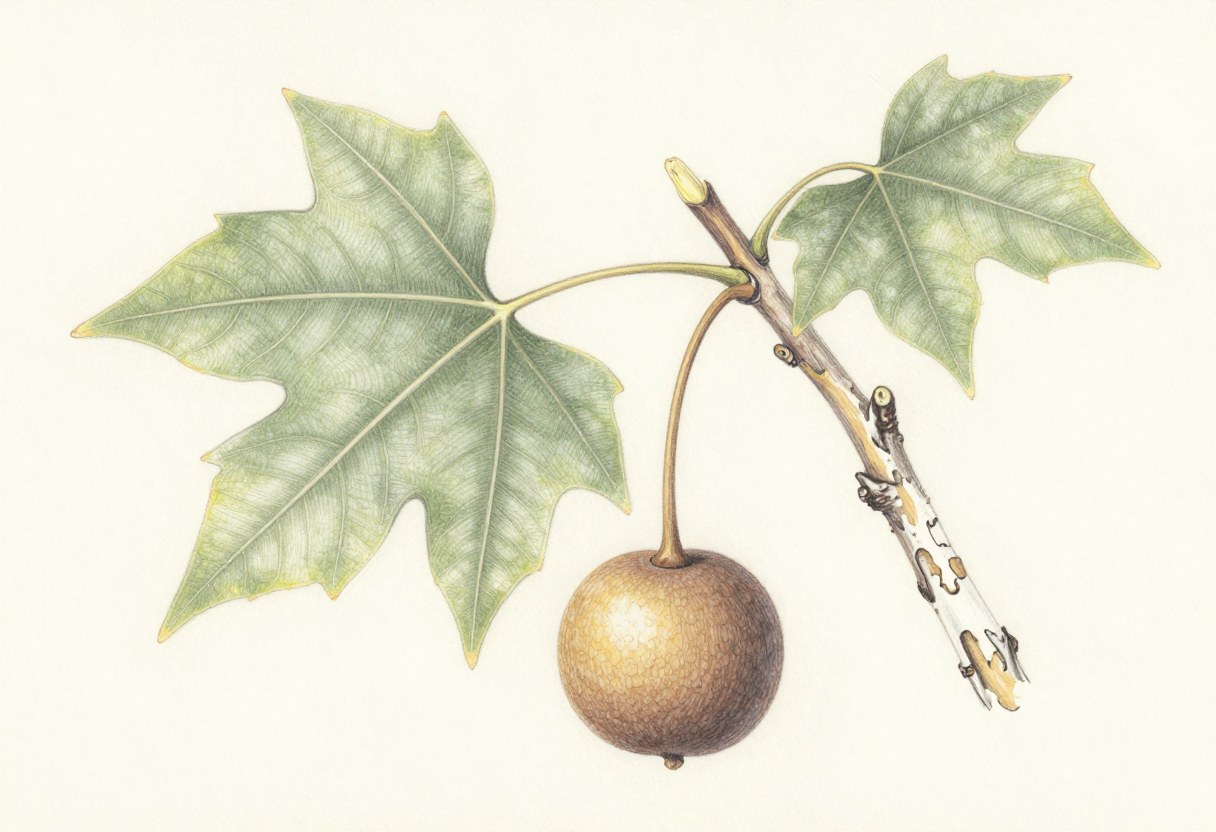
- Bark peels in patches, leaving a mottled pattern of white, tan, and olive.
- Leaves are broad, with three to five shallow, pointed lobes.
- Fruits are round balls about an inch across that hang on long stalks.
- Upper branches look chalky white from a distance.
Often confused with
- Sweetgum: has star-shaped leaves and spiky seed balls.
Why it matters outdoors
- Grows along streams and rivers, so a sycamore is a clue that water is nearby.
- Hollow trunks and limbs shelter raccoons, wood ducks, bats, and other wildlife.
- Poor firewood, since the wood is hard to split and burns unevenly.
Field notes
A sycamore stands out in winter. Its pale upper branches show clearly against a gray sky, and a row of sycamores often traces a creek.
Because the trees grow so large, hollow ones are valuable den trees.
Related guides
This guide helps you recognize trees and avoid harmful plants. It does not teach foraging, and nothing here is advice to eat or use a wild plant. Identification from a drawing can be wrong, so check with a regional field guide or a local expert, such as your state forestry or extension service.