
Douglas-fir
Pseudotsuga menziesii
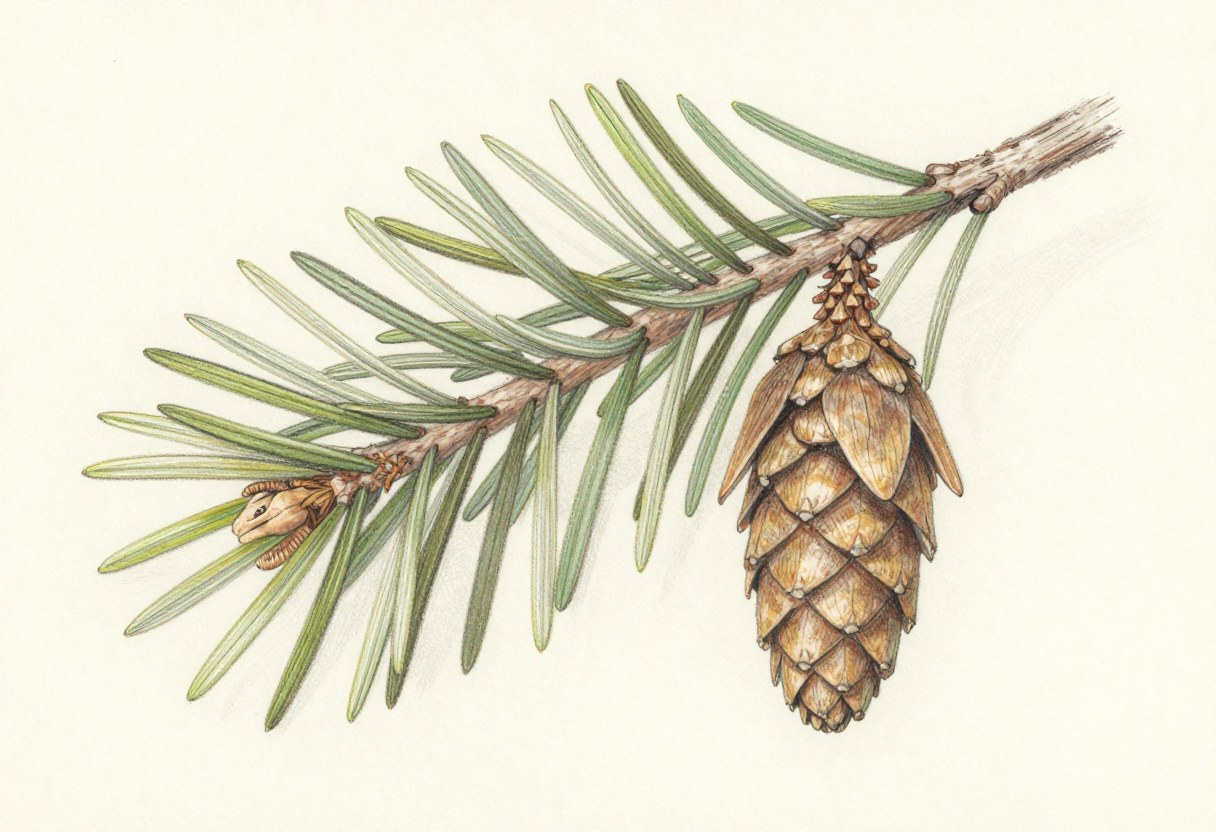
A giant Western conifer whose cones have little three-pointed bracts, like the tail and hind feet of a mouse.
- Type
- Conifers
- Leaves
- Needles
- Region
- Rockies & West
- Typical size
- 100–250 ft tall, with a trunk 3–6 ft across
- Range
- The Pacific Northwest, the Rocky Mountains, and the Southwest mountains
- Look for it
- Year-round, since the needles stay green
How to identify it
- Needles are flat, soft, and grow singly around the twig.
- Cones hang down, with three-pointed bracts sticking out between the scales like mouse tails.
- Bark is thick, corky, and deeply furrowed on older trees.
- Buds are pointed and reddish-brown, like a sharp spindle.
Often confused with
- Grand fir: a true fir with flat needles in two rows and upright cones.
Why it matters outdoors
- Elk and deer shelter in Douglas-fir forests, especially in winter.
- Good firewood, though it is resinous and spits sparks.
- Large Douglas-firs can drop big limbs, so look up before pitching a tent.
Field notes
Douglas-fir is not a true fir. The mouse-tail bracts on its cones are the surest identification mark, and even old fallen cones show them.
In the Pacific Northwest, it is the dominant tree of the forest and shelters much of the region's big game.
Related guides
This guide helps you recognize trees and avoid harmful plants. It does not teach foraging, and nothing here is advice to eat or use a wild plant. Identification from a drawing can be wrong, so check with a regional field guide or a local expert, such as your state forestry or extension service.