
Pace Count
Also called: ranger beads, counting steps, dead reckoning, distance by pacing, double pace
Count your steps to measure how far you have walked. Combined with a compass bearing, it lets you navigate with no landmarks at all.
- Type
- Techniques
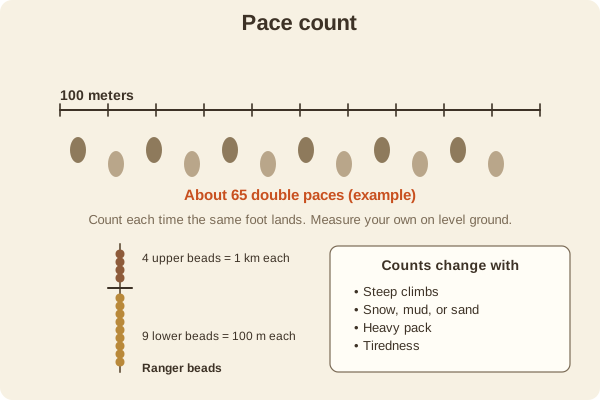
- Double pace
- Counting each time one foot lands, so a left-right pair is one
- Typical range
- Roughly 55 to 75 double paces per 100 meters for many adults on level ground
- Ranger beads
- A string of beads that you slide as you count, often 9 lower beads (100 meters each) and 4 upper beads (1 kilometer each)
- Naismith's rule
- A rough time guide of about 3 miles an hour plus an hour for each 2,000 feet of climb
- Used for
- Hiking & camping, Hunting
What it is good for
- Finding a turn, creek, or stand in thick woods or fog.
- Backup navigation when the GPS is dead.
Where it falls short
- Your count changes with slope, pack weight, mud, snow, and fatigue.
- Counting errors build up, so recheck against a landmark.
Tips
- Measure out 100 meters on flat ground and count your double paces three times; use the average.
- Expect a higher count uphill, in snow, or with a heavy pack.
- Write your own count in your notebook.
Works well with
- Taking a Bearing: gives you direction; the count gives distance.
- Map Scale: converts map distance to the count you need.
- Handrails and Catching Features: a check that the count was right.
Field notes
Pace counting is old, simple, and still useful. Combined with a bearing, it is called dead reckoning: you know where you started, how far you walked, and in what direction.
Related guides
Numbers here are typical, and values such as magnetic declination change over time and place, so check a current source such as NOAA or your map's legend. Practice near home before you rely on a skill far from help, carry a paper map and compass as a backup, and tell someone your plan. Rules on electronics, land access, and trespass differ by state; our state resources directory links to each state's official regulations. Want a step-by-step guide? Read Trail Navigation Basics.