
Handrails and Catching Features
Also called: handrail, catching feature, attack point, backstop, linear features, collecting feature
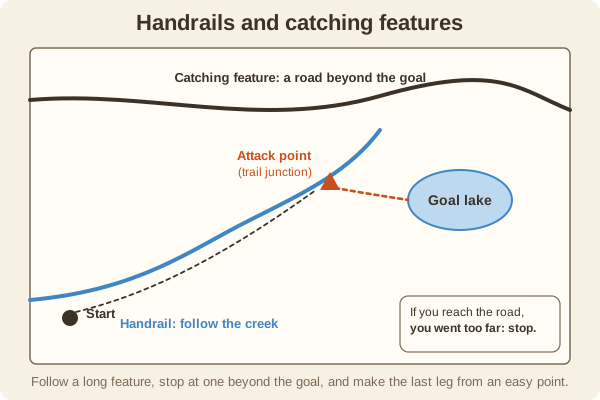
A handrail is a long feature, such as a creek or fence, that you follow. A catching feature is one beyond your goal that tells you if you went too far.
- Type
- Techniques
- Handrail
- A linear feature such as a stream, ridge line, trail, or shoreline that you keep beside you
- Catching feature
- A feature past your goal, such as a road or river, that stops you from overshooting
- Attack point
- An easy-to-find spot near your target, from which you make the final short leg
- Used for
- Hiking & camping, Hunting, Fishing & boating
What it is good for
- Making a long cross-country trip simple and safe.
- Finding a small target such as a lake, camp, or stand.
Where it falls short
- A handrail can lead you the wrong way if you pick the wrong one.
- Features in the real world may differ from the map, such as a dry creek.
Tips
- Plan the route on the map by listing the handrails and the catching feature.
- Pick an attack point you can see or hear, such as a bridge or a trail junction.
- If you cross the catching feature, stop and think; do not keep going.
Works well with
- Aiming Off: another way to build in a safe error.
- Pace Count: measures the last leg from an attack point.
Field notes
Good navigators avoid long open stretches where one small mistake grows. By picking features that guide and stop you, you turn a hard problem into a few easy ones.
Related guides
Numbers here are typical, and values such as magnetic declination change over time and place, so check a current source such as NOAA or your map's legend. Practice near home before you rely on a skill far from help, carry a paper map and compass as a backup, and tell someone your plan. Rules on electronics, land access, and trespass differ by state; our state resources directory links to each state's official regulations. Want a step-by-step guide? Read Trail Navigation Basics.