
Vulpecula
The Fox
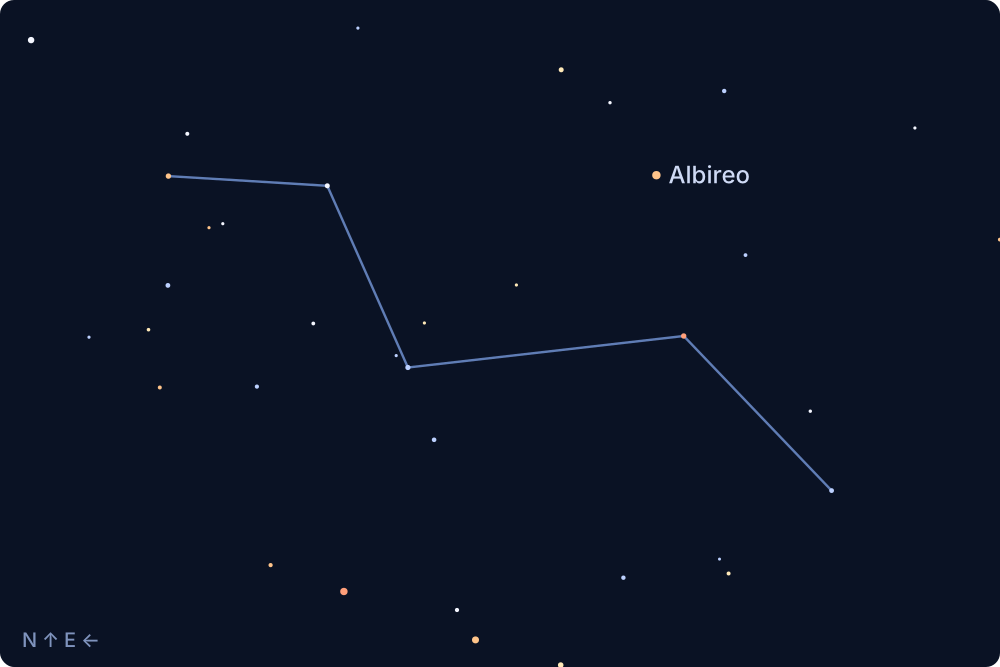
A faint summer constellation in the Milky Way that is best known for the Dumbbell Nebula and the Coathanger star group.
- Best season
- Summer
- Best months
- June through October, high overhead on summer evenings
- Visibility
- Visible from everywhere in the United States
- Abbreviation
- Vul
How to find it
- Look between Cygnus and Aquila, near Albireo, for a faint patch with no bright stars.
- Point binoculars at the area and look for a chain of stars shaped like a coat hanger.
Brightest stars
- Anser (Alpha Vulpeculae, the brightest and still faint)
What to look for
- The Coathanger, a tight group of stars shaped like an upside-down hanger, easy to spot in binoculars.
Binocular and telescope targets
- Dumbbell Nebula (M27): the first planetary nebula ever discovered, visible in binoculars as a faint glow
- Coathanger (Brocchi's Cluster): a chain of stars that looks like a coat hanger in binoculars
Using it to find other things
- Vulpecula lies between Cygnus and Aquila, just beyond Albireo.
About this constellation
Vulpecula is a faint constellation, but it has two real treats for a pair of binoculars. The Coathanger is a group of stars that forms a hook and a bar, and the Dumbbell Nebula is a glowing shell of gas blown off by a dying star.
The Dumbbell was the first planetary nebula ever discovered, by Charles Messier in 1764.
Related guides
Visibility depends on your latitude, the date, and the time of night. The months above assume a typical evening from the contiguous United States, so use a planetarium app to confirm what is up tonight. Never look at the Sun through binoculars or a telescope without a proper solar filter.
Star positions: Hipparcos and Bright Star catalogues via d3-celestial (BSD-3-Clause, © 2015 Olaf Frohn).