
Ursa Major
The Great Bear
Home of the Big Dipper, the most famous pattern in the northern sky and the easiest pointer to the North Star.
- Best season
- Spring
- Best months
- March through June, when the Dipper rides high in the north on spring evenings; visible in the north at other times of year
- Visibility
- Visible from across the United States. In the northern states the whole Dipper stays above the horizon all night; farther south its handle dips below the northern horizon for part of the year
- Abbreviation
- UMa
How to find it
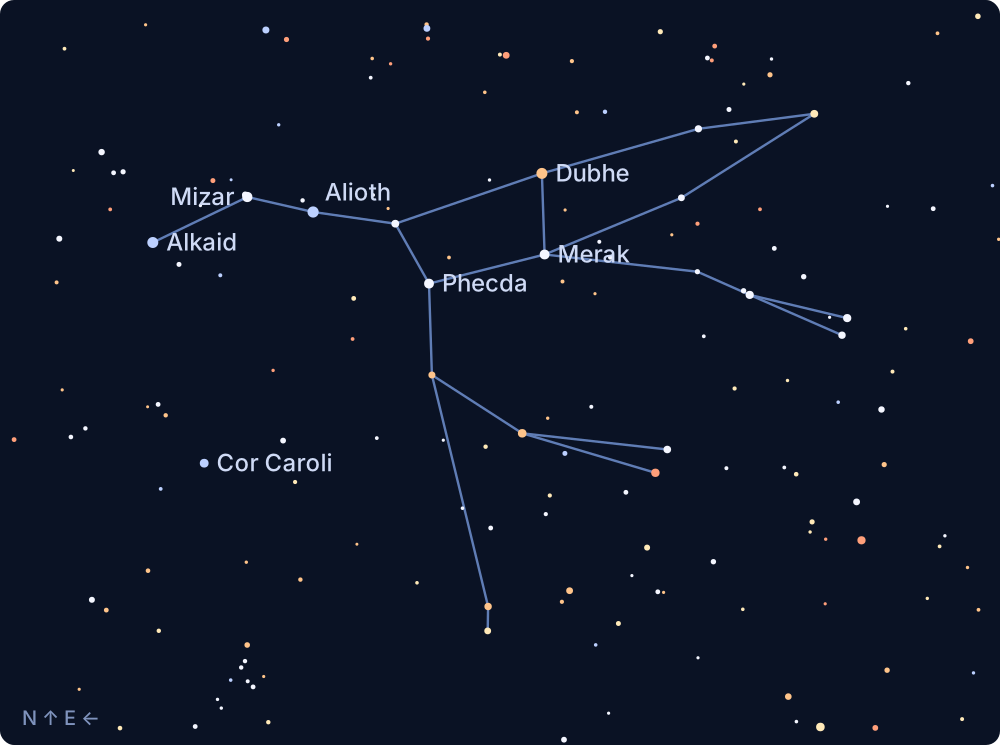
- Look north for seven fairly bright stars forming a large ladle: four in the bowl and three in the curved handle. That is the Big Dipper.
- The Dipper is part of the larger bear. The bowl is the bear's back and hindquarters, and the handle is its tail, with faint stars outlining the legs and head.
- On spring evenings the Dipper stands high in the north, upside down, as if pouring out. In fall it sits low in the north.
Brightest stars
- Alioth (the brightest star of the Dipper, and the first star of the handle)
- Dubhe
- Alkaid (the end of the handle)
- Mizar (with the faint star Alcor beside it)
What to look for
- The middle star of the handle, Mizar, which has a fainter companion, Alcor, right next to it. Seeing the two separately is a classic test of eyesight.
- How the Dipper turns around the North Star through the night and through the seasons.
Binocular and telescope targets
- Mizar and Alcor: a naked-eye double star in the handle
- M81 and M82: a pair of galaxies near the Dipper's bowl, visible in binoculars from a dark site
- The Pinwheel Galaxy (M101): a faint spiral galaxy near the end of the handle, for dark skies and a telescope
Using it to find other things
- The two stars at the end of the bowl, Dubhe and Merak, point almost directly at Polaris, the North Star. Extend the line about five times the distance between them.
- Follow the curve of the handle onward to reach the bright orange star Arcturus, and then continue to Spica.
About this constellation
The Big Dipper is not a constellation by itself but an asterism: a recognizable group of stars inside the larger constellation of Ursa Major. It is one of the first patterns most people learn, and for good reason. It is bright, large, and for most of the United States it never sets, so you can find it on any clear night.
Its most useful job is pointing the way north. Draw a line through the two stars at the front edge of the bowl and extend it, and you land on Polaris, which stays almost fixed in the sky while everything else turns around it. That makes the Dipper a handy compass when you are outdoors at night.
Because the Dipper circles the pole, its orientation changes through the year. Learn it in a few positions, including upside down in spring and low on the northern horizon in autumn, so you can recognize it whenever you look.
Related guides
Visibility depends on your latitude, the date, and the time of night. The months above assume a typical evening from the contiguous United States, so use a planetarium app to confirm what is up tonight. Never look at the Sun through binoculars or a telescope without a proper solar filter.
Star positions: Hipparcos and Bright Star catalogues via d3-celestial (BSD-3-Clause, © 2015 Olaf Frohn).