
Serpens
The Serpent
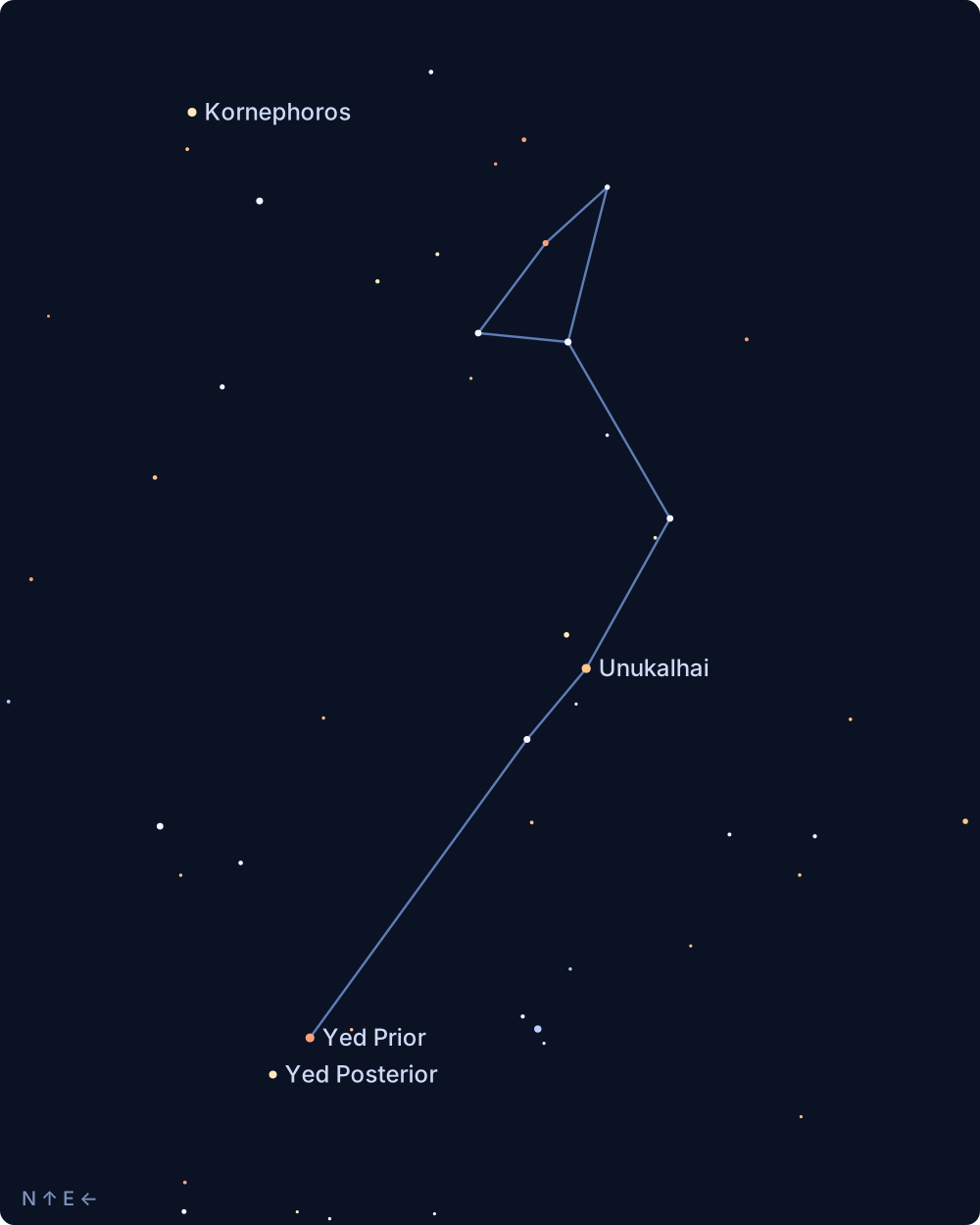
The only constellation split into two separate pieces, the Head and the Tail of a snake held by Ophiuchus, with bright globular cluster M5 and the Eagle Nebula.
- Best season
- Summer
- Best months
- May through August, in the south on late spring and summer evenings
- Visibility
- Visible from everywhere in the United States
- Abbreviation
- Ser
How to find it
- Find Corona Borealis, the small arc of stars between Boötes and Hercules. The serpent's head, Serpens Caput, lies just south of it, and Unukalhai is its brightest star.
- The tail, Serpens Cauda, lies on the other side of Ophiuchus, toward Aquila and the Milky Way.
Brightest stars
- Unukalhai (the serpent's neck, in the head half)
- Alya in the tail half, a faint double star
What to look for
- The two halves of the serpent, on either side of Ophiuchus, which together make Serpens the only constellation in two parts.
Binocular and telescope targets
- M5: one of the brightest globular clusters, a fuzzy ball in binoculars
- Eagle Nebula (M16): a glowing nebula in the tail half, a good target for a telescope and the home of the Pillars of Creation, made famous by the Hubble Space Telescope
Using it to find other things
- Serpens Caput sits just south of Corona Borealis. Serpens Cauda lies toward Aquila.
About this constellation
Serpens is divided in two by Ophiuchus, who holds the snake in his hands. The head and the tail count as a single constellation, and Serpens is the only one split this way.
The head half has bright globular cluster M5. The tail half sits in the Milky Way and contains the Eagle Nebula, where the famous Hubble photograph of the Pillars of Creation was taken.
Related guides
Visibility depends on your latitude, the date, and the time of night. The months above assume a typical evening from the contiguous United States, so use a planetarium app to confirm what is up tonight. Never look at the Sun through binoculars or a telescope without a proper solar filter.
Star positions: Hipparcos and Bright Star catalogues via d3-celestial (BSD-3-Clause, © 2015 Olaf Frohn).