
Scorpius
The Scorpion
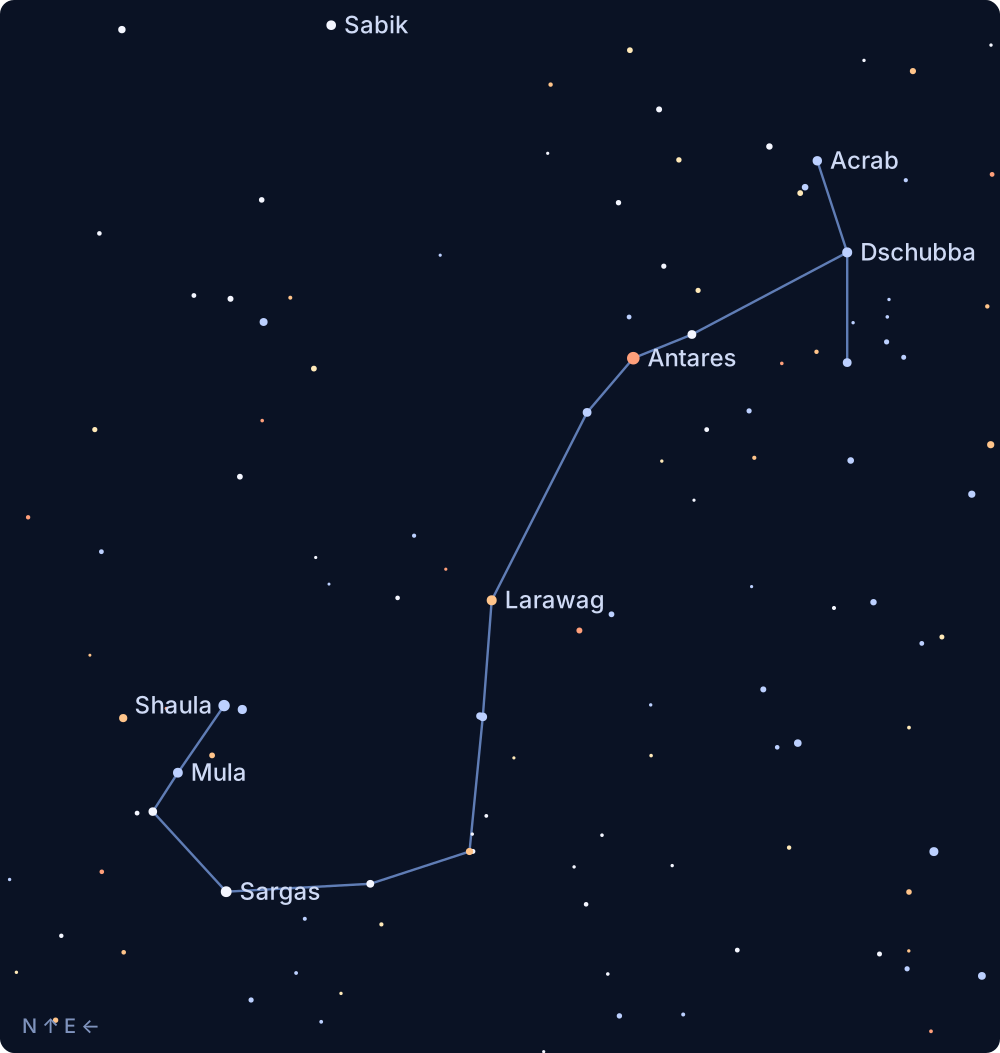
One of the few constellations that actually looks like what it is named for: a curving scorpion with a bright red heart and a long, hooked tail low in the southern summer sky.
- Best season
- Summer
- Best months
- June through August, low in the south on summer evenings
- Visibility
- Visible from the whole United States, but low in the south, so it is best seen from southern latitudes and from sites with a clear southern horizon
- Abbreviation
- Sco
How to find it
- Look low in the south on a summer evening for a bright, noticeably red star. That is Antares, the heart of the scorpion.
- A curved line of stars on either side of Antares forms the head and claws, and a long curve of stars trails down and hooks upward to form the tail and stinger.
- Because the tail dips toward the horizon, you need a clear view south to see the whole scorpion.
Brightest stars
- Antares (red supergiant, the scorpion's heart)
- Shaula and Lesath (the stinger)
- Acrab (also called Graffias) and Dschubba (the claws)
What to look for
- The red color of Antares, which is easy to see next to the nearby white and blue-white stars.
- The curve of the tail, ending in the pair of stars that mark the stinger.
Binocular and telescope targets
- M4: a globular cluster just beside Antares, visible in binoculars as a fuzzy patch
- M6 and M7: two bright open clusters near the stinger, visible to the naked eye from a dark site and excellent in binoculars
- The Milky Way: the brightest part of our galaxy rises nearby, in Sagittarius, just to the east
Using it to find other things
- Antares sits close to the ecliptic, the path of the Sun, Moon, and planets, so planets sometimes pass near it.
- To the east of Scorpius lies Sagittarius, the teapot, with the thickest part of the Milky Way rising above it.
About this constellation
Scorpius is one of the few constellations whose pattern really does resemble its name. The red star Antares marks the scorpion's heart, and the curving line of stars that sweeps down and around to the stinger makes an unmistakable tail.
The name Antares means roughly "rival of Mars," because its reddish color is similar to the planet's. It is a red supergiant, far larger than the Sun, and its color is one of the easiest to see with the naked eye.
From the northern United States, much of the tail stays low on the horizon, so you need a clear southern view. From a dark site in summer, the Milky Way rises right next to the scorpion, making this one of the most rewarding parts of the sky to scan with binoculars.
Related guides
Visibility depends on your latitude, the date, and the time of night. The months above assume a typical evening from the contiguous United States, so use a planetarium app to confirm what is up tonight. Never look at the Sun through binoculars or a telescope without a proper solar filter.
Star positions: Hipparcos and Bright Star catalogues via d3-celestial (BSD-3-Clause, © 2015 Olaf Frohn).