
Pisces
The Fishes
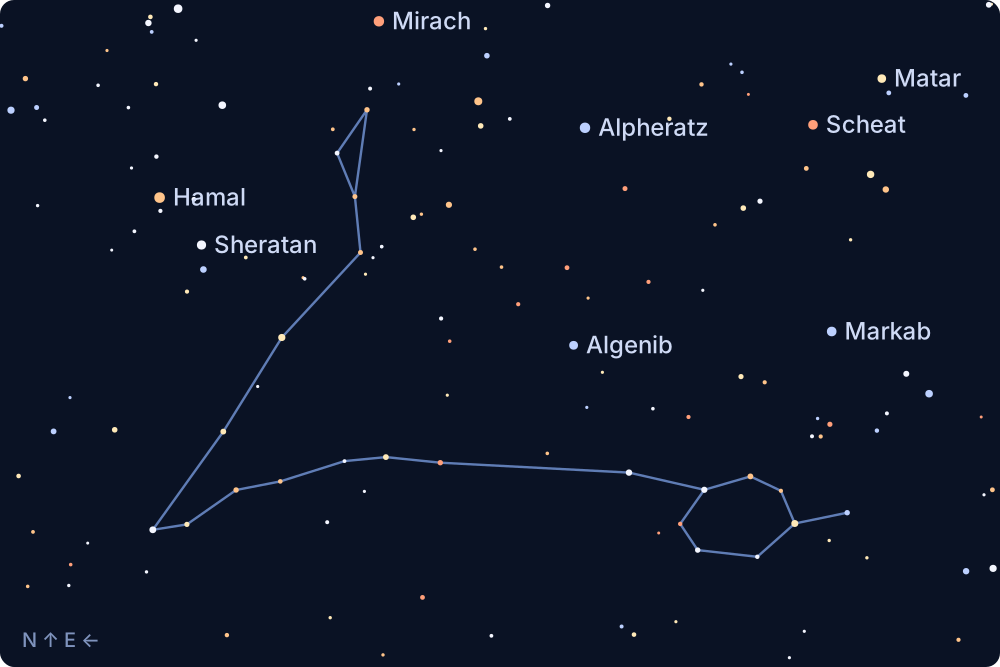
A faint, V-shaped autumn zodiac constellation with two fish tied by a cord, just south of the Great Square of Pegasus.
- Best season
- Autumn
- Best months
- September through December, in the south on autumn evenings
- Visibility
- Visible from everywhere in the United States, but too faint to see from bright cities
- Abbreviation
- Psc
How to find it
- Find the Great Square of Pegasus. A small ring of faint stars, the Circlet, hangs just below its southern side.
- A long, faint line of stars runs from the Circlet to the knot at Alrescha, and a second line rises from there toward Andromeda.
Brightest stars
- Alrescha (the knot where the cords meet)
- Eta Piscium
What to look for
- The Circlet of Pisces, a small ring of faint stars that stands out on a dark night.
Binocular and telescope targets
- M74: a faint face-on spiral galaxy, a challenge for small telescopes
Using it to find other things
- Pisces is the constellation that holds the Sun at the March equinox, as the Sun crosses the celestial equator.
About this constellation
Pisces is faint and spread out, so it demands a dark sky. The Circlet is the easiest part to find, and the two long lines of stars give the rest of the shape.
The Sun currently crosses the celestial equator, marking the start of spring in the Northern Hemisphere, while it is in Pisces. That spot is known as the vernal equinox.
Related guides
Visibility depends on your latitude, the date, and the time of night. The months above assume a typical evening from the contiguous United States, so use a planetarium app to confirm what is up tonight. Never look at the Sun through binoculars or a telescope without a proper solar filter.
Star positions: Hipparcos and Bright Star catalogues via d3-celestial (BSD-3-Clause, © 2015 Olaf Frohn).