
Pegasus
The Winged Horse
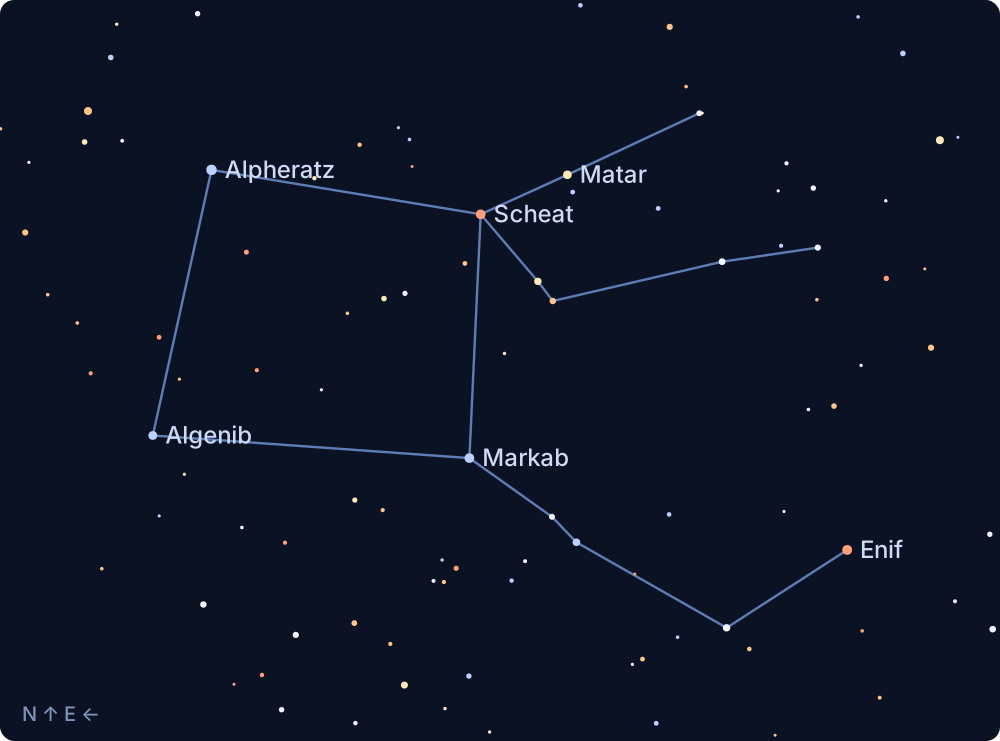
An autumn constellation whose Great Square is one of the easiest patterns to find, with the horse's neck and head extending toward Enif.
- Best season
- Autumn
- Best months
- September through November, high in the south on autumn evenings
- Visibility
- Visible from everywhere in the United States
- Abbreviation
- Peg
How to find it
- Look high in the south on an autumn evening for a large square of four stars, each about the same brightness. That is the Great Square.
- The horse's neck and head extend from one corner toward the southwest, ending at Enif.
Brightest stars
- Enif (orange, the horse's nose)
- Markab
- Scheat
- Algenib
What to look for
- How empty the inside of the Square looks. Counting the faint stars inside it is a classic test of sky darkness.
- Enif, the horse's orange nose.
Binocular and telescope targets
- M15: a bright globular cluster near Enif, visible in binoculars
Using it to find other things
- One corner of the Great Square, Alpheratz, is shared with Andromeda and leads toward the Andromeda Galaxy.
About this constellation
The Great Square is a beginner's signpost for the whole autumn sky. From it you can reach Andromeda, Pisces, and Aquarius.
Pegasus appears upside-down in the sky: the horse's body is the Square, and its neck and head extend below it.
Related guides
Visibility depends on your latitude, the date, and the time of night. The months above assume a typical evening from the contiguous United States, so use a planetarium app to confirm what is up tonight. Never look at the Sun through binoculars or a telescope without a proper solar filter.
Star positions: Hipparcos and Bright Star catalogues via d3-celestial (BSD-3-Clause, © 2015 Olaf Frohn).