
Orion
The Hunter
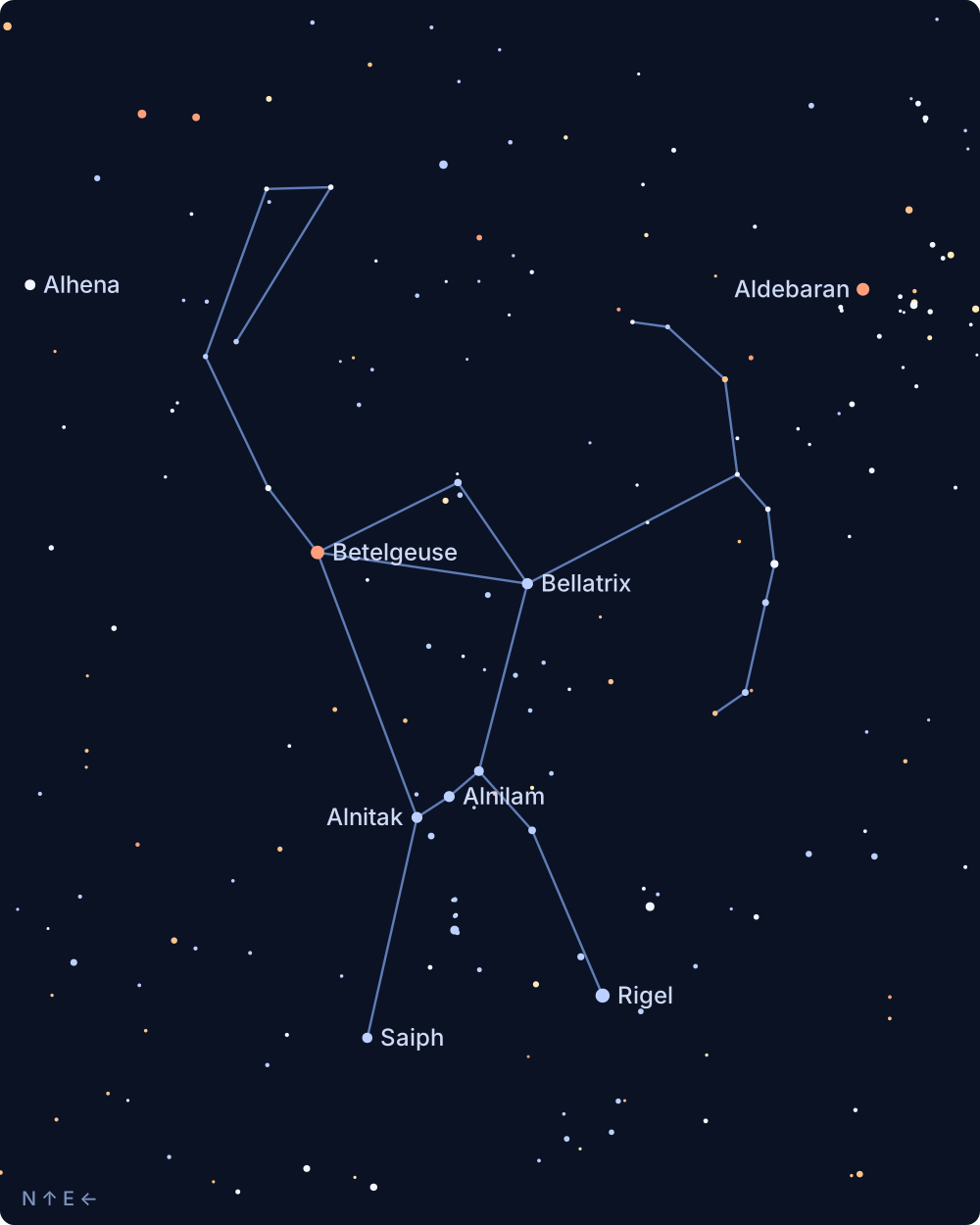
The brightest and easiest constellation to recognize: a hunter marked by a tight row of three belt stars, with a red giant at one shoulder and a blue-white supergiant at one foot.
- Best season
- Winter
- Best months
- December through March, high in the south on winter evenings
- Visibility
- Visible from everywhere in the United States, and from nearly everywhere on Earth
- Abbreviation
- Ori
How to find it
- Look south on a winter evening for three bright stars in a short, straight, evenly spaced row. That is Orion's belt.
- Two bright stars sit above the belt and two below, forming a large rectangle around it. The upper left is reddish Betelgeuse, and the lower right is blue-white Rigel.
- A short line of fainter stars hangs below the belt. That is Orion's sword.
Brightest stars
- Rigel (blue-white supergiant, the hunter's foot)
- Betelgeuse (red supergiant, the shoulder)
- Bellatrix
- Alnitak, Alnilam, and Mintaka (the belt)
What to look for
- The color difference between orange-red Betelgeuse and blue-white Rigel, which is easy to see with the naked eye.
- The fuzzy middle star in the sword: that is not a star but the Orion Nebula.
Binocular and telescope targets
- Orion Nebula (M42): a glowing cloud of gas where stars are forming, visible to the naked eye as a fuzzy patch in the sword and impressive in binoculars
- The Belt stars: three bright stars in a straight line, easy to spot even from a city
- Betelgeuse and Rigel: two of the brightest stars in the sky, with strongly contrasting colors
Using it to find other things
- Follow the belt down and to the left to reach Sirius, the brightest star in the night sky.
- Follow the belt up and to the right to reach Aldebaran, the orange eye of Taurus, and then the Pleiades star cluster.
About this constellation
Orion is the best place to start learning the sky. The belt is a compact, unmistakable line of three equally bright stars, and the surrounding stars form a figure big enough to take in at a glance. Once you can find Orion, you can use it as a signpost to Sirius, Aldebaran, and the Pleiades.
The two brightest stars of the figure are very different. Betelgeuse is a red supergiant so large that, if it replaced the Sun, it would swallow the orbits of the inner planets. Rigel is a hot blue-white supergiant. Looking at both through the same night sky is a neat lesson in how star color tracks temperature.
Orion is a winter constellation for evening viewers in the United States. In late summer it rises before dawn, and by spring it sinks into the west soon after dark.
Related guides
Visibility depends on your latitude, the date, and the time of night. The months above assume a typical evening from the contiguous United States, so use a planetarium app to confirm what is up tonight. Never look at the Sun through binoculars or a telescope without a proper solar filter.
Star positions: Hipparcos and Bright Star catalogues via d3-celestial (BSD-3-Clause, © 2015 Olaf Frohn).