
Ophiuchus
The Serpent Bearer
A large summer constellation straddling the celestial equator, with the Sun passing through it for about two weeks each December, and Barnard's Star, one of our closest neighbors.
- Best season
- Summer
- Best months
- June through August, in the south on summer evenings
- Visibility
- Visible from everywhere in the United States, though the lower part stays low in the south
- Abbreviation
- Oph
How to find it
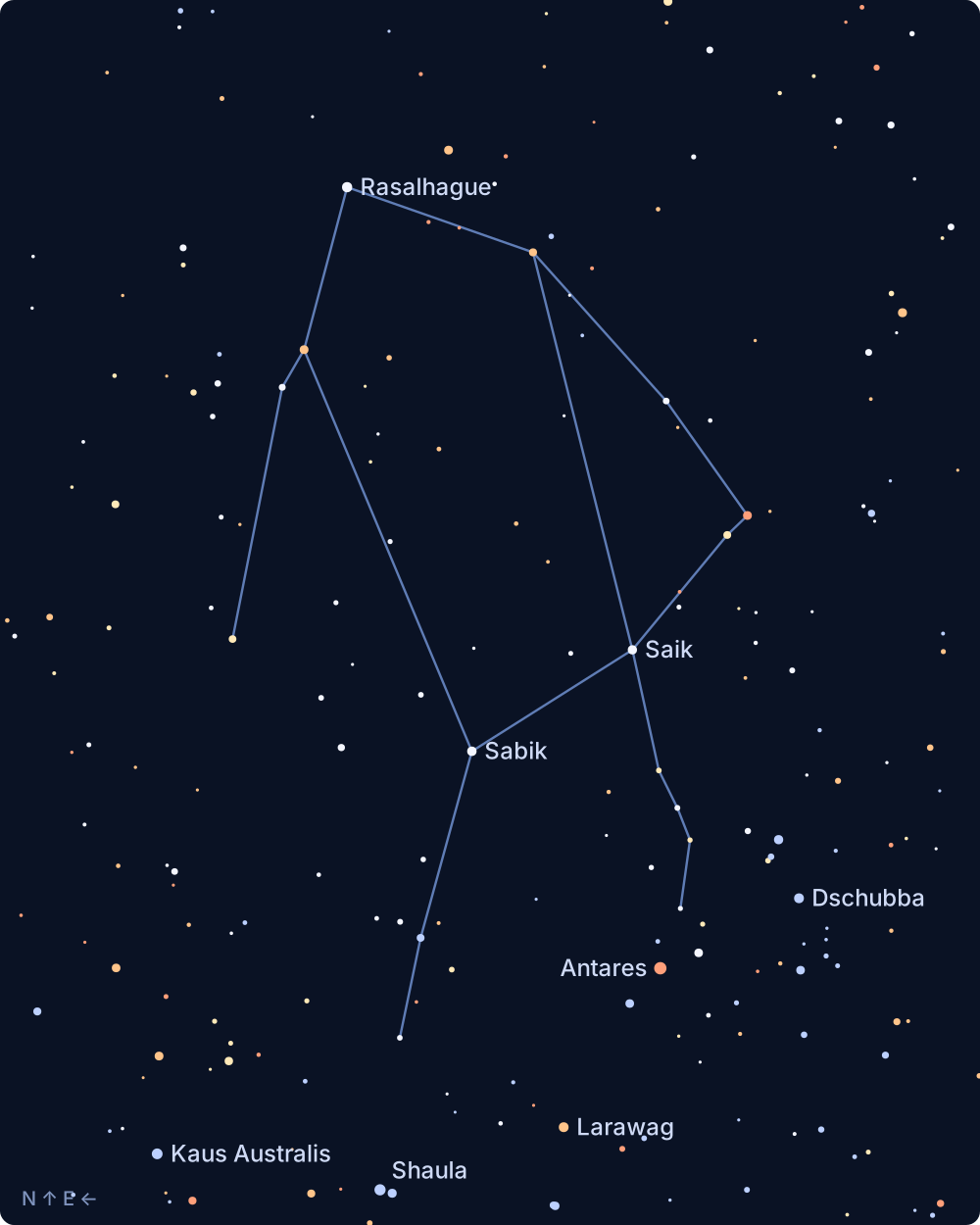
- Look for Rasalhague, a modestly bright star near Hercules's head star Rasalgethi. Together they mark the two heads.
- From Rasalhague a large, roughly kite-shaped figure stretches south toward Scorpius, with the bearer's feet resting near Antares.
Brightest stars
- Rasalhague (the head of the Serpent Bearer)
- Sabik
- Cebalrai
- Han
What to look for
- The size of the figure. It covers a big stretch of the summer sky between Hercules and Scorpius.
- M10 and M12, two globular clusters visible as fuzzy patches in binoculars.
Binocular and telescope targets
- M10 and M12: two bright globular clusters, visible in binoculars
- Barnard's Star: a faint red dwarf only about six light-years away, which needs a telescope and a good chart
- Kepler's Supernova remnant: the remains of a star seen exploding in 1604
Using it to find other things
- Ophiuchus sits between Hercules and Scorpius. The serpent Serpens is split into two parts, one on each side of the Bearer.
About this constellation
Ophiuchus is a big constellation with no really bright stars, so it takes a dark sky to trace the whole figure. The best way in is Rasalhague, which sits close to Hercules's head star.
The Sun passes through Ophiuchus from about November 30 to December 17, but it is not one of the traditional twelve zodiac signs. That makes it a popular trivia question.
Barnard's Star in Ophiuchus is one of the nearest stars to the Sun and has the largest apparent motion across the sky of any star. It is too faint to see without a telescope.
Related guides
Visibility depends on your latitude, the date, and the time of night. The months above assume a typical evening from the contiguous United States, so use a planetarium app to confirm what is up tonight. Never look at the Sun through binoculars or a telescope without a proper solar filter.
Star positions: Hipparcos and Bright Star catalogues via d3-celestial (BSD-3-Clause, © 2015 Olaf Frohn).