
Monoceros
The Unicorn
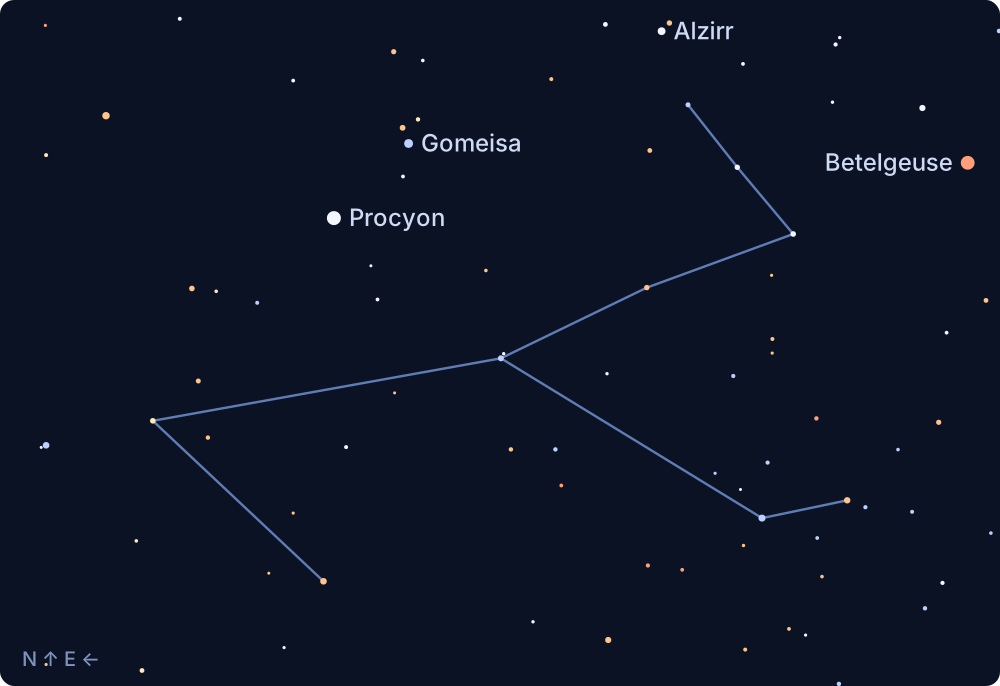
A faint winter constellation that fills the middle of the Winter Triangle, rich in star clusters and nebulae along the winter Milky Way.
- Best season
- Winter
- Best months
- December through March, high in the south on winter evenings
- Visibility
- Visible from everywhere in the United States, best from dark sites
- Abbreviation
- Mon
How to find it
- Find the Winter Triangle of Betelgeuse, Sirius, and Procyon. Monoceros is the faint region in the middle.
Brightest stars
- Beta Monocerotis (a striking triple star in small telescopes)
- Alpha Monocerotis
What to look for
- The Christmas Tree Cluster in binoculars as a triangular group of stars.
Binocular and telescope targets
- Rosette Nebula: a large glowing cloud around a star cluster, best in a dark sky with binoculars or a wide-field telescope
- Christmas Tree Cluster and Cone Nebula: a cluster shaped like a tree, in binoculars
- M50: a heart-shaped open cluster
- Beta Monocerotis: a beautiful triple star in a small telescope
Using it to find other things
- Monoceros sits inside the Winter Triangle, between Orion and Canis Major.
About this constellation
Monoceros has no bright stars, but it lies along the winter Milky Way and holds many clusters and glowing clouds of gas.
On a dark night, sweep binoculars across the middle of the Winter Triangle.
Related guides
Visibility depends on your latitude, the date, and the time of night. The months above assume a typical evening from the contiguous United States, so use a planetarium app to confirm what is up tonight. Never look at the Sun through binoculars or a telescope without a proper solar filter.
Star positions: Hipparcos and Bright Star catalogues via d3-celestial (BSD-3-Clause, © 2015 Olaf Frohn).