
Hydra
The Water Snake
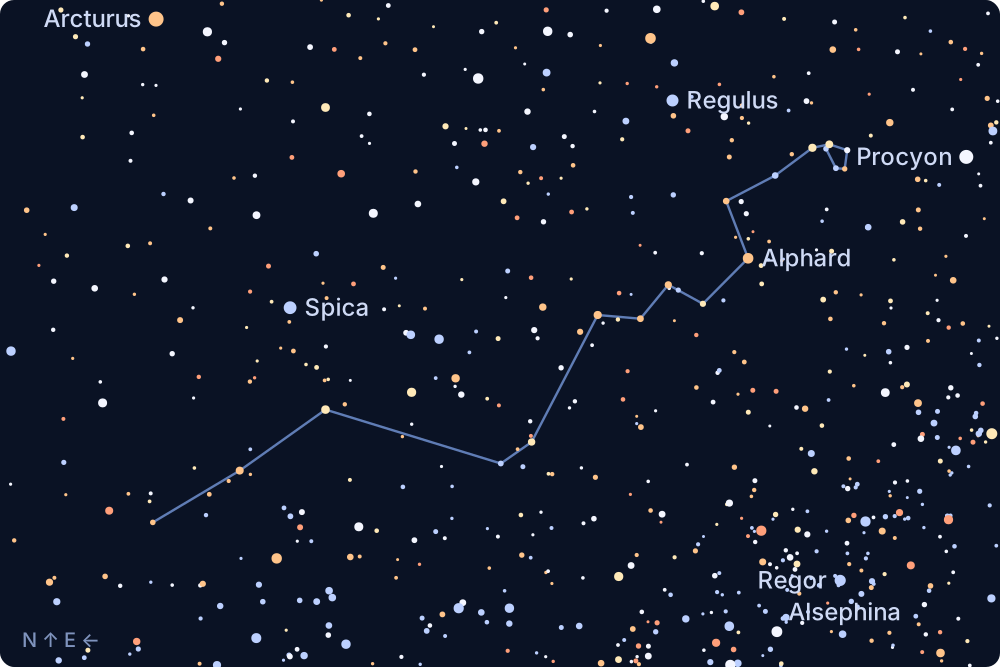
The largest constellation in the sky, a long chain of faint stars that stretches from below Cancer to near Libra, with orange Alphard in the middle.
- Best season
- Spring
- Best months
- February through May, low in the south on late winter and spring evenings
- Visibility
- Visible from the United States, though much of its length stays low in the south
- Abbreviation
- Hya
How to find it
- Look south of Cancer for the Hydra's head, a small ring of faint stars.
- From there, follow a long, winding line of faint stars that stretches south of Leo and Virgo. Alphard is the one bright star standing alone in that stretch.
Brightest stars
- Alphard (an orange giant, the heart of the Water Snake)
What to look for
- Alphard, whose name means 'the solitary one,' for how isolated it looks in an empty region of sky.
Binocular and telescope targets
- M48: an open cluster visible in binoculars
- M83: a bright spiral galaxy, best from southern states
Using it to find other things
- Hydra stretches below Cancer, Leo, and Virgo.
About this constellation
Hydra is the largest of the 88 constellations. Its length is its main feature, and it takes patience to follow the whole thing.
The easiest part to recognize is Alphard, which stands alone in a patch of sky with few other bright stars.
Related guides
Visibility depends on your latitude, the date, and the time of night. The months above assume a typical evening from the contiguous United States, so use a planetarium app to confirm what is up tonight. Never look at the Sun through binoculars or a telescope without a proper solar filter.
Star positions: Hipparcos and Bright Star catalogues via d3-celestial (BSD-3-Clause, © 2015 Olaf Frohn).