
Draco
The Dragon
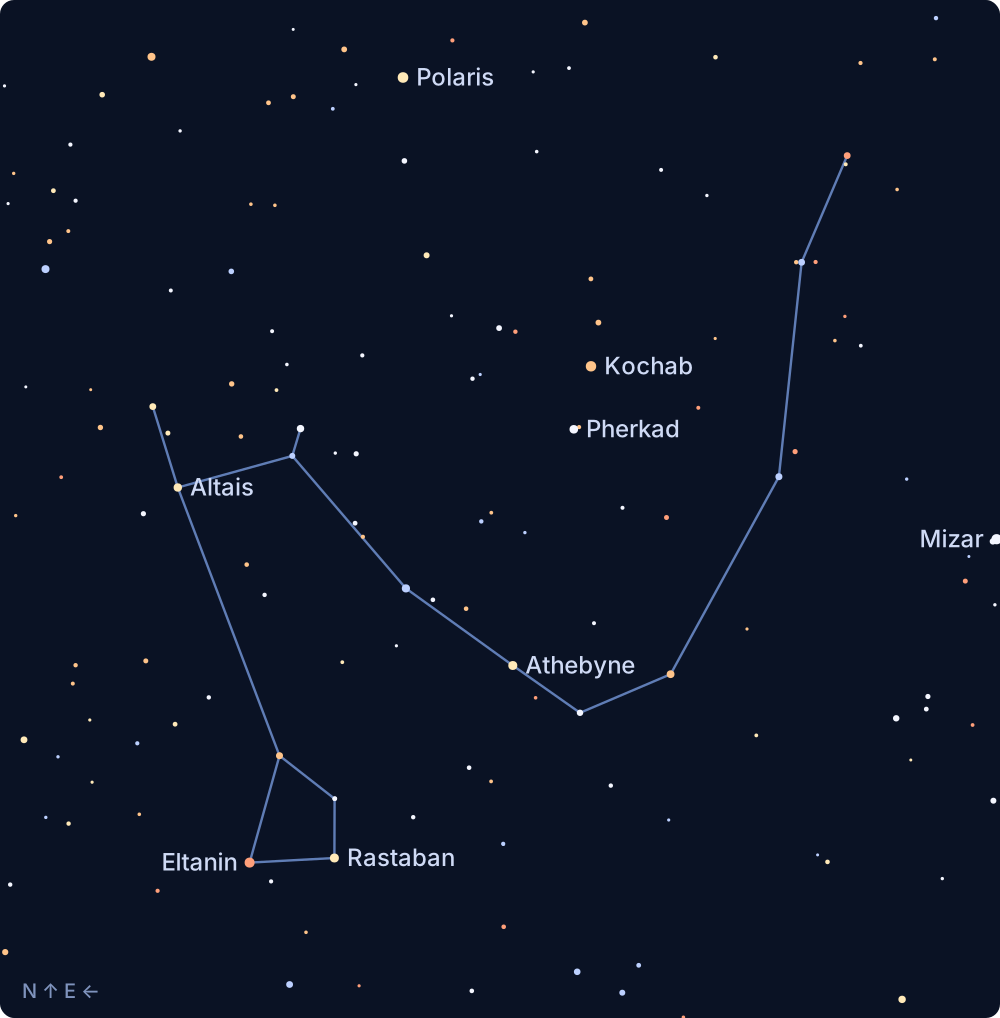
A long, winding circumpolar constellation that curls between the Big and Little Dippers, ending in a lopsided head near Vega.
- Best season
- Summer
- Best months
- Visible all year in the north, best on summer evenings
- Visibility
- Most of the constellation stays above the horizon all night from the northern United States
- Abbreviation
- Dra
How to find it
- Look north of Vega for a lopsided four-sided figure, the dragon's head, led by Eltanin and Rastaban.
- From the head, a long chain of faint stars winds between the Big Dipper and the Little Dipper, ending in a tail.
Brightest stars
- Eltanin (an orange giant, in the dragon's head)
- Rastaban (also in the head)
- Thuban (the north star of ancient Egypt)
What to look for
- The dragon's head, which makes a compact figure of four stars.
- How the line of the tail curves around the Little Dipper.
Binocular and telescope targets
- Cat's Eye Nebula (NGC 6543): a bright planetary nebula, small and bluish in a telescope
Using it to find other things
- Draco's head sits near Vega and Hercules; its tail winds between the Big and Little Dippers.
About this constellation
Draco has few bright stars, so it takes a dark night and a patient eye to trace the whole dragon. The head is easy, and the winding body is the reward for a clear sky.
About 4,800 years ago, a star in Draco named Thuban was closest to the north celestial pole, making it the north star in the time of the pyramid builders. Earth's axis slowly wobbles, so the pole star changes over thousands of years.
Related guides
Visibility depends on your latitude, the date, and the time of night. The months above assume a typical evening from the contiguous United States, so use a planetarium app to confirm what is up tonight. Never look at the Sun through binoculars or a telescope without a proper solar filter.
Star positions: Hipparcos and Bright Star catalogues via d3-celestial (BSD-3-Clause, © 2015 Olaf Frohn).