
Coma Berenices
Berenice's Hair
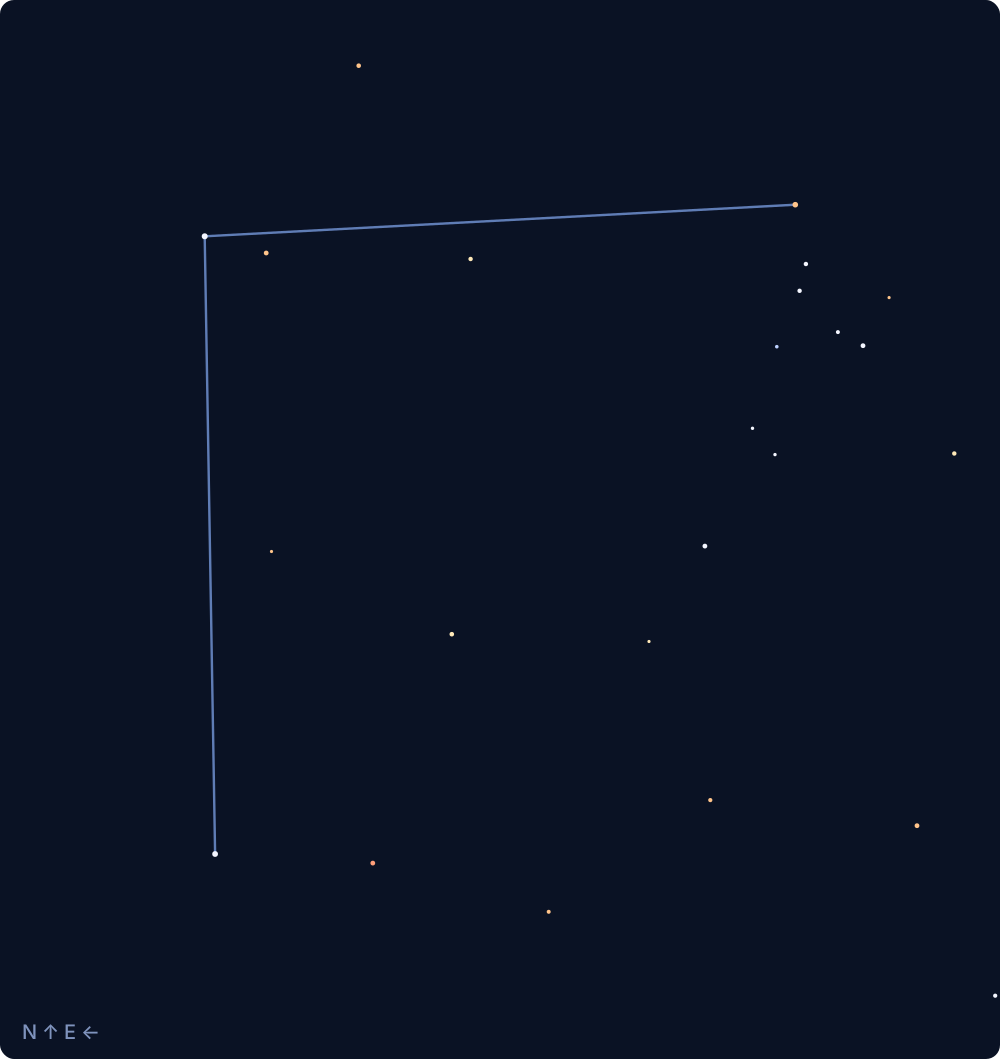
A faint spring constellation that is best known for the Coma Star Cluster, a large, loose cluster of stars visible to the naked eye in a dark sky.
- Best season
- Spring
- Best months
- April through June, high in the sky on spring evenings
- Visibility
- Visible from everywhere in the United States, best from dark sites
- Abbreviation
- Com
How to find it
- Look midway between Denebola in Leo and Arcturus in Boötes for a hazy patch in a dark sky.
- Binoculars show it as a spray of stars.
Brightest stars
- Beta Comae Berenices
- Alpha Comae Berenices
What to look for
- The Coma Star Cluster, a loose cluster that looks like a hazy patch to the naked eye in a dark sky and a spray of stars in binoculars.
Binocular and telescope targets
- Coma Star Cluster (Melotte 111): a large, loose cluster, best in binoculars
- Black Eye Galaxy (M64): a bright spiral galaxy with a dark dust lane
- Needle Galaxy (NGC 4565): a galaxy seen edge-on, a favorite for telescopes
Using it to find other things
- Coma Berenices lies between Leo and Boötes, below Canes Venatici.
About this constellation
Coma Berenices is a small, faint constellation with a big attraction: the Coma Star Cluster, which looks best in binoculars from a dark site.
It also lies in the direction of the north galactic pole, which means we look out of the Milky Way's disk and see many distant galaxies.
Related guides
Visibility depends on your latitude, the date, and the time of night. The months above assume a typical evening from the contiguous United States, so use a planetarium app to confirm what is up tonight. Never look at the Sun through binoculars or a telescope without a proper solar filter.
Star positions: Hipparcos and Bright Star catalogues via d3-celestial (BSD-3-Clause, © 2015 Olaf Frohn).