
Cassiopeia
The Queen
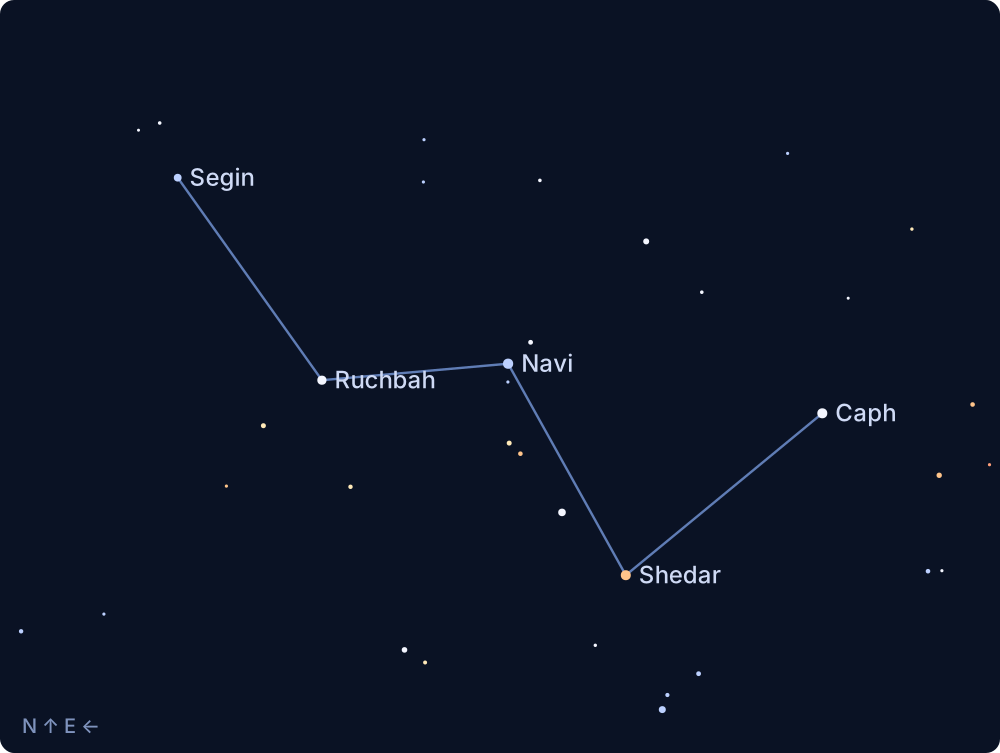
A bright, zigzag 'W' of five stars that circles the North Star opposite the Big Dipper, and the easiest way to find your way around the northern sky in autumn.
- Best season
- Autumn
- Best months
- September through December, high in the northeast to north on autumn evenings; visible in the north at other times
- Visibility
- Visible from across the United States, and above the horizon all night, all year, from all but the far southern states
- Abbreviation
- Cas
How to find it
- Look north and a little east on an autumn evening for five fairly bright stars in a zigzag shaped like a W, or an M when it is upside down.
- Cassiopeia and the Big Dipper sit on opposite sides of Polaris, so when one is high the other is low.
- The W lies in the band of the Milky Way, so from a dark site the stars around it look dense and glowing.
Brightest stars
- Schedar
- Caph
- Gamma Cassiopeiae (the center of the W)
What to look for
- How the W turns into an M as the night goes on and as the seasons change.
- The rich star fields around the constellation, which are especially striking in binoculars.
Binocular and telescope targets
- The Double Cluster (between Cassiopeia and Perseus): two clusters of stars side by side, visible to the naked eye as a hazy patch and spectacular in binoculars
- M52 and the other open clusters scattered through the constellation, easy targets for binoculars
- The surrounding Milky Way: dense star fields that reward slow sweeps with binoculars
Using it to find other things
- Polaris sits roughly halfway between Cassiopeia and the Big Dipper.
- A line from Cassiopeia through Polaris continues to the Big Dipper on the other side of the pole.
About this constellation
Cassiopeia is the other half of a useful pair. The Big Dipper and the W of Cassiopeia sit on opposite sides of the North Star, circling it like two seats on a slow carousel. Between them, one of the two is almost always high enough to find, which makes them a reliable way to orient yourself on any clear night.
The W is easy to spot because its five stars are of similar brightness and form a clean, angular shape. It also lies along the Milky Way, so a quick sweep with binoculars nearby reveals more stars than you expect.
If you can find Cassiopeia, you can find Polaris and, from there, north. It is a handy piece of knowledge for night hiking and camping.
Related guides
Visibility depends on your latitude, the date, and the time of night. The months above assume a typical evening from the contiguous United States, so use a planetarium app to confirm what is up tonight. Never look at the Sun through binoculars or a telescope without a proper solar filter.
Star positions: Hipparcos and Bright Star catalogues via d3-celestial (BSD-3-Clause, © 2015 Olaf Frohn).