
Camelopardalis
The Giraffe
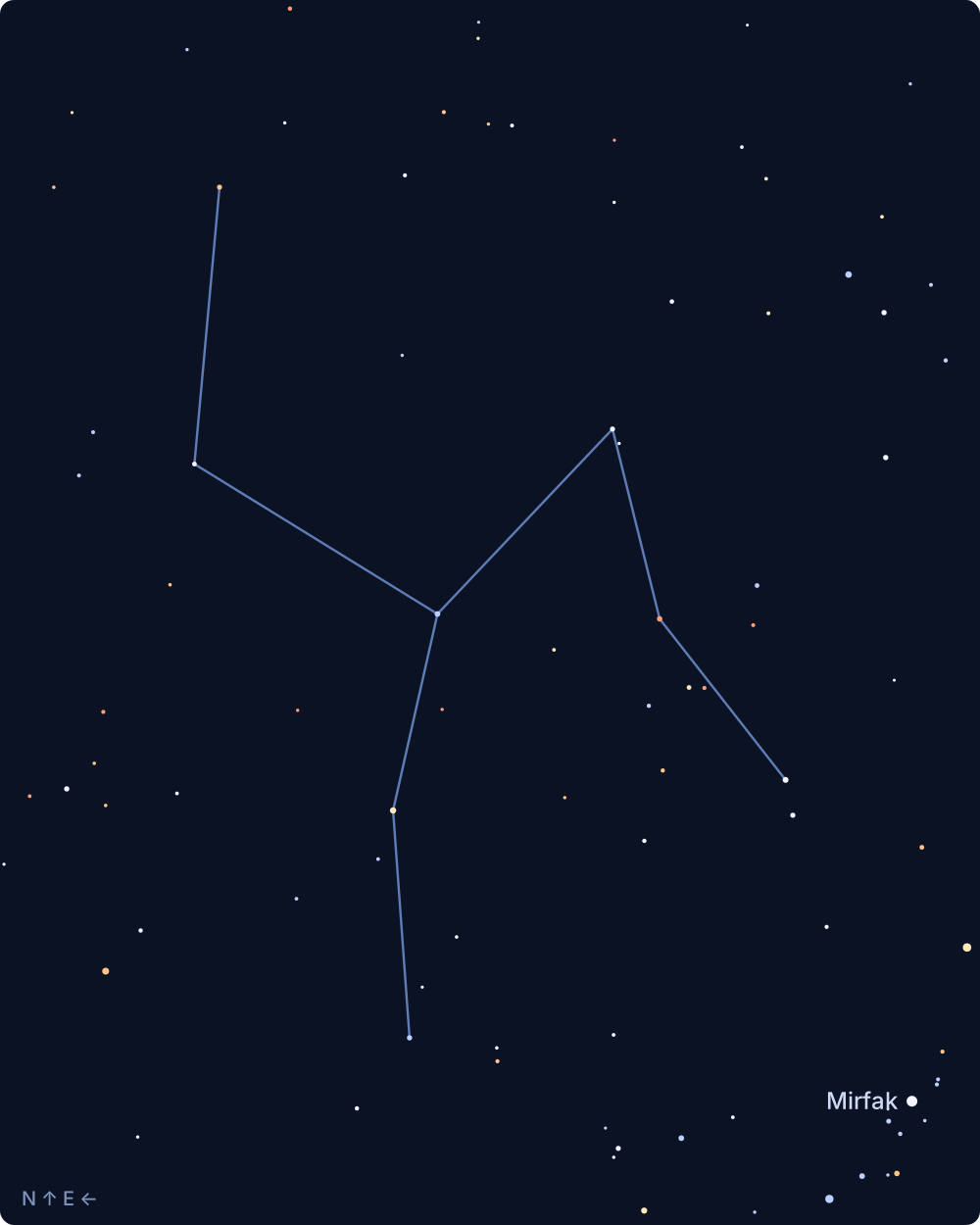
A large, very faint circumpolar constellation between Cassiopeia and the Big Dipper, home to the stream of stars called Kemble's Cascade.
- Best season
- Winter
- Best months
- Visible all year in the north, highest on winter evenings
- Visibility
- Most of the constellation stays above the horizon all night from the northern United States; too faint to see from towns
- Abbreviation
- Cam
How to find it
- Look in the empty region between Cassiopeia, Perseus, and the Big Dipper, near Polaris. That dim, star-poor region is Camelopardalis.
- In binoculars, look for a straight chain of stars called Kemble's Cascade.
Brightest stars
- Beta Camelopardalis
- Alpha Camelopardalis
What to look for
- Kemble's Cascade, a chain of faint stars in a line that ends at a small open cluster, NGC 1502, visible in binoculars.
Binocular and telescope targets
- Kemble's Cascade: a long straight chain of faint stars, spectacular in binoculars
- NGC 1502: a small open cluster at the end of the Cascade
Using it to find other things
- Camelopardalis lies between Cassiopeia and Perseus on one side and the Big Dipper on the other.
About this constellation
Camelopardalis is one of the faintest large constellations. Its stars are dim, so it is better known for the gaps than for its pattern.
Kemble's Cascade is a long chain of faint stars that looks like a stream pouring down the sky. It is named for the Canadian amateur astronomer Lucian Kemble, who described it in binoculars.
Related guides
Visibility depends on your latitude, the date, and the time of night. The months above assume a typical evening from the contiguous United States, so use a planetarium app to confirm what is up tonight. Never look at the Sun through binoculars or a telescope without a proper solar filter.
Star positions: Hipparcos and Bright Star catalogues via d3-celestial (BSD-3-Clause, © 2015 Olaf Frohn).