
Boötes
The Herdsman
A spring constellation shaped like a kite or ice-cream cone, led by orange Arcturus, the brightest star in the northern sky.
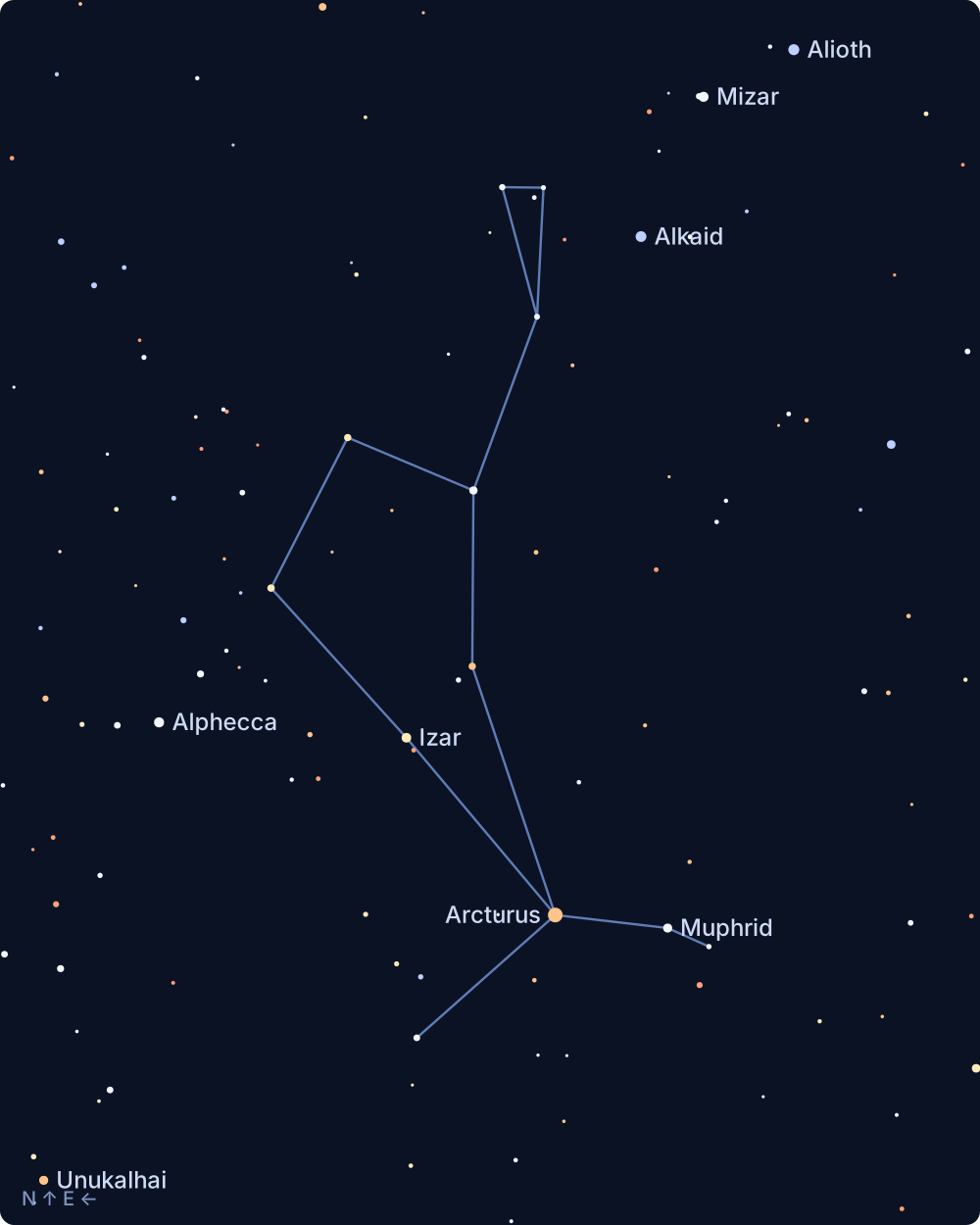
- Best season
- Spring
- Best months
- April through August, high in the east to overhead on spring evenings
- Visibility
- Visible from everywhere in the United States
- Abbreviation
- Boo
How to find it
- Follow the curve of the Big Dipper's handle away from the bowl. The arc leads to Arcturus, a bright orange star.
- From Arcturus, a kite shape of stars stretches back toward the Dipper.
Brightest stars
- Arcturus (orange giant, brightest star north of the celestial equator)
- Izar (a colorful double star)
- Muphrid
What to look for
- Arcturus's orange color, easy to see even in a bright sky.
- The kite shape, with Arcturus at its bottom.
Binocular and telescope targets
- Izar: a colorful double star, orange and blue-white, in a small telescope
Using it to find other things
- Arc to Arcturus, speed to Spica: the Big Dipper's handle leads to Arcturus, then Spica in Virgo.
- Corona Borealis lies just east of the kite.
About this constellation
Boötes is simple to locate because of the famous arc: follow the handle of the Big Dipper and you reach Arcturus. It is the fourth-brightest star in the whole sky.
The Quadrantid meteor shower, one of the strongest of the year, appears to come from near Boötes in early January.
Related guides
Visibility depends on your latitude, the date, and the time of night. The months above assume a typical evening from the contiguous United States, so use a planetarium app to confirm what is up tonight. Never look at the Sun through binoculars or a telescope without a proper solar filter.
Star positions: Hipparcos and Bright Star catalogues via d3-celestial (BSD-3-Clause, © 2015 Olaf Frohn).