
Aries
The Ram
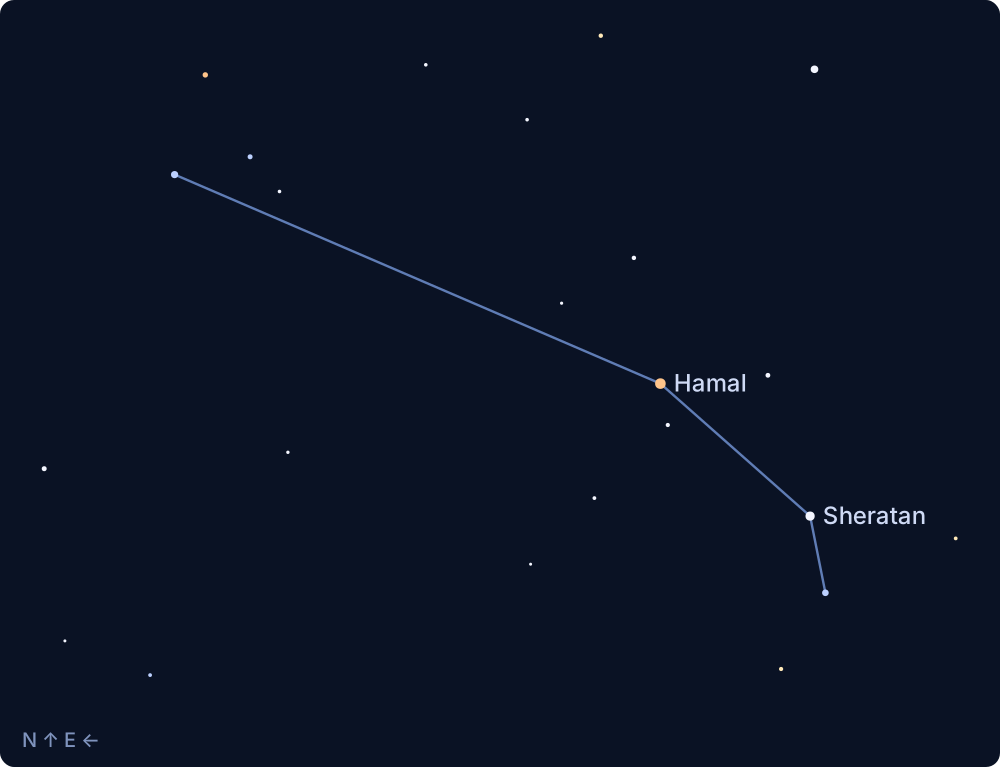
A small, faint zodiac constellation made of a short bent line of stars, led by orange Hamal. Easy to find once you know it sits between Pegasus and the Pleiades.
- Best season
- Autumn
- Best months
- October through January, high in the south on autumn evenings
- Visibility
- Visible from everywhere in the United States
- Abbreviation
- Ari
How to find it
- Find the Pleiades, the small misty dipper-shaped cluster in Taurus, then look to the right for a short, slightly bent line of stars.
- Hamal is the brightest of them and the only one you can count on seeing from a suburb. Sheratan sits just next to it, and fainter Mesarthim completes the line.
- On a dark night, the faint stars between Aries and the Great Square of Pegasus fill in the rest of the figure.
Brightest stars
- Hamal (orange giant, the brightest star of the Ram)
- Sheratan
- Mesarthim (a close double star in small telescopes)
What to look for
- The orange tint of Hamal compared with its paler neighbors.
- How compact the pattern is. The three main stars fit inside roughly the width of your fist held at arm's length.
Binocular and telescope targets
- Mesarthim: a close double star that splits into two equal white stars in a small telescope
Using it to find other things
- Aries lies next to Taurus on the Pleiades side, so once you have the Pleiades you can walk straight over to Hamal.
About this constellation
Aries is one of the faintest of the zodiac constellations, but it is worth finding because the Sun, Moon, and planets all pass through the zodiac. When a bright planet sits near Hamal, you get an easy marker for the path they all follow.
Its three main stars form a short, slightly bent line. Hamal, the brightest, is an orange giant star; Sheratan and Mesarthim are white. Aries has few showpiece objects, so think of it as a signpost rather than a destination.
Related guides
Visibility depends on your latitude, the date, and the time of night. The months above assume a typical evening from the contiguous United States, so use a planetarium app to confirm what is up tonight. Never look at the Sun through binoculars or a telescope without a proper solar filter.
Star positions: Hipparcos and Bright Star catalogues via d3-celestial (BSD-3-Clause, © 2015 Olaf Frohn).