
Map Symbols and Legend
Also called: map legend, topo symbols, map colors, map key
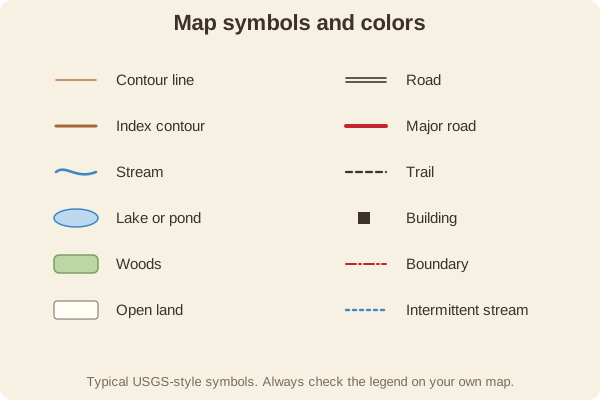
Colors and small symbols on a map stand for roads, water, woods, buildings, and trails. The legend explains the ones on your sheet.
- Type
- Maps & Grids
- Typical USGS-style colors
- Black for man-made features, blue for water, green for woods, brown for contours, white for open land, red for major roads and boundaries
- Common symbols
- Dashed lines for trails, solid lines for roads, small squares for buildings, dotted lines for intermittent streams
- Where to look
- The map's legend, or the agency's symbol sheet
- Used for
- Hiking & camping, Hunting, Fishing & boating
What it is good for
- Telling a trail from a road and a stream from a canal.
- Spotting water sources, fences, and gates before a trip.
Where it falls short
- Symbols differ between map makers, so check each map's own legend.
- A feature drawn on the map may be gone, and new ones may be missing.
Tips
- Look at the legend before you leave, not at the trailhead.
- Learn the symbols for a spring, a gate, a cliff, and a trail, since those matter most.
Works well with
- Topographic Map: where these symbols appear.
- Plat Maps and Land Ownership: shows boundaries that topo maps may not.
Field notes
On classic USGS maps the colors carry meaning, so even a quick glance can tell you where the woods, water, and roads are. Newer digital maps and agency maps use their own styles, so always check the key.
Related guides
Numbers here are typical, and values such as magnetic declination change over time and place, so check a current source such as NOAA or your map's legend. Practice near home before you rely on a skill far from help, carry a paper map and compass as a backup, and tell someone your plan. Rules on electronics, land access, and trespass differ by state; our state resources directory links to each state's official regulations. Want a step-by-step guide? Read Trail Navigation Basics.