
Cygnus
The Swan
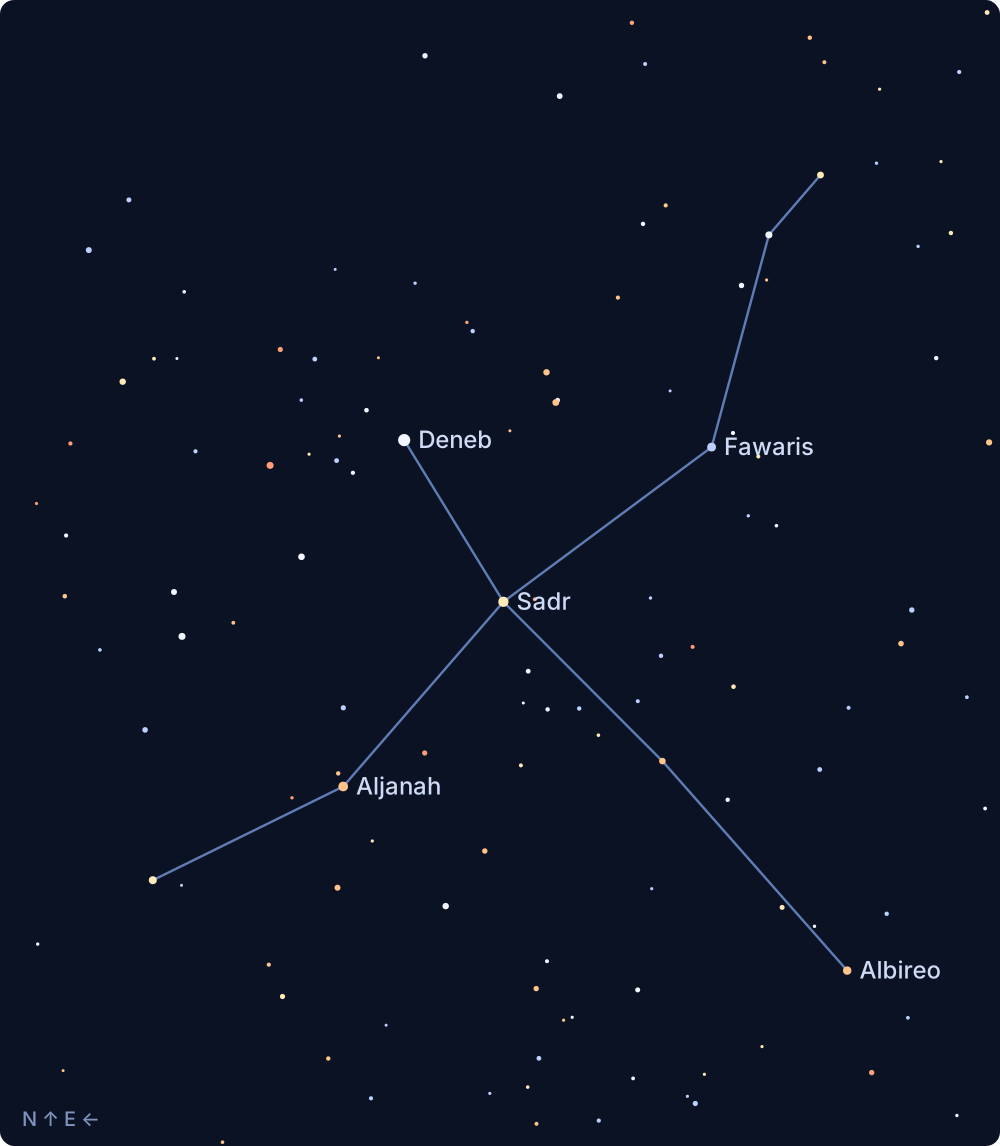
A summer constellation shaped like a large cross, flying along the Milky Way, with Deneb at the tail and the colorful double star Albireo at the beak.
- Best season
- Summer
- Best months
- June through November, high overhead on summer and early autumn evenings
- Visibility
- Visible from everywhere in the United States
- Abbreviation
- Cyg
How to find it
- Find Deneb, the bright star at one corner of the Summer Triangle with Vega and Altair.
- From Deneb, a straight line of stars runs down the swan's neck to Albireo, crossed by a shorter line forming the wings.
Brightest stars
- Deneb (the tail, one of the most distant bright stars)
- Sadr (the center of the cross)
- Albireo (the beak, a colorful double star)
What to look for
- The Milky Way flowing through Cygnus on a dark night, split by dark lanes.
- Albireo's two stars, one golden and one blue, in a small telescope.
Binocular and telescope targets
- Albireo: a gold-and-blue double star, one of the finest in the sky for small telescopes
- North America Nebula: a large glowing cloud visible from a very dark site
- Veil Nebula: the remains of an exploded star, a delicate arc best seen with a filter
- Cygnus Rift: dark dust lanes that split the Milky Way
Using it to find other things
- Deneb is one corner of the Summer Triangle, with Vega in Lyra and Altair in Aquila.
About this constellation
Cygnus is one of the easiest summer constellations because it makes a large, clear cross, sometimes called the Northern Cross. Deneb marks the tail.
Deneb is well over a thousand light-years away, which means it is intrinsically one of the most luminous stars visible to the naked eye. The Milky Way passes through the swan, making it a rich area for binoculars.
Related guides
Visibility depends on your latitude, the date, and the time of night. The months above assume a typical evening from the contiguous United States, so use a planetarium app to confirm what is up tonight. Never look at the Sun through binoculars or a telescope without a proper solar filter.
Star positions: Hipparcos and Bright Star catalogues via d3-celestial (BSD-3-Clause, © 2015 Olaf Frohn).