
Cetus
The Whale
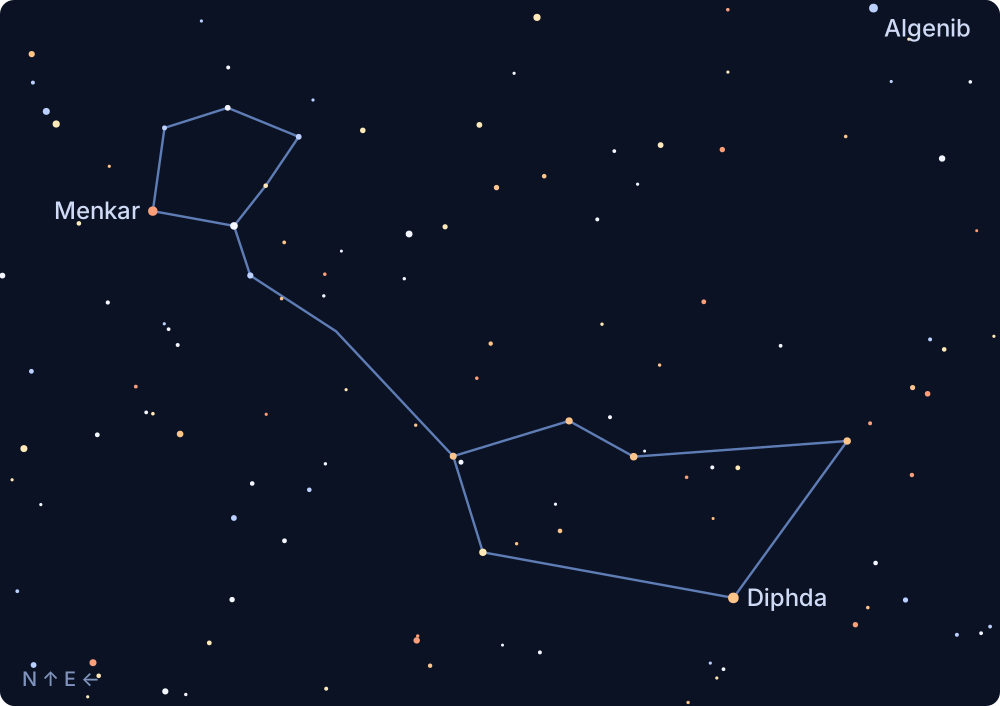
A large, faint autumn constellation of the Whale, home to Mira, a star that rises and falls in brightness over about eleven months.
- Best season
- Autumn
- Best months
- October through December, low in the south on autumn evenings
- Visibility
- Visible from the United States, low in the south
- Abbreviation
- Cet
How to find it
- Extend the eastern side of the Great Square of Pegasus south, roughly toward Diphda, a moderately bright star in an empty region.
- A circlet of stars forms the whale's head, to the east, with Menkar at one end.
Brightest stars
- Diphda (also called Deneb Kaitos, the tail)
- Menkar (the nose)
- Mira (a famous variable star)
What to look for
- Mira, which at its brightest is a naked-eye star and fades out of naked-eye view for months.
Binocular and telescope targets
- Mira (Omicron Ceti): a red giant star that varies in brightness over a cycle of about 332 days
- M77: a bright spiral galaxy, visible in a small telescope
Using it to find other things
- Cetus lies south of Pisces and Aries. Diphda is the main landmark.
About this constellation
Cetus is large and faint, so the best starting point is Diphda or the circlet of the whale's head.
Mira, whose name means 'wonderful,' was one of the first stars recognized to change in brightness. At its best it is easy to see, and a few months later it can be invisible without a telescope. Check a current chart for when it will peak.
Related guides
Visibility depends on your latitude, the date, and the time of night. The months above assume a typical evening from the contiguous United States, so use a planetarium app to confirm what is up tonight. Never look at the Sun through binoculars or a telescope without a proper solar filter.
Star positions: Hipparcos and Bright Star catalogues via d3-celestial (BSD-3-Clause, © 2015 Olaf Frohn).