
Centaurus
The Centaur
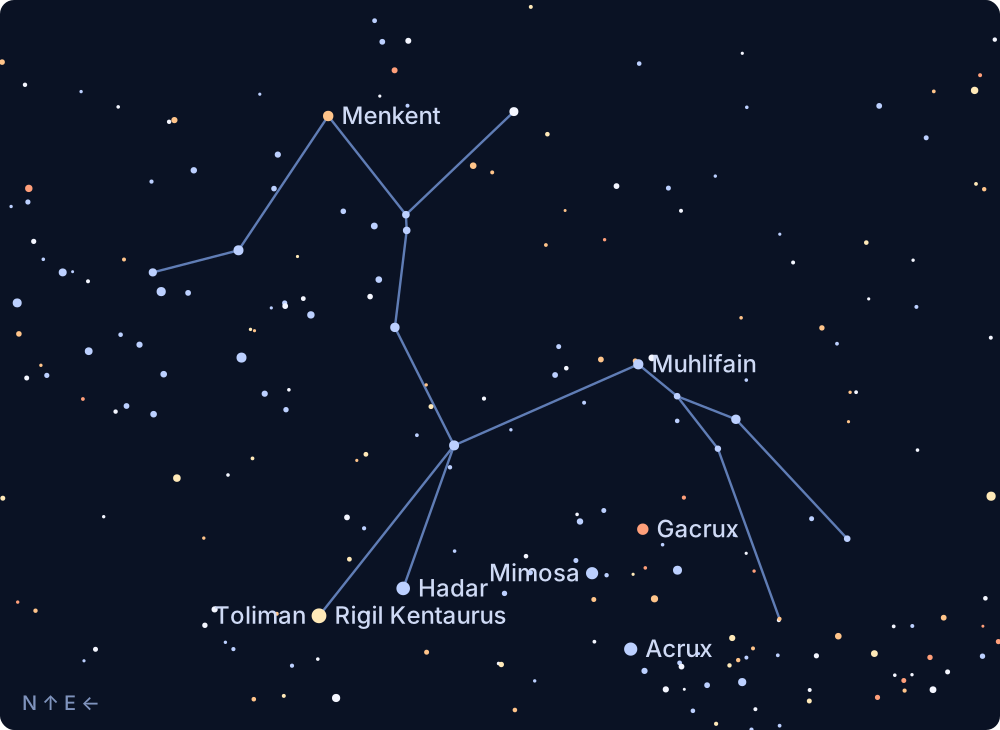
A large, bright constellation of the southern sky, home to Alpha Centauri, the nearest star system to the Sun, and Omega Centauri, the biggest globular cluster. Only the northern part is visible from most of the United States.
- Best season
- Spring
- Best months
- April through June, low in the south on spring evenings
- Visibility
- Only the northern part is visible from most of the United States, low in the south; the brightest stars, Alpha and Beta Centauri, are visible only from the far southern states
- Abbreviation
- Cen
How to find it
- Look low in the south on a spring evening, below Hydra and Virgo, for Menkent, a moderately bright orange star.
- From the far southern states, look for the two brilliant 'Pointer' stars, Alpha and Beta Centauri, which point toward the Southern Cross.
Brightest stars
- Alpha Centauri (Rigil Kentaurus, the nearest bright star, visible only from the far south)
- Hadar (Beta Centauri)
- Menkent (visible low from much of the United States)
What to look for
- Omega Centauri, a glowing globular cluster visible from the far southern states as a fuzzy star
Binocular and telescope targets
- Omega Centauri: the largest globular cluster in the sky, visible from the far southern states
- Alpha Centauri: the nearest star system to our Sun, visible from the far southern states
- Centaurus A: a bright galaxy, best from southern latitudes
Using it to find other things
- The two bright stars Alpha and Beta Centauri point toward the Southern Cross, Crux.
About this constellation
Centaurus is a huge constellation, but most of it lies too far south to see from the northern United States. From Florida and southern Texas, it is much richer.
Alpha Centauri is the closest star system to the Sun. Its faintest member, Proxima Centauri, is the closest star of all, though it is too faint to see without a telescope.
Related guides
Visibility depends on your latitude, the date, and the time of night. The months above assume a typical evening from the contiguous United States, so use a planetarium app to confirm what is up tonight. Never look at the Sun through binoculars or a telescope without a proper solar filter.
Star positions: Hipparcos and Bright Star catalogues via d3-celestial (BSD-3-Clause, © 2015 Olaf Frohn).