
Andromeda
The Chained Princess
An autumn constellation of two long lines of stars, home to the Andromeda Galaxy, the farthest object most people can see with the naked eye.
- Best season
- Autumn
- Best months
- September through January, high in the northeast to overhead on autumn evenings
- Visibility
- Visible from everywhere in the United States
- Abbreviation
- And
How to find it
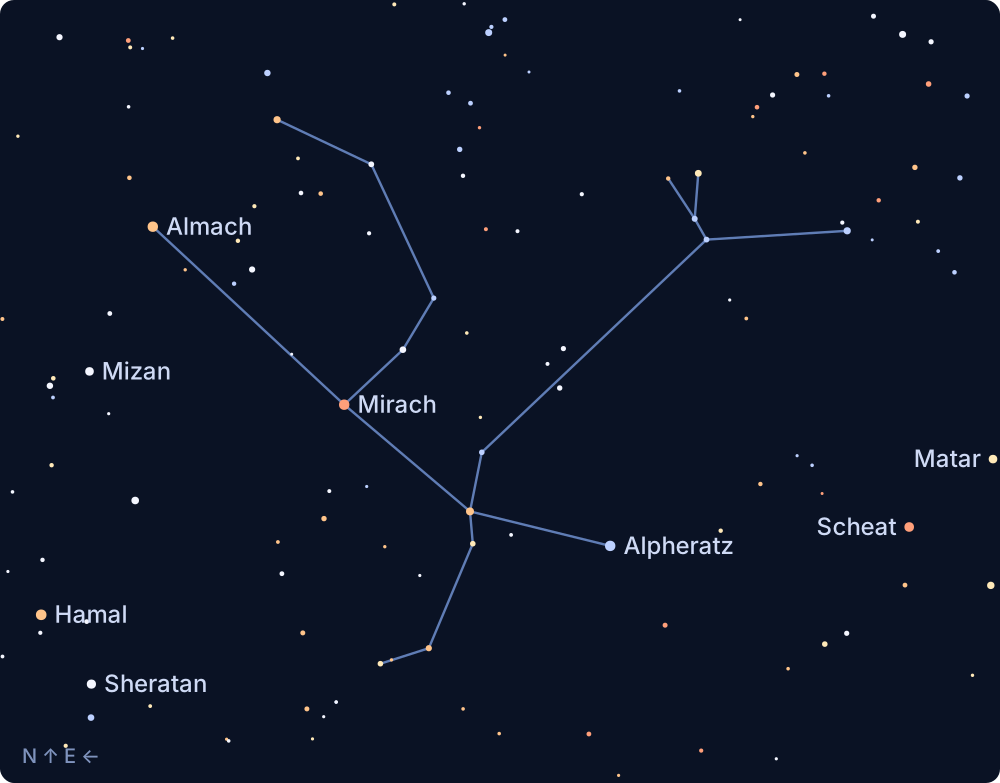
- Start at Alpheratz, the corner of the Great Square of Pegasus that points toward Cassiopeia.
- Two long lines of stars extend from there. Follow the line through Mirach, then hop up two stars to find the faint oval smudge of the Andromeda Galaxy.
Brightest stars
- Alpheratz (shared with the Great Square of Pegasus)
- Mirach
- Almach (a gold-and-blue double star)
What to look for
- The Andromeda Galaxy as a faint oval patch in a dark sky. It is easiest to see with a slightly averted glance.
- Almach, a golden star with a blue companion in a small telescope.
Binocular and telescope targets
- Andromeda Galaxy (M31): a huge spiral galaxy about 2.5 million light-years away, visible to the naked eye from a dark site
- M32 and M110: two small companion galaxies, visible in a telescope
- Almach: a gold-and-blue double star, a showpiece for small telescopes
Using it to find other things
- Alpheratz joins Andromeda to Pegasus. Cassiopeia is just to the north.
About this constellation
The Andromeda Galaxy contains hundreds of billions of stars, and it is so far away that its light left roughly 2.5 million years ago. In a dark sky it shows as a faint, elongated patch.
Binoculars help a great deal. They show the oval shape and its brighter core, and make the galaxy easier to find.
Related guides
Visibility depends on your latitude, the date, and the time of night. The months above assume a typical evening from the contiguous United States, so use a planetarium app to confirm what is up tonight. Never look at the Sun through binoculars or a telescope without a proper solar filter.
Star positions: Hipparcos and Bright Star catalogues via d3-celestial (BSD-3-Clause, © 2015 Olaf Frohn).