
Total Solar Eclipse
Also called: total eclipse of the Sun
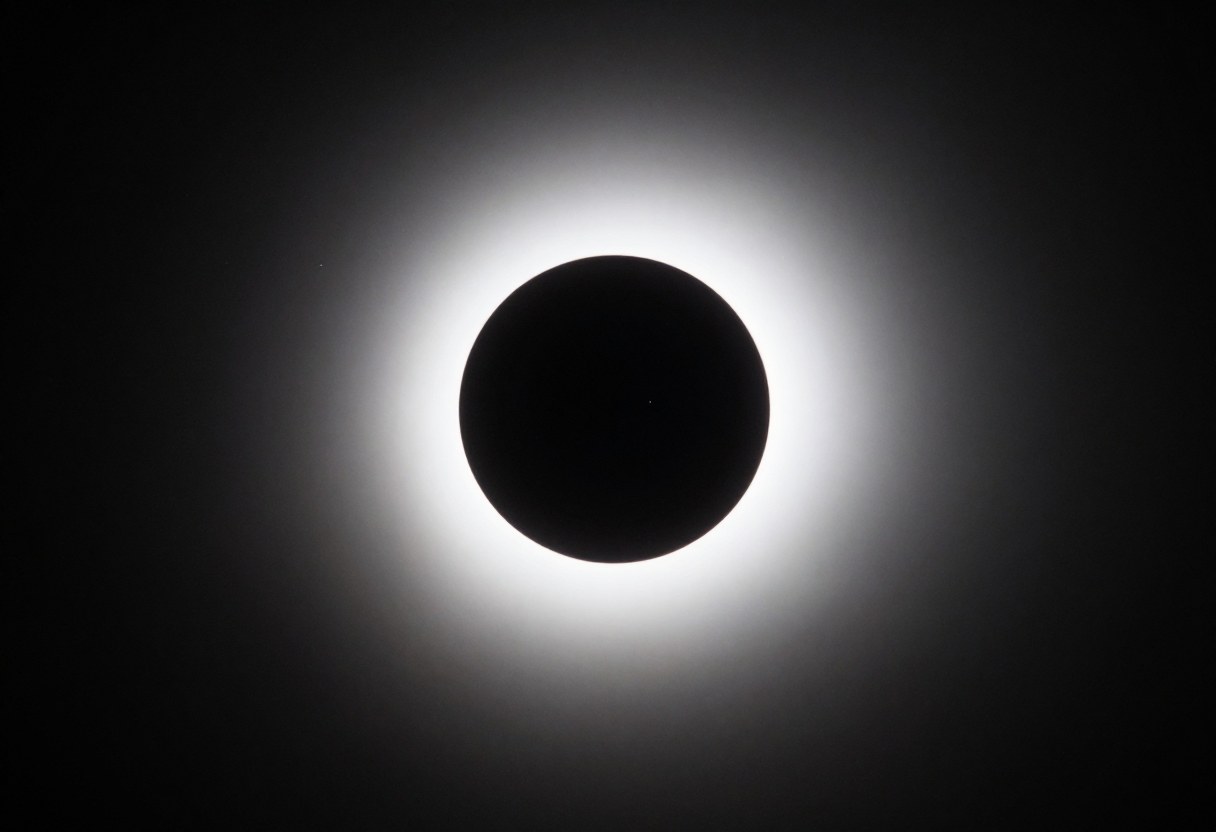
When the Moon completely covers the Sun for a few minutes, turning day into twilight. Only the narrow path of totality sees it, and it is safe to look only during totality.
- Type
- Eclipses
- Best season
- Any time of year
- Gear
- Naked eye
- When to look
- Rare for any one place; somewhere on Earth about every 18 months
- Totality lasts
- Up to about 7½ minutes at most, usually 2–4 minutes
- Path
- A narrow strip, typically about 100 miles wide or less
- Next in the US
- August 2044 (Montana and North Dakota) and August 2045 (coast to coast)
- Partial phases
- More than an hour before and after totality, and never safe to view without a filter
Safety: Never look at the Sun without a proper solar filter. Use eclipse glasses that meet the ISO 12312-2 standard, and throw away any pair that is scratched or damaged. Ordinary sunglasses are not safe. Do not look at the Sun through binoculars, a telescope, or a camera unless a solar filter is fitted over the front of the instrument.
What you will see
- The Sun gradually covered by the Moon over about an hour.
- In totality, a black disc ringed by the white corona, with bright planets and stars.
- A sunset-colored glow all around the horizon and a sudden drop in temperature.
- The diamond ring at the start and end of totality.
How to watch
- Use certified eclipse glasses for all partial phases.
- Travel to the path of totality, since a partial eclipse is a very different experience.
- Only during totality, and only when the Sun is completely covered, may you take off the glasses; put them back on as soon as the first bright sliver returns.
- Plan for crowds and traffic, and keep a backup plan for clouds.
Field notes
A total solar eclipse is one of the most striking sights in nature. The shadow of the Moon races across the landscape, and the sky darkens like twilight.
If you are not in the path of totality, you will see a partial eclipse at most, which needs eye protection the entire time.
Related guides
Dates and times repeat from year to year but shift slightly, and the Moon's phase and the planets' positions are different every year. Check a current source such as NASA, the American Meteor Society, or a stargazing app before you plan a night out, and check the weather forecast for clear skies.