
Field Guide / Shot Sizes & Chokes
Cylinder Choke
Also called: cylinder bore, CYL
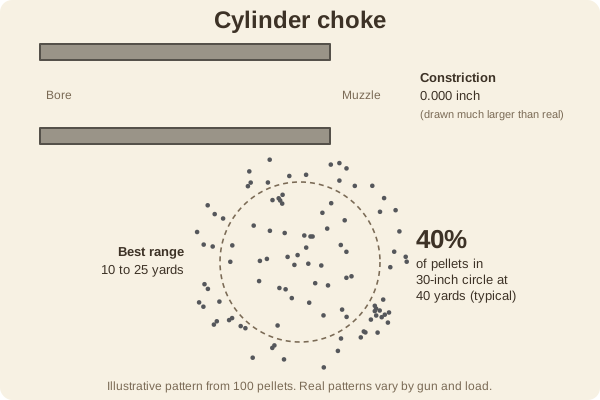
No constriction at the muzzle, so the shot spreads fast. Used for close targets, buckshot, and rifled slugs.
- Type
- Chokes
- Constriction (12 gauge)
- None (0.000 inch)
- Pattern at 40 yards
- About 40% in a 30-inch circle
- Best range
- About 10 to 25 yards
- Used for
- Upland birds, Deer & hogs, Clays
What it is good for
- Very close flushing birds and brush hunting.
- Rifled slugs and buckshot.
- Skeet and close clay targets.
Where it falls short
- Open patterns lose pellets at longer ranges.
- Not suited to turkeys or waterfowl at typical range.
- Wounding risk on distant birds.
Tips
- Pair with small shot for close birds.
- Slug and buckshot guns often use a cylinder bore.
Works well with
- Rifled Slug: a common choke for slugs.
- 00 Buckshot: often fired through a cylinder bore.
Field notes
A cylinder bore has the same diameter all the way to the muzzle, which lets shot spread quickly. It is the most open standard choke.
Related guides
Pellet counts, patterns, and ranges are typical figures, not guarantees. Pattern your own shotgun with your own loads at the distances you hunt, and follow the shotgun manual for which shells and chokes are safe. Nonlead shot rules and legal shot types differ by state and area; our state resources directory links to each state's official regulations.