

Lensatic Compass
Also called: military compass, sighting compass, wire sight compass
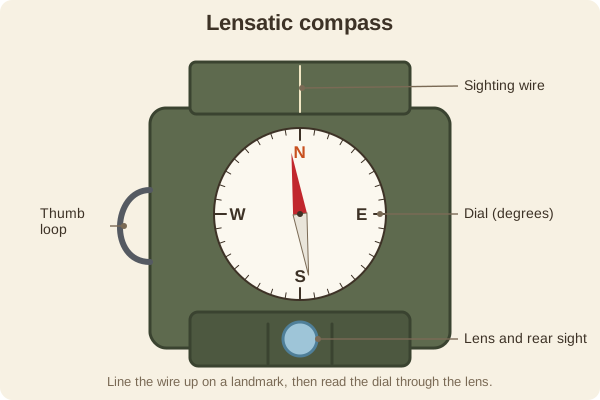
A rugged folding compass with a sighting wire and a lens. It is built to take a precise bearing to a far-off landmark.
- Type
- Compass
- Sighting
- A slotted rear sight with a lens and a front hairline wire; you line up the wire on the landmark
- Housing
- Metal case with a folding cover, a thumb loop, and a glow-in-the-dark needle or marks on many models
- Scales
- Degrees, and often a second scale in mils
- Weight
- Heavier than a baseplate compass
- Used for
- Hiking & camping, Hunting
What it is good for
- Taking an accurate bearing to a distant tree, peak, or tower.
- Rough use, since the case survives bumps and mud.
- People who already learned it in the military or scouts.
Where it falls short
- It does not sit on a map the way a baseplate does, so map work takes more steps.
- Many models are dry-needle, so the needle swings longer before settling.
- Heavier and bulkier than a baseplate compass.
Tips
- Hold it close to your eye and brace your elbow against your body for a steady reading.
- Fold the cover so the sighting slot stands straight, then read the dial through the lens.
Works well with
- Baseplate Compass: easier for working directly on a map.
- Triangulation (Resection): needs precise bearings to landmarks, which a sighting compass is good at.
Field notes
The lensatic compass is the classic military design. Its strength is accuracy when you sight along the wire at a landmark. Its weakness is that you transfer the number to the map yourself instead of laying the compass on it.
Related guides
Numbers here are typical, and values such as magnetic declination change over time and place, so check a current source such as NOAA or your map's legend. Practice near home before you rely on a skill far from help, carry a paper map and compass as a backup, and tell someone your plan. Rules on electronics, land access, and trespass differ by state; our state resources directory links to each state's official regulations. Want a step-by-step guide? Read Trail Navigation Basics.