
Ursa Minor
The Little Bear
The Little Dipper, a faint dipper-shaped constellation whose handle ends in Polaris, the North Star.
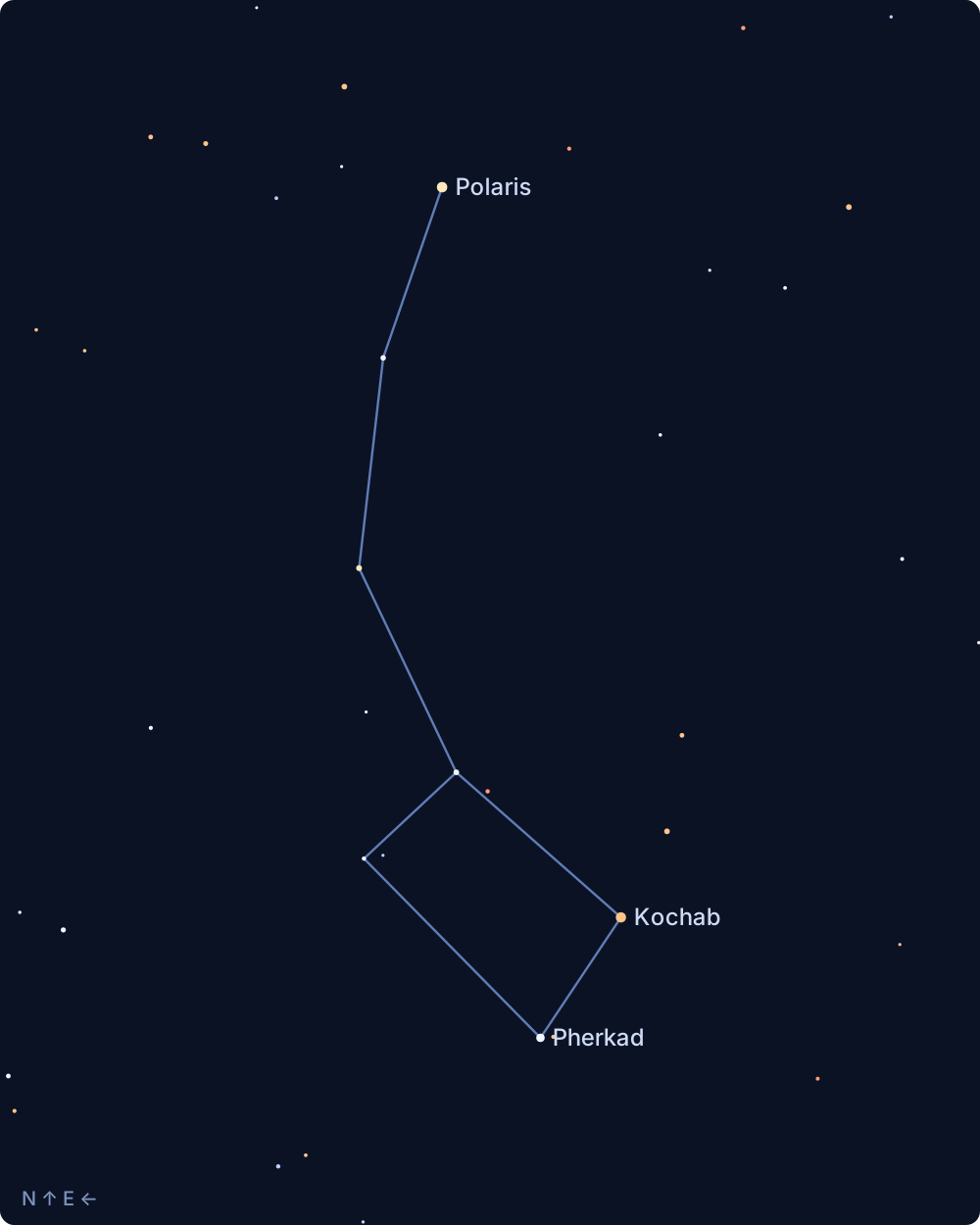
- Best season
- Summer
- Best months
- Visible all year, best on late spring and summer evenings
- Visibility
- Visible all night, all year, from everywhere in the United States; the fainter stars need a dark sky
- Abbreviation
- UMi
How to find it
- Find the Big Dipper. The two stars at the end of its bowl, Merak and Dubhe, point to Polaris.
- Polaris is the end of the Little Dipper's handle. At the other end of the handle is the bowl, with Kochab and Pherkad marking its outer edge.
Brightest stars
- Polaris (the North Star, at the tip of the handle)
- Kochab and Pherkad (the two bright stars of the bowl, the Guardians of the Pole)
What to look for
- How faint the Little Dipper is. In a dark sky you can see all seven stars; from a city you may see only Polaris, Kochab, and Pherkad.
Using it to find other things
- The pointers at the end of the Big Dipper's bowl lead to Polaris.
- Polaris stays almost exactly due north, and its height above the horizon equals your latitude.
About this constellation
Ursa Minor is famous for Polaris, which sits almost exactly over the north celestial pole. All the other stars appear to wheel around it during the night, while Polaris holds nearly still.
Polaris is not the brightest star in the sky, only moderately bright, which surprises many people. What makes it useful is its position, not its brightness. Its altitude above the northern horizon equals your latitude, so it is a handy check on direction and location.
Related guides
Visibility depends on your latitude, the date, and the time of night. The months above assume a typical evening from the contiguous United States, so use a planetarium app to confirm what is up tonight. Never look at the Sun through binoculars or a telescope without a proper solar filter.
Star positions: Hipparcos and Bright Star catalogues via d3-celestial (BSD-3-Clause, © 2015 Olaf Frohn).