
Field Guide / Clouds & Weather Signs
Cirrus
mares' tails
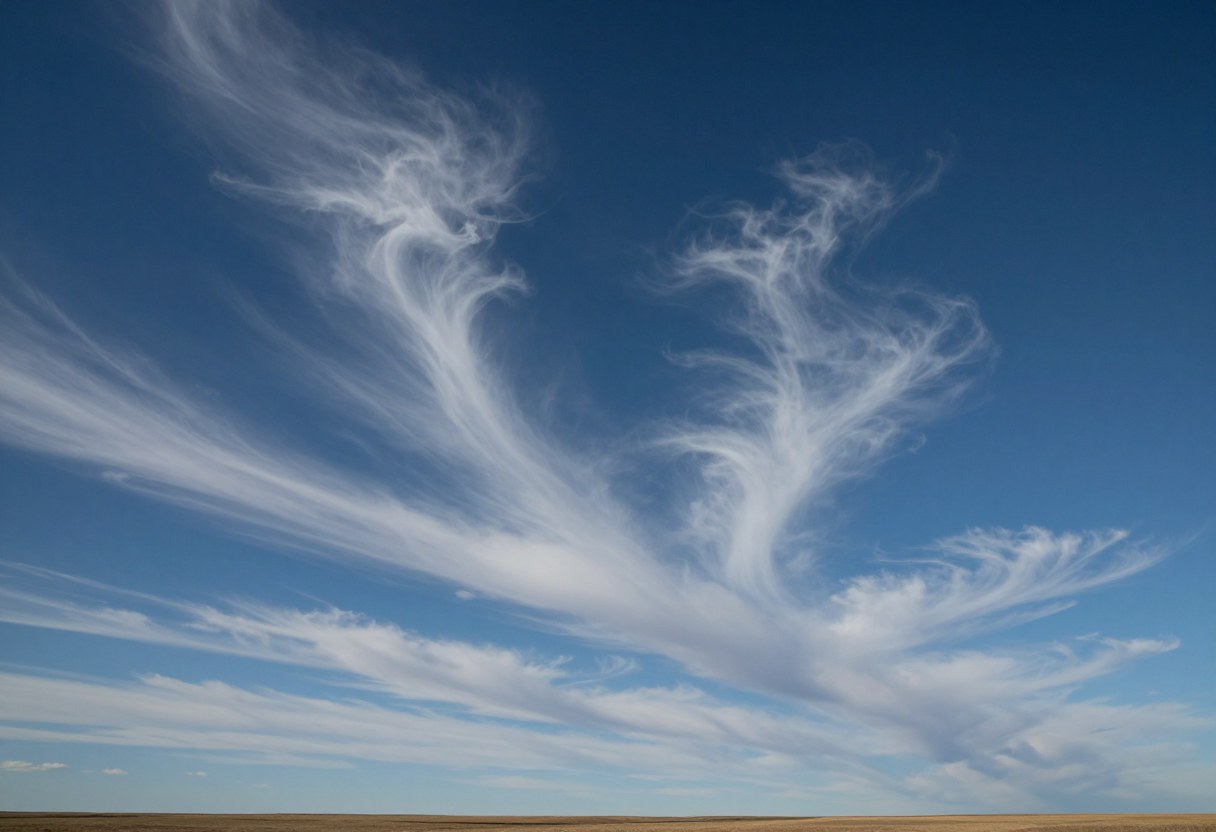
Thin, wispy, hair-like clouds high in the sky. Alone they are harmless, but a spreading and thickening sheet of cirrus can be an early sign of a change in the weather.
- Height
- High Clouds
- Abbreviation
- Ci
- Typical altitude
- Above about 20,000 ft (6,000 m); made of ice crystals
- Usually means
- Weather changing
How to recognize it
- White, thin, wispy streaks or feathery curls, often with silky edges.
- Blue sky shows clearly through and between the streaks.
- No gray shading and no shadow: the clouds are too thin to cast one on the ground.
What it usually means
- Scattered cirrus on an otherwise clear day usually means fair weather.
- A growing sheet of cirrus spreading in from the west and lowering through the day can mean a front is approaching, with rain or snow arriving in a day or so.
- Cirrus that thickens into a milky veil often turns into cirrostratus, which is a stronger sign of coming rain.
What to do outdoors
- It is fine to head out, but check the forecast and pack rain layers if the cirrus is thickening.
- Note how fast it is spreading. A slow change gives you a day. A fast change gives you much less.
Often confused with
- Cirrostratus: a thin uniform veil rather than separate streaks, often with a halo around the sun or moon.
- Contrails: jet exhaust trails that can spread into cirrus-like sheets when the upper air is humid.
Field notes
Cirrus is the highest of the common clouds and is made entirely of ice crystals. Because it is so high and thin, it often catches the first and last light of the day and glows pink or gold.
Look at cirrus the way you would look at a gauge: one sighting means little, but a trend over several hours is useful.
Related guides
Cloud signs are rough guides, not forecasts. Always check the National Weather Service forecast at weather.gov before and during a trip, carry a way to receive alerts, and treat any watch or warning as a reason to change your plans. If you can hear thunder, you are close enough to be struck by lightning.